
Products
Natural Calcium Carbonate
Micronised ground calcite entering formulations as filler and raw material in plastics, paint, paper and construction chemicals.
CaCO₃

Overview
Natural ground calcium carbonate (GCC) is a mineral filler produced by crushing, grinding and air-classifying high-purity calcite ore down to micron sizes. Chemically it is CaCO₃, and that formula says almost nothing about how the product will behave; performance in a formulation is set by the physical profile that grinding and classification produce: particle size distribution, whiteness, oil absorption and surface chemistry.
Buying calcium carbonate is therefore not buying one product. A calcite with a d50 of 2 µm delivers opacity and print surface in paper coating, while the same grade in a plastics compound raises extruder torque, energy consumption and cost for no benefit. We start selection from the target recipe and the equipment on the line, not from a certificate of analysis.
Technical specifications
| Parameter | Value | |
|---|---|---|
| Chemical formula | CaCO₃ | Calcite phase — low dolomite |
| CaCO₃ content | ≥ 98.5% | XRF / complexometric titration |
| MgCO₃ | ≤ 0.6% | Dolomite impurity |
| Fe₂O₃ | ≤ 0.05% | Drives yellowness and glass colour |
| Whiteness (Ry) | ≥ 95 | ISO 2469 / ISO 3688 |
| d50 | 1–20 µm | By grade — ISO 13320 laser diffraction |
| d97 (top cut) | 4–63 µm | Scratch and film puncture criterion |
| Oil absorption | 14–22 g/100 g | ISO 787-5 |
| Specific surface (BET) | 1.5–9 m²/g | ISO 9277 — sets the coating level |
| Moisture (105 °C) | ≤ 0.2% | Bubble limit in extrusion |
| Surface coating | 0.8–2.0% stearic acid | Per surface area; uncoated also supplied |
| Mohs hardness | 3 | Low equipment wear |
Chemical formula
CaCO₃
Calcite phase — low dolomite
CaCO₃ content
≥ 98.5%
XRF / complexometric titration
MgCO₃
≤ 0.6%
Dolomite impurity
Fe₂O₃
≤ 0.05%
Drives yellowness and glass colour
Whiteness (Ry)
≥ 95
ISO 2469 / ISO 3688
d50
1–20 µm
By grade — ISO 13320 laser diffraction
d97 (top cut)
4–63 µm
Scratch and film puncture criterion
Oil absorption
14–22 g/100 g
ISO 787-5
Specific surface (BET)
1.5–9 m²/g
ISO 9277 — sets the coating level
Moisture (105 °C)
≤ 0.2%
Bubble limit in extrusion
Surface coating
0.8–2.0% stearic acid
Per surface area; uncoated also supplied
Mohs hardness
3
Low equipment wear
Highlights
d50 and d97 are reported together on the same sheet — a choice made on mean size alone cannot see the scratch and puncture problems that come from the top cut.
Whiteness is reported as Ry together with b* (yellowness); in recipes that extend TiO₂, yellowness is the decisive number.
Oil absorption is measured to ISO 787-5 — it sets binder, plasticiser and resin demand, and therefore formulation cost.
Stearate coating is not a fixed percentage; it is set as a function of specific surface area.
Coated and uncoated grades come from the same base product, so the particle profile stays constant when the recipe changes.
Samples, the full PSD curve and commissioning support come with the product.
Use
d50 alone does not describe the product
d50 is the size below which half the mass lies, and it is the first number a catalogue uses to define a grade. Yet most field problems come not from the mean but from the top end of the distribution. In a 30 µm filled film a single 15 µm particle starts a puncture; the same particle in paint lowers gloss and makes brush marks visible. Asking for d97 (top cut) alongside d50 is therefore not a technical nicety but part of troubleshooting.
Distribution width is the second factor. Of two grades with the same d50, the narrow one gives lower packing density, higher viscosity and a smoother surface; the broad one fills voids with fine particles and allows a higher loading, but raises surface roughness. Construction chemicals usually want a broad, controlled distribution in the 5–40 µm band, while thin film and masterbatch want a narrow distribution with a low top cut.
The measurement method also changes what the number means. A d50 measured by laser diffraction (ISO 13320) can differ markedly from one measured by sedimentation on the same sample; dispersion time, ultrasound and the refractive index setting shift the result too. When comparing suppliers, use the same method and the same dispersion protocol — otherwise the two reports cannot be read against each other.
Whiteness is not one number
In practice whiteness is discussed through three separate quantities: Ry, measured as blue-light reflectance to ISO 2469; L* (lightness) in the CIE Lab system; and b* (yellowness). A grade may show Ry 95 and still bring a visible yellow cast into a white masterbatch if its b* is 2.5. TiO₂ does not correct that cast, it only covers it — masking bought at pigment prices.
Yellowness comes from iron and manganese oxides at ppm level. Holding Fe₂O₃ below 0.05% depends on selective extraction of the ore and on preventing metal pick-up in the grinding circuit; iron shed by wear parts looks like a small number in chemical analysis but reads directly in colour.
Measurement conditions must be fixed. The pressure applied to the pressed powder tablet, the moisture of the sample and the instrument's calibration standard can shift the result by several points. Writing whiteness ≥ 95 into a specification is not enough; the standard and the sample preparation belong in the specification too.
How oil absorption sets the cost of a formulation
Oil absorption is the amount of liquid needed to saturate 100 g of filler under ISO 787-5, expressed in g/100 g. It matters far more than it looks: every gram the filler absorbs is spent from the most expensive item in the recipe — binder, plasticiser or resin. Choosing a calcite at 16 g/100 g instead of 22 g/100 g lowers total cost per tonne even when the filler price per kilogram is identical.
The value depends mainly on specific surface area and particle shape. As grinding gets finer the BET surface grows and oil absorption rises; angular, platy particles demand more binder than near-spherical ones. In paint this shifts the critical pigment volume concentration (CPVC) directly — running a high oil-absorption filler at the same PVC increases film porosity, staining and scrub loss.
Stearate coating makes the surface hydrophobic and typically lowers oil absorption by a few units, cutting plasticiser demand visibly in PVC compounds. Coated grades naturally cost more per kilogram; the decision is made by checking whether the coating premium is smaller than the plasticiser saving. A coating decision taken without that calculation is usually just extra cost.
When stearate coating helps and when it hurts
Surface coating means covering the polar surface of the calcite particle with a monolayer of stearic acid or calcium stearate. The amount required is not a fixed percentage but a function of surface area: one gram of stearic acid covers roughly 400–450 m² as a monolayer. On a grade with 4 m²/g BET that is about 0.9%; on an ultrafine grade at 9 m²/g it is closer to 2%. Applying 1% to every fineness means under-coating the fine grade and over-coating the coarse one.
The benefit in polymer systems is clear: agglomerates break down, extruder torque and energy consumption fall, higher loadings become possible at the same mechanical values, and moisture pick-up — hence bubble risk in extrusion — drops. In polyolefin compounding, running uncoated calcite usually comes back as a dispersion defect, gels and surface faults.
The harm shows up on the side that gets ignored. In waterborne paint a hydrophobic surface resists wetting and lengthens dispersion time; in reactive systems such as polyurethane and unsaturated polyester, free stearic acid can retard cure. With over-coating, unbound stearate migrates to the mould surface (plate-out) and raises cleaning frequency. So the question is not only the coating level but the coating efficiency and the free stearate content.
Which particle size suits which equipment
For a compounding line on a twin-screw extruder, coated grades at d50 1.5–3 µm and d97 8–12 µm are typical. Finer calcite needs higher shear and longer residence time to disperse, which costs line output. In a filler masterbatch at 70–80% loading, uncoated material tends to bridge in the feed zone and make feeding unstable.
On the coatings side a high-speed disperser opens the 5–15 µm band without trouble; grades below 2 µm realistically need a bead or ball mill. In primers, fillers and mastics a d50 of 20–40 µm is both sufficient and economical — finer material there buys binder consumption, not performance.
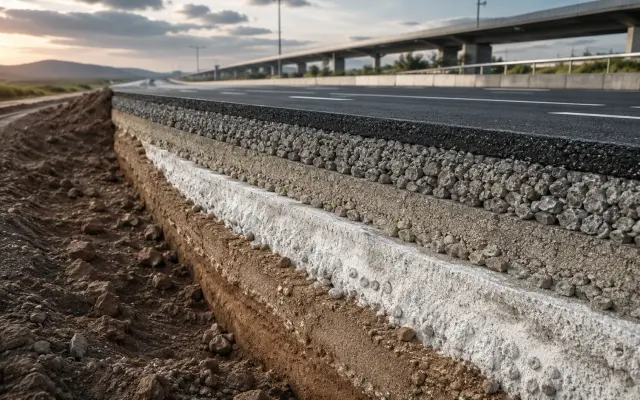
Asphalt filler is selected on a completely different logic: the criterion is sieving, not microns, and what counts is the fraction passing 0.063 mm together with the void content of the filler. The coarse fraction from the same quarry is used as aggregate without micronising; both products come from one ore, but their specifications do not overlap at all.
GCC or PCC: which property decides
Natural ground calcium carbonate comes straight from the ore. Precipitated calcium carbonate (PCC) is made by carbonating, with carbon dioxide, the milk of lime obtained from slaking quicklime. The real difference is not purity but morphology control: in PCC the crystal habit — scalenohedral, prismatic or aragonite needle — and the particle size can be set within the process.
In practice PCC brings higher specific surface, higher opacity and lower bulk density; the price is higher oil absorption, higher binder and plasticiser demand, and a markedly higher cost per tonne. GCC offers low oil absorption, high loading and a cost advantage, and is the economical choice wherever tight morphology is not required.
The right question is not which is better but where the bottleneck sits in the recipe. If the bottleneck is opacity, volume or surface area, PCC wins; if it is cost, loading level or binder demand, GCC does. In many paper and paint recipes the two are used together, in different roles.
Why the same grade behaves differently in paper, paint and glass
In paper, calcite is both filler and coating pigment; it sets ash content, opacity and the printing surface. The critical constraint is chemical: carbonate dissolves and releases CO₂ in acid stock, so it can only be used in neutral or alkaline processes. On the coating side, gloss is governed less by d50 than by the steepness of the distribution and particle shape.
In paint, calcite usually acts as a TiO₂ extender: by spacing pigment particles apart it delivers the same hiding power with less TiO₂. The gain does not come from volume alone but from choosing the right particle size; an over-fine filler that lands in the same size range as TiO₂ can cause flocculation instead of spacing.
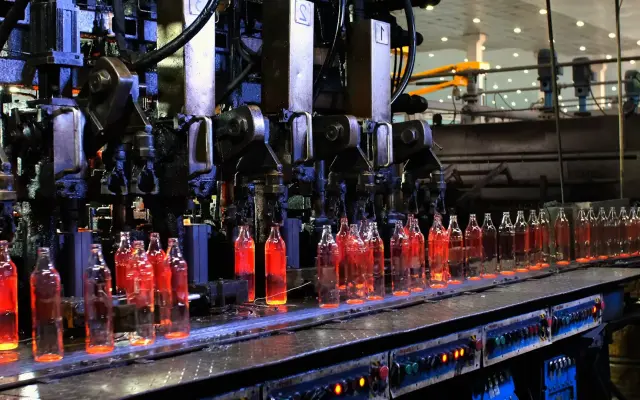
In glass and ceramics calcite is not a filler but a raw material, serving as the CaO source in the melt. Here fineness is not decisive — chemical purity is. Because iron carries into glass colour even at ppm level, the specification states an Fe₂O₃ limit rather than a whiteness figure. Likewise in agriculture and livestock use the discussion is about neutralising value and sieve analysis, not microns.
Moisture, caking and silo behaviour
Calcite is not hygroscopic, but fine powder holds physical moisture on its surface. Shipping moisture is kept below 0.2%; exceeding that shows up as bubbles and streaks on extruded film, and as viscosity drift in paint. On coated grades the hydrophobic surface slows moisture pick-up noticeably and tolerates opened packaging better.
Silo and feeding behaviour follow fineness directly. Grades below 2 µm flow poorly; bridging and ratholing risk rises. Cone angle, aeration layout and feeder type therefore belong in the same conversation as grade selection — forcing a fine grade into an existing silo creates a production loss that comes from the plant, not from the product.
In long-haul sea shipments the real risk is not rain but condensation inside the container. In a box that warms by day and cools at night, moisture condenses on the roof and drips onto the big bags, causing local caking. That is why a desiccant and a container liner are standard practice on our container shipments.
Packaging and delivery
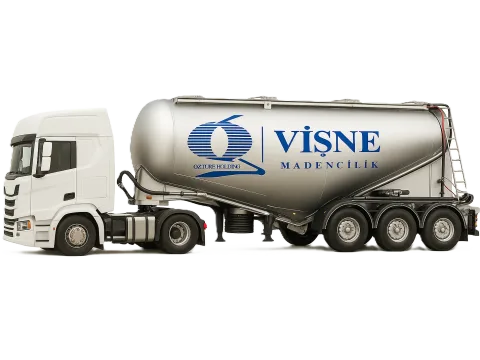
Silo truck — bulk
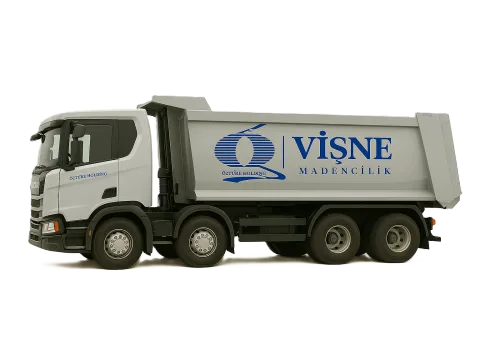
Tipper — bulk
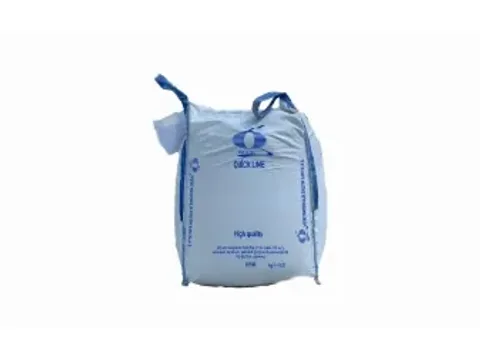
Big bag (1000 kg)
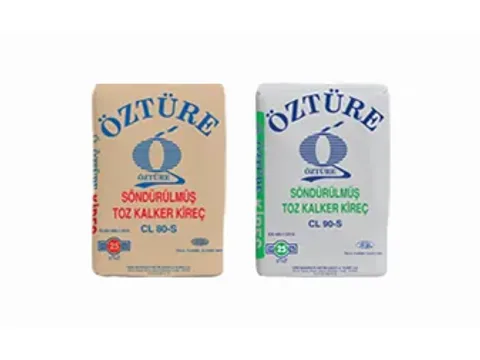
Bag (25 kg)
25 kg PE or kraft bag — palletised and stretch-wrapped
1000–1250 kg big bag — single or four-loop
Bulk — silo truck, pneumatic discharge
Container loading — with liner and desiccant
Custom labelling, packaging and pallet pattern on request
Where this product is used








Frequently asked questions
Which d50 should I choose?
The shear available in your process and the surface expected from the end product decide it. A paint line on a high-speed disperser typically works at 5–15 µm, a twin-screw extruder with coated grades at 1.5–3 µm, fillers and mastics at 20–40 µm. Finer is not automatically better; often it only raises binder demand and energy consumption.
Why do you also ask for d97?
Most complaints come from the top cut rather than the mean: film puncture, scratches and gloss loss in paint, rising filter pressure — all track d97. Two grades with the same d50 can behave completely differently on the line because of that single difference.
Coated or uncoated?
In polyolefin and PVC compounds, filler masterbatch and solvent-borne systems, a coated grade improves dispersion and the achievable loading. In waterborne paint, cement-based mortars and reactive systems such as polyurethane, uncoated is preferred; stearate can hinder wetting or retard cure in those systems.
Is the coating level fixed at 1%?
No. The stearic acid required is proportional to specific surface area: one gram covers roughly 400–450 m² as a monolayer. A grade at 4 m²/g needs about 0.9%, an ultrafine grade at 9 m²/g can need up to 2%. Under-coating means agglomerates; over-coating means plate-out and dirtier tooling.
How does oil absorption affect my purchasing decision?
The binder, plasticiser or resin absorbed by the filler is the most expensive line in the recipe. The gap between a grade at 16 g/100 g and one at 22 g/100 g under ISO 787-5 changes cost per tonne even when filler price per kilogram is identical. Compare on total formulation cost, not on filler price.
Why does whiteness read differently in our laboratory?
Whiteness measurement is highly method-sensitive. Ry to ISO 2469 and L* in CIE Lab are not the same number, and tablet pressing pressure, sample moisture and instrument calibration shift the result by several points. An acceptance criterion should state the standard and the sample preparation, not just the figure.
Should I use PCC instead of GCC?
If the bottleneck in the recipe is opacity, volume or specific surface, precipitated calcium carbonate has the advantage. If it is cost, loading level or binder demand, natural ground calcium carbonate fits better. Many paper and paint recipes use both, in different roles.
Can calcium carbonate replace lime?
No — they do different jobs. Hydrated lime takes suspension pH above 12 and neutralises fast; calcium carbonate sits near pH 9 and gives slow, self-limiting buffering. Where the risk of overdosing is unacceptable, carbonate is used; where fast, strong pH lift is needed, lime is.
Do you supply food and pharmaceutical grades?
As a food additive, calcium carbonate carries the code E 170 and its purity criteria, including heavy-metal limits, are defined in regulation; pharmaceutical use follows the relevant pharmacopoeia monograph. These grades require a separate production flow, separate packaging and certification, so the requirement should be stated from the outset.
How do I get a sample and technical support?
Send us your target recipe, the specification of the filler you use today and the equipment on the line, and we ship the matching grade with a full PSD curve and analysis report. We agree beforehand which parameters to measure on the first trial — torque, viscosity, gloss, mechanical values — and review the results with the feedback we receive through contact.
Sample and dose recommendation for this process
Describe your current usage and target; our technical team will come back with a suitable specification and a starting dose.