
Applications
Iron, Steel & Metallurgy
Selecting the right lime by furnace type and charge chemistry to build slag basicity and strip sulphur and phosphorus.
Overview
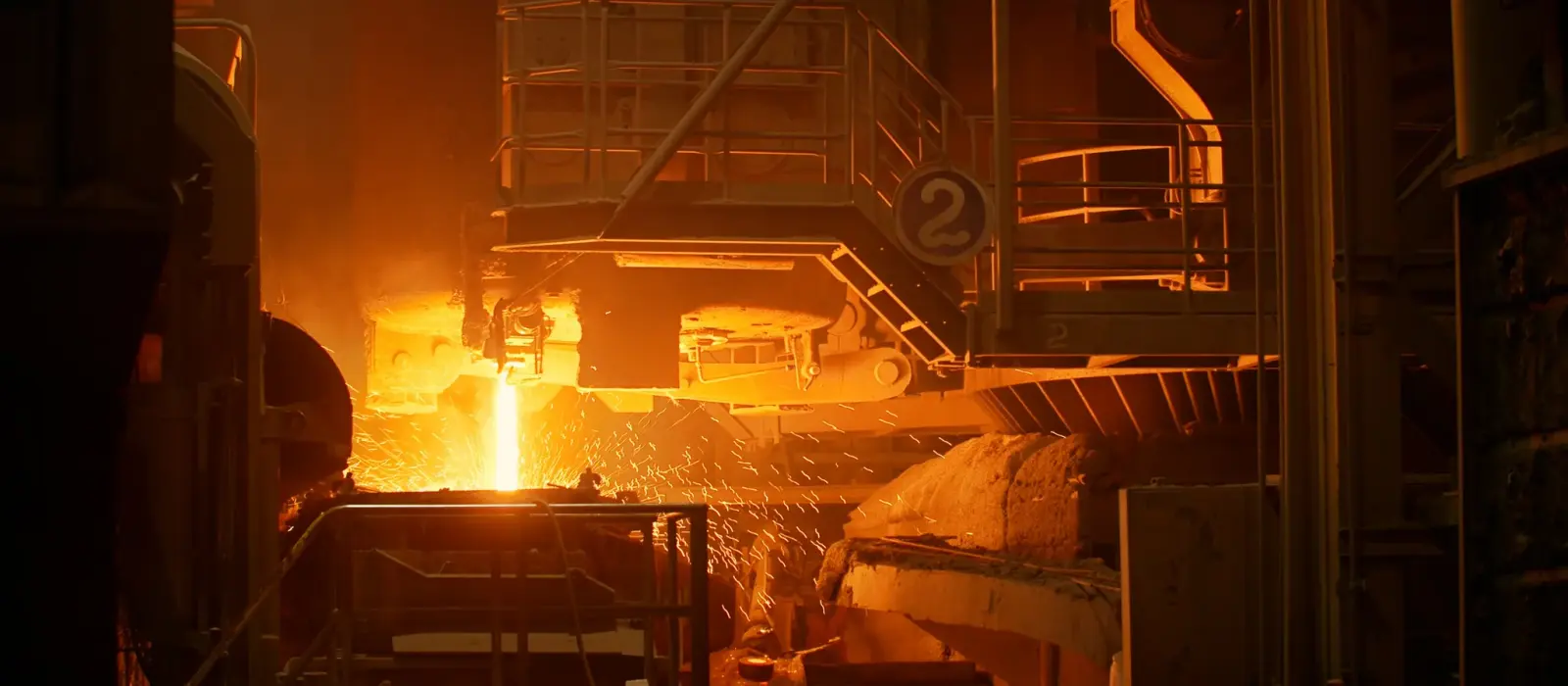
In a steel plant lime is not an additive; it is the slag itself. The quicklime charged into the converter or the electric arc furnace binds the SiO₂ formed as silicon oxidises, gives the slag its basic character and builds the chemical environment that can pull phosphorus out of the metal and hold it. That makes the lime decision a process decision rather than a purchasing line: the basicity you target, the size fraction you charge and how fast the lime dissolves all show up directly in the heat analysis.
This page looks at ironmaking and steelmaking through the lime side of the process: what B2, B3 and B4 actually measure, why BOF and EAF lime demand differ, which mass balance the charge rate comes from, and how MgO saturation governs refractory life. The numerical ranges given are typical operating values; they are written to be verified against your own slag analyses, scrap profile and hot metal composition.
Two things should be said at the outset. First, lime charged into the slag and lime dissolved in the slag are not the same quantity; the gap between the charge sheet and the slag analysis is lived as a silent loss in most plants. Second, the same slag that refines the metal also eats the lining — basicity, FeO and MgO together set refining efficiency and refractory life at the same time. Good lime practice optimises the two together, not one against the other.
The same slag that refines the metal eats the lining
Steelmaking is a refining process: silicon, phosphorus, sulphur and part of the manganese are taken out of the metal and transferred to the slag. To do that the slag must be both basic and fluid. But a fluid basic slag also dissolves the MgO of an MgO-C lining. The lining registers that the slag is not saturated in MgO and gives itself up until it is. Most refractory consumption is chemical wear, not mechanical; before changing the brick recipe it is worth looking at the slag recipe.
The second contradiction is between phosphorus and sulphur. Dephosphorisation wants an oxidising environment: 15–25% FeO in the slag, a relatively low temperature (1550–1600 °C) and high basicity. Desulphurisation wants the exact opposite: FeO below 1%, high temperature and low oxygen activity. You cannot bring both to their optimum in the same vessel at the same time. That is why sulphur is removed before the converter in hot metal pretreatment and after it in the ladle furnace; the converter's real job is phosphorus.
The third difficulty is measurement itself. Total CaO on the lime certificate and the available CaO that actually contributes to the slag are different quantities. Overburnt lime may analyse at 93% CaO, but with grown crystals and a closed pore structure it takes the whole blow to dissolve instead of a few minutes. If lime in the silo picks up moisture and CO₂ the loss on ignition rises and the active substance delivered per tonne falls. The charge weight stays the same, the slag basicity drops — and why it dropped stays invisible unless someone looks at the lime analysis.
The fourth is dissolution kinetics. When a lime particle enters the slag a 2CaO·SiO₂ (C2S) shell forms on its surface; that compound melts at 2130 °C, so at steelmaking temperature it is solid. The moment the shell closes, the path into the particle is shut and the lime travels through the slag as a solid island. CaO looks high in the slag analysis while the true basicity of the liquid phase sits below target. This is why charging more lime does not always raise basicity; sometimes it only grows slag volume, iron loss and refractory wear.
What lime actually does in the slag, and the spec that follows
The primary slag former is quicklime (CaO). For a steel plant the meaningful specification comes down to four headings: available CaO ≥ 92% (EN 459-2 sucrose titration or ASTM C25), loss on ignition ≤ 2%, sulphur ≤ 0.05% and reactivity t60 ≤ 3 minutes. Sulphur is the one most often overlooked, although lime is precisely the material tasked with removing sulphur. Every 100 ppm of S arriving with the charge is extra load you will fight in the ladle furnace across a shift on low-sulphur grades.
Size distribution matters as much as chemistry. For BOF charging, 10–40 mm is the standard band: finer material is entrained by the off-gas during charging and ends up in the dedusting system, while coarser lumps cannot finish dissolving within the blow. In the EAF, bucket charging runs 10–40 mm and continuous feeding 5–25 mm. Hot metal desulphurisation and ladle injection need the opposite end of the spectrum: 0–1 mm, d50 of 40–100 µm, and lime that keeps its flow properties in pneumatic conveying.
MgO saturation is the second leg of lime practice. Dolomitic lime (CaO·MgO; typically 55–60% CaO, 35–40% MgO) saturates the slag in MgO and stops it dissolving magnesia out of the lining. Saturation is not a fixed number: MgO solubility rises with temperature and with FeO, so the target drifts from heat to heat. In practice 8–12% MgO is targeted in BOF slag and 8–14% in EAF slag. Staying just above saturation also generates second-phase particles that thicken the slag, hold the foam up and make BOF slag splashing possible.
The charge calculation is a mass balance, not a catalogue figure. Every 1% Si in the hot metal is 10 kg Si per tonne of metal, which produces 21.4 kg of SiO₂. For a target B2 of 3.2 that calls for 68.5 kg of CaO, and with lime at 92% available CaO it becomes 74.5 kg/t. On top of that come scrap contamination, ore gangue, SiO₂ from ferroalloys and lining wear; on high-phosphorus charges a B3 correction is applied. With a typical hot metal at 0.4–0.6% Si, lime charge settles at 40–60 kg per tonne of liquid steel.
In secondary metallurgy the job changes completely. In white slag (CaO–Al₂O₃–SiO₂, FeO+MnO below 1%) the sulphur partition ratio Ls = (S)/[S] reaches 300–1000; in converter slag the same quantity sits around 2–8. That two-order gap comes from lowering oxygen activity, not from basicity. Hydrated lime has no place here: the chemically bound water in Ca(OH)₂ is a direct hydrogen source in liquid steel. Its place in a steel plant is not the metal but the side streams — neutralising acid pickling effluent, capturing SO₂ in flue gas and conditioning sludge.
Operating ranges
| Parameter | Value | |
|---|---|---|
| Slag basicity B2 = CaO/SiO₂ — BOF | 3.0–3.5 | Dephosphorisation target |
| Slag basicity B2 — EAF | 1.8–2.4 | Foam stability governs |
| B4 = (CaO+MgO)/(SiO₂+Al₂O₃) | 1.6–2.2 | Tracked on DRI/HBI charges |
| Lime charge — BOF | 40–60 kg/t liquid steel | Driven by hot metal Si |
| Lime charge — EAF | 30–50 kg/t | Driven by scrap cleanliness |
| Dolomitic lime charge | 8–20 kg/t | For MgO saturation |
| MgO in slag — BOF / EAF | 8–12% / 8–14% | Just above saturation |
| FeO in slag — dephosphorisation | 15–25% | Oxidising slag |
| FeO in ladle white slag | FeO+MnO < 1% | Reducing, for desulphurisation |
| Available CaO | ≥ 92% | EN 459-2 sucrose titration / ASTM C25 |
| Reactivity t60 | ≤ 3 min | EN 459-2 wet slaking; soft-burnt |
| S in lime / loss on ignition | ≤ 0.05% / ≤ 2% | S ≤ 0.03% for low-sulphur grades |
| Size — BOF / EAF continuous feed | 10–40 mm / 5–25 mm | Dust loss vs dissolution |
| Injection lime | 0–1 mm, d50 40–100 µm | Hot metal desulphurisation |
| Sulphur partition Ls = (S)/[S] | 300–1000 (LF) / 2–8 (BOF) | Set by oxygen activity |
| End-of-blow temperature — BOF | 1620–1680 °C | P reversion risk above 1650 °C |
Slag basicity B2 = CaO/SiO₂ — BOF
3.0–3.5
Dephosphorisation target
Slag basicity B2 — EAF
1.8–2.4
Foam stability governs
B4 = (CaO+MgO)/(SiO₂+Al₂O₃)
1.6–2.2
Tracked on DRI/HBI charges
Lime charge — BOF
40–60 kg/t liquid steel
Driven by hot metal Si
Lime charge — EAF
30–50 kg/t
Driven by scrap cleanliness
Dolomitic lime charge
8–20 kg/t
For MgO saturation
MgO in slag — BOF / EAF
8–12% / 8–14%
Just above saturation
FeO in slag — dephosphorisation
15–25%
Oxidising slag
FeO in ladle white slag
FeO+MnO < 1%
Reducing, for desulphurisation
Available CaO
≥ 92%
EN 459-2 sucrose titration / ASTM C25
Reactivity t60
≤ 3 min
EN 459-2 wet slaking; soft-burnt
S in lime / loss on ignition
≤ 0.05% / ≤ 2%
S ≤ 0.03% for low-sulphur grades
Size — BOF / EAF continuous feed
10–40 mm / 5–25 mm
Dust loss vs dissolution
Injection lime
0–1 mm, d50 40–100 µm
Hot metal desulphurisation
Sulphur partition Ls = (S)/[S]
300–1000 (LF) / 2–8 (BOF)
Set by oxygen activity
End-of-blow temperature — BOF
1620–1680 °C
P reversion risk above 1650 °C
Application steps
- 01
Slag mass balance and the lime charge calculation
The amount of lime is calculated from the acidic oxide load entering the slag, not from the basicity target. The sources are listed in order: silicon in the hot metal (each 1% Si → 21.4 kg SiO₂/t), sand and dirt on the scrap, gangue from ore or pellets, SiO₂ and Al₂O₃ from ferroalloys, MgO from lining wear. Until that total exists, a target B2 has no numerical meaning.
The calculation has two steps. First find the CaO the target basicity demands (CaO = B2 × ΣSiO₂), then divide it by the available CaO of the lime. With lime at 92% available CaO, 68.5 kg of CaO needs 74.5 kg of product; if available CaO has drifted to 86%, the same result costs 80 kg. Those extra 6 kg arrive straight from the certificate, with no operator error involved.
The chain starts in ore preparation, not in the melt shop. Sinter mix basicity and pellet fluxing are set on the mining and ore beneficiation side; high-basicity sinter lowers the acidic oxide load reaching the converter from the outset. Confining the charge calculation to the melt shop means ignoring the cheapest source of basicity you have.
- 02
Defining the lime specification and incoming inspection
There is an order to reading a certificate: available CaO first, then loss on ignition, then sulphur, then reactivity, and size distribution last. Total CaO alone is misleading; overburnt lime looks chemically clean but does not dissolve in the slag and contributes nothing to basicity despite being present on the charge sheet.
Reactivity is measured by the EN 459-2 wet slaking test and expressed as t60: the time for water at 20 °C to reach 60 °C. Soft-burnt lime comes in under three minutes; anything beyond six minutes is hard-burnt and dissolves late in the melt shop. This test reads the calibration of the lime kiln, not the chemistry — it is usually why two plants behave very differently on the same CaO figure.
Lime chemistry comes from its feedstock. The SiO₂, Al₂O₃ and sulphur profile of the natural calcium carbonate fed to the kiln sets the impurity profile of the lime that leaves it; when the quarry or the seam changes, expect the lime analysis to shift too. Tracking each source rather than each batch is usually enough at incoming inspection — but once silo residence exceeds three to four weeks, loss on ignition should be re-measured.
- 03
Hot metal pretreatment — taking sulphur out before the converter
Sulphur in blast furnace hot metal typically runs 0.020–0.040%. Because the converter is an oxidising vessel it cannot remove sulphur effectively; expecting it to only grows slag volume and iron loss. Sulphur is therefore removed in the torpedo car or the charging ladle, with a KR-type stirrer or by co-injection.
A typical co-injection recipe is 0.4–0.8 kg/t of magnesium with 3–6 kg/t of fine lime. Magnesium drops sulphur fast; the lime binds the sulphide in a stable form, prevents reversion and keeps the slag skimmable. Lime alone needs 5–10 kg/t and a longer treatment; the choice between them is a comparison between the magnesium price and the time window available on the ladle.
Particle size decides the outcome here: 0–1 mm, d50 of 40–100 µm, and a product that does not cake in pneumatic conveying. Lime that has picked up moisture plugs the lance and the transport line, so injection lime needs its own closed, dry silo. Target sulphur is generally below 0.005%, and below 0.002% for IF and line pipe grades.
- 04
Slag formation and dephosphorisation in the converter
Most of the lime is charged in the first third of the blow. Early lime stops the acidic primary slag formed by silicon oxidation from attacking the lining; lime charged late has no time to dissolve and remains as a solid island at the end of the blow. Charging timing changes the result as much as lime quality does.
Dephosphorisation demands three conditions at once: 15–25% FeO in the slag, B2 ≥ 3.0 and a relatively low temperature. Above 1650 °C the equilibrium reverses and phosphorus returns from the slag to the metal. End-of-blow temperature is therefore not a separate variable alongside the phosphorus target but a direct part of it.
The phosphorus partition ratio Lp = (%P)/[%P] sits between 50 and 150 in a well-run converter. If it is low, the first thing to question is not the lime charge but whether the slag is genuinely liquid. Undissolved lime raises basicity on paper without taking phosphorus; that gap between measurement and reality is the real reason behind most decisions to charge more lime.
- 05
Foaming slag and MgO saturation in the electric arc furnace
Target basicity in the EAF is lower than in the converter; B2 typically runs 1.8–2.4. The reason is physical rather than chemical: to cover the arc, foaming slag has to stay viscous and fluid at the same time. Above 2.5 the slag dries out, the foam collapses and the arc is exposed; panel heat load, electrode consumption and noise all rise together.
What holds the foam up is the solid second-phase particles inside the slag. Running just above MgO saturation (8–14% MgO) generates those particles; staying below saturation both weakens the foam and pulls MgO out of the lining. On DRI/HBI charges, Al₂O₃ and SiO₂ both rise, so B4 = (CaO+MgO)/(SiO₂+Al₂O₃) should be tracked; on those charges B2 alone reads systematically optimistic.
The dust and gas leaving the furnace are another point of contact for lime. Capturing acidic components upstream of the baghouse and removing SO₂ from the sinter plant stack belong to flue gas treatment; the fineness and reactivity required of that sorbent are a completely different specification from slag lime, and the two do not share a silo.
- 06
White slag and desulphurisation in the ladle furnace
Converter slag carried over into the ladle during tapping is the single biggest obstacle in front of a white slag. Every kilogram of FeO-bearing slag that gets across is consumed by aluminium in the ladle, raises alloy cost and delays desulphurisation. Slag stoppers, thickness measurement and the practice of cutting the tap early matter as much here as lime quality.
White slag is built in the CaO–Al₂O₃–SiO₂ system with FeO+MnO below 1% and basicity in the 2.5–4.0 band. Under those conditions the sulphur partition ratio Ls climbs to 300–1000; the same quantity is 2–8 in the converter. The difference comes from lowering oxygen activity, not from basicity — in a ladle that has not been aluminium-killed, sulphur will not come down whatever the basicity.
Lime entering the ladle must be low in sulphur, low in loss on ignition and dry. Damp lime or hydrate is a hydrogen source in liquid steel; on heavy sections even a 1 ppm rise in hydrogen enlarges the risk of flaking. Calcium aluminate based synthetic slags are not a replacement for lime but a companion to it, used to speed up how fast the lime melts in.
- 07
Refractory life and slag splashing practice
The life of an MgO-C lining depends largely on whether the slag is saturated in MgO. Unsaturated slag dissolves the lining; saturated slag leaves a protective layer on its surface. Taking slag MgO from 6% to 10% in the same furnace produces a visible change in refractory consumption per heat without touching the brick recipe at all.
In the converter this principle becomes slag splashing practice: the slag left after tapping is thickened with dolomitic lime and splashed onto the lining with a nitrogen blow, where it freezes. Well-executed splashing lifts converter campaign life from a few thousand heats into the tens of thousands; the critical variables are the MgO and FeO content of the remaining slag and the blowing time.
But raising MgO without limit does not work either. Far above saturation the slag becomes viscous, metal–slag mixing during the blow deteriorates, phosphorus removal falls and slag retention problems begin. The right practice is to stay just above the saturation curve and move the target as temperature and FeO move — a fixed MgO target is as misleading as a fixed lime dose.
- 08
Side streams: slag, dust, flue gas and effluent
Steel plant slag is not waste; it is a product that has to be managed. Because free CaO and MgO in converter slag hydrate and expand in contact with water, the slag must be weathered for three to six months or steam-stabilised before it goes into road base or concrete. Skip that step and material laid as aggregate heaves months later and lifts the pavement above it.
Granulated blast furnace slag, once ground, is a binder that substitutes for cement and creates value directly on the construction and building materials side. Converter slag cannot follow the same route because of its free lime; treating the two as one line item is wrong both technically and commercially, and in most plants it hides half the revenue slag could earn.
Acidic effluent from pickling lines, cooling water blowdown and mill scale sludge are neutralised with lime on the water and wastewater treatment side; the product used there is not melt shop lime but directly dosable hydrate. If you want a lime balance built from your own slag analyses and charge records, you can reach us through the contact page.
Products used in this field
Frequently asked questions
Should I track slag basicity with B2, B3 or B4?
B2 = CaO/SiO₂ is the common language of daily operation and is enough on a typical converter charge. On high-phosphorus charges B3 = CaO/(SiO₂+P₂O₅) reads better, and on alumina-rich DRI/HBI charges and in ladle slag B4 = (CaO+MgO)/(SiO₂+Al₂O₃) is closer to reality. The practical route is to calculate all three and see which one correlates with heat results on your own charge mix.
Why is lime demand so different between BOF and EAF?
In the BOF the slag is created by oxidising silicon from the hot metal, and that SiO₂ load is large; phosphorus removal also demands high basicity. In the EAF, SiO₂ comes from scrap contamination, DRI gangue and ferroalloys, it is smaller, and the real target is foam stability. The result is B2 of 3.0–3.5 in the BOF against 1.8–2.4 in the EAF, with lime charge around 40–60 kg/t and 30–50 kg/t respectively.
How much does the gap between total and available CaO change the calculation?
It changes it directly, because available CaO is the divisor in the charge calculation. A lime certified at 94% total CaO but down to 86% available through overburning and carbonation needs roughly 9% more charge for the same basicity. Available CaO is measured by sucrose titration to EN 459-2 or ASTM C25 and should sit ahead of total CaO in incoming inspection.
How does lime size affect charge efficiency?
You lose at both ends. Material below 5 mm is entrained by the off-gas during charging and reports to the dedusting system — it exists on the weigh scale, not in the slag. Lumps above 40–50 mm cannot fully dissolve within the blow and remain as solid islands. Practical bands are 10–40 mm for the BOF and 5–25 mm for EAF continuous feed; injection applications need 0–1 mm.
How is MgO saturation determined — is it a fixed number?
It is not fixed. MgO solubility in slag rises with both temperature and FeO, so a 30 °C change in end-of-blow temperature on the same furnace moves the saturation point. In practice 8–12% MgO is targeted in BOF slag and 8–14% in EAF slag, staying just above saturation. The soundest approach is to build a working map of FeO, temperature and MgO from your own slag analyses.
Why can't sulphur and phosphorus be removed in the same slag?
Because they want opposite oxygen environments. Phosphorus transfers to the slag by oxidation, which needs 15–25% FeO and a relatively low temperature. Sulphur transfers as sulphide ion, which needs low oxygen activity — FeO below 1%. That is why sulphur is taken out of the hot metal before the converter and in the ladle furnace after it.
What limits should apply to sulphur and loss on ignition in the lime?
For melt shop lime, sulphur is expected at ≤ 0.05% and ≤ 0.03% for low-sulphur grades; since lime is the material meant to remove sulphur, whatever it brings in is a direct extra load. Loss on ignition should be ≤ 2%; higher figures point either to incomplete calcination or to moisture and CO₂ pickup in the silo, and in both cases available CaO has already fallen.
Does charging more lime always raise basicity?
No. Lime charged into the slag and lime dissolved in it are different quantities. The 2CaO·SiO₂ shell that forms on the particle surface — melting point 2130 °C — halts dissolution; charge more and CaO rises in the analysis while the true basicity of the liquid phase stays put. The action at that point is not more charge but a review of lime reactivity, size and slag fluidity.
Can hydrated lime be used in liquid steel?
No. The chemically bound water in Ca(OH)₂ decomposes at high temperature and hands hydrogen to the steel; on heavy sections that is a direct flaking risk. The place of hydrated lime in a steel plant is the side streams: neutralising pickling effluent, capturing SO₂ in flue gas and conditioning treatment sludge.
Can I fluidise the slag without fluorspar?
In most cases yes. Fluorspar breaks the C₂S shell quickly but eats the refractory just as quickly and brings fluoride emissions with it. The alternatives are softer-burnt, more porous lime, a smaller size fraction, deliberately keeping FeO high in the early blow, and calcium aluminate based fluxing aids. Applied together, these usually cut fluorspar consumption markedly.
Sample and dose recommendation for this process
Describe your current usage and target; our technical team will come back with a suitable specification and a starting dose.