
Applications
Construction & Building Materials
How binder and filler functions shape formulations in dry mortar, plaster, aerated concrete and sand-lime brick.
Overview
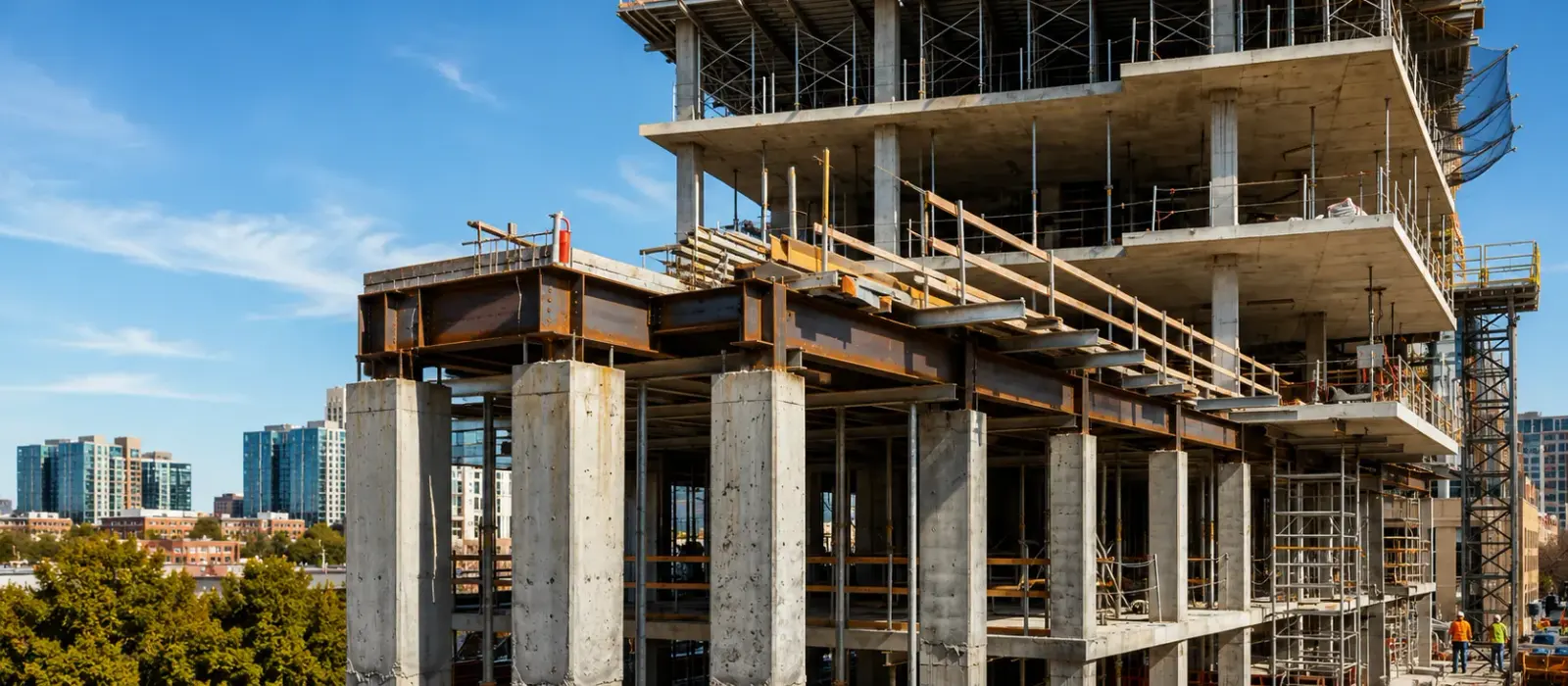
Factory mortar, render, autoclaved aerated concrete and calcium silicate brick look like four separate products from the outside. In process terms they are four lines asking the same three questions at different temperatures and pressures: in what form does calcium enter the system, when and in which phase does it react with silica, and how much of the mix water is chemically bound versus lost to the substrate and the air. Change the answers and you change the product.
The role of calcium compounds on these lines does not fit under one heading. Natural calcium carbonate looks like an inert filler in a dry mix, yet it packs into the voids between cement grains, lowers water demand and supplies nucleation surface for C-S-H. Calcined, the same raw material becomes the heat source that lifts an AAC cake to 70 °C; hydrated, it becomes the plate-like portlandite crystals that decide how a render holds its water.
On site, things rarely go wrong because of compressive strength. The cube cast from the mould reaches its class at 28 days without difficulty, while on the wall the render cracks, the mortar fails to bond and the AAC cake collapses before wire cutting. This page is not about the strength table; it is about the balance of water, particle size and timing behind it.
Not strength — water, particle size and timing
What decides how a mortar behaves on the wall is, first of all, the suction of the substrate. Aerated blocks, perforated brick and dry pumice block pull water out of the mortar within seconds. At the interface the water/cement ratio collapses, hydration stops in that thin layer and adhesive strength (EN 1015-12) falls away. Meanwhile the specimen cast from the same mortar cures with enough water and reaches its compressive class (EN 1015-11) comfortably. The measurement is correct; what misleads is that it does not represent the field problem.
The second constraint is sand grading. In washed crushed sand the fraction below 0.063 mm leaves with the wash water, and what remains is a skeleton full of voids that bleeds. This is what the mason means when he calls a mortar harsh. The reflex is to add cement: workability improves a little, but elastic modulus and shrinkage rise and the render shows hairline cracking in the first week. What is missing is not binder content but the fine fraction.
Third is the rate limit on carbonation. The reaction Ca(OH)₂ + CO₂ → CaCO₃ only proceeds where a thin water film sits on the pore wall. Below 40 % relative humidity there is no film for CO₂ to dissolve into; above 90 % the pores are water-filled and CO₂ diffusion is some four orders of magnitude slower than in the gas phase. In a closed, unheated space in winter a lime render can stay chalky for weeks — the problem is the curing environment, not the lime class.
Fourth is synchronisation on autoclaved lines. In an AAC cake the slaking exotherm of quicklime and the hydrogen evolution from aluminium powder must fall in the same time window. A very reactive lime (t60 below one minute) stiffens the mix early: gas bubbles are trapped, the cake never completes its rise and tears at cutting. A very slow lime releases its heat after the rise is over, so the cake enters the wire cutter before reaching green strength and deforms. In both cases the available CaO figure from the laboratory looks impeccable.
Where lime and carbonate actually enter the mix
In factory mortar and render the decisive product is hydrated lime. A CL 90-S grade to EN 459-1 holds mix water physically, thanks to its high specific surface (typically 15–25 m²/g) and the plate-like morphology of portlandite. Water retention measured to EN 1015-8 sits at 75–82 % for a plain cement mortar and rises above 90 % once lime is added at 10–25 % of cement mass. In practice that means hydration does not stall at the interface on an absorbent substrate.
Lime's second contribution is rheological and mechanical, and it works against strength. A lime-bearing mortar has a low elastic modulus; it accommodates the moisture- and temperature-driven movement difference with the substrate without accumulating stress. Its vapour diffusion resistance is low (µ ≈ 6–12, EN 1015-19), so it does not seal the wall. This is why in EN 998-1 external renders the target is not maximum compressive strength but staying in the CS II–CS III band while meeting adhesion and the capillary absorption class (W1/W2, EN 1015-18).
On the filler side calcium carbonate does three jobs at once. A carbonate with D50 in the 3–20 µm range fills the voids left by cement and sand, raises packing density and lowers the water needed for the same consistence. Second, the particles provide surface for C-S-H nucleation, so early strength develops faster. Third, the effect is chemical: carbonate forms monocarboaluminate with C₃A, stabilises ettringite, delays its conversion to monosulfate and steadies volume behaviour. Typical use in dry mixes is 10–40 % of the dry blend.
In AAC the main calcium source is quicklime, and the selection criterion is reactivity rather than purity. Used at 15–25 % on a dry-solids basis, the lime should show a t60 of 1.5–4.0 minutes to EN 459-2, available CaO ≥ 90 % and CO₂ ≤ 2 %. Slaking releases roughly 1160 kJ per kilogram of CaO; that heat lifts the casting bed from 38–45 °C to 70–80 °C and directly governs the gassing rate of the aluminium. In the autoclave, at 180–195 °C and 10–12 bar of saturated steam, the CaO–SiO₂–H₂O system converts to tobermorite; holding the Ca/Si ratio at 0.8–1.0 decides the pore structure and the final strength.
For calcium silicate brick the recipe is leaner: 88–92 % silica sand, 6–10 % quicklime and water. The mix slakes in a reactor silo for 1–4 hours, is pressed at 20–60 MPa and held in the autoclave at 200–203 °C and 16 bar for 4–8 hours (EN 771-2). Here sand grading matters as much as the binder: the fine fraction supplies the reactive silica surface, the coarse fraction gives green strength after pressing. The same grading logic governs aggregate selection and is a close relative of the filler discussion in road infrastructure and asphalt.
Operating ranges
| Parameter | Value | |
|---|---|---|
| Hydrated lime grade | CL 90-S | EN 459-1, Ca(OH)₂ ≥ 80 % |
| Lime share in mortar | 10–25 % of cement mass | ≈ 30–80 kg/m³ of mortar |
| Fresh mortar water retention | ≥ 88 % | EN 1015-8 |
| Flow (consistence) | 165 ± 5 mm | EN 1015-3 |
| Air content | 8–20 % | EN 1015-7, rendering mortar |
| Carbonate filler share | 10–40 % of dry blend | D50 3–20 µm |
| Carbonate purity and moisture | CaCO₃ ≥ 98 %, moisture ≤ 0.2 % | Ry ≥ 90 for white render |
| Quicklime in AAC | 15–25 % on dry solids | Available CaO ≥ 90 %, CO₂ ≤ 2 % |
| Lime reactivity t60 | 1.5–4.0 min | EN 459-2, medium reactive |
| Casting temperature / rise time | 38–45 °C / 25–60 min | Green strength at cutting 0.10–0.15 N/mm² |
| Autoclave regime | 180–195 °C, 10–12 bar, 6–12 h | AAC; brick at 200–203 °C / 16 bar |
| Relative humidity for carbonation | 50–70 % | Optimum CO₂ diffusion |
Hydrated lime grade
CL 90-S
EN 459-1, Ca(OH)₂ ≥ 80 %
Lime share in mortar
10–25 % of cement mass
≈ 30–80 kg/m³ of mortar
Fresh mortar water retention
≥ 88 %
EN 1015-8
Flow (consistence)
165 ± 5 mm
EN 1015-3
Air content
8–20 %
EN 1015-7, rendering mortar
Carbonate filler share
10–40 % of dry blend
D50 3–20 µm
Carbonate purity and moisture
CaCO₃ ≥ 98 %, moisture ≤ 0.2 %
Ry ≥ 90 for white render
Quicklime in AAC
15–25 % on dry solids
Available CaO ≥ 90 %, CO₂ ≤ 2 %
Lime reactivity t60
1.5–4.0 min
EN 459-2, medium reactive
Casting temperature / rise time
38–45 °C / 25–60 min
Green strength at cutting 0.10–0.15 N/mm²
Autoclave regime
180–195 °C, 10–12 bar, 6–12 h
AAC; brick at 200–203 °C / 16 bar
Relative humidity for carbonation
50–70 %
Optimum CO₂ diffusion
Application steps
- 01
Measure substrate suction before choosing the mortar
The water absorption behaviour of the surface is settled before the mortar recipe. An aerated block can absorb several times what a clay brick takes in the first ten minutes; a concrete shear wall absorbs almost nothing, and then bleeding at the interface becomes the bonding problem instead. On site the time a sprayed film of water takes to disappear gives a rough indication; in the laboratory the EN 772-11 capillary absorption test is used.
With a highly absorbent substrate there are two options: prime the surface, or raise the water retention of the mortar. The second is usually more robust, because a primer layer is exposed to application error and thickness variation. A lime-bearing mortar with retention above 88 % can sustain interfacial hydration even on unprimed aerated block.
- 02
Map the sand grading and close the fines gap
Sieve analysis runs from 0.063 mm to 4 mm and the curve is compared with the EN 13139 limit envelopes. The most common defect in washed crushed sand is a shortage of the fraction below 0.125 mm; that shortage causes bleeding in the fresh mortar and a porous, dusting surface once hardened.
The gap is closed with filler, not with cement. A calcium carbonate of suitable grading both fills the voids and lowers the water needed for the same consistence. The same logic applies in soil improvement and stabilisation: particle size distribution governs mix behaviour as much as binder dosage does.
- 03
Set the cement–lime balance by function, not by habit
In masonry mortar the target is load bearing; in render it is surface integrity and movement tolerance. For EN 998-2 masonry mortars in the M5–M10 band the recipe is cement-led, while for EN 998-1 external render in the CS II–CS III band it is lime-led. The classic volumetric ratios 1:1:6 and 1:2:9 (cement:lime:sand) are the practical expression of that logic.
As the lime share rises, water retention, workability and vapour permeability increase while early strength and freeze resistance fall. In winter work that balance is shifted. Rather than fixing one recipe for the whole year, validate a summer and a winter variant separately: accept the winter variant on 7-day compressive strength and EN 1015-12 adhesion measured at a substrate surface temperature of +5 °C, and the summer variant on workable life determined to EN 1015-9 at 30 °C and 30 % relative humidity.
- 04
Select the carbonate filler by particle size and whiteness
There is no single “calcium carbonate” for filler duty. Fine grades (D50 ≈ 3–8 µm) raise packing density and early strength but, with the larger specific surface, can push water demand back up; coarse grades (D50 ≈ 20–40 µm) substitute for the fine end of the sand and cut cost. In most dry mixes a blend of two fractions outperforms a single one.
For decorative and white renders, purity and colour criteria come in: CaCO₃ ≥ 98 %, Ry whiteness ≥ 90 and free moisture ≤ 0.2 %. Moisture must be written into the acceptance criteria because it directly affects silo flow and caking in the dry blend — it is the line most often forgotten in a supply specification.
- 05
Test fresh mortar as a full set, not one number
Before a recipe is signed off, flow (EN 1015-3, typically 165 ± 5 mm), fresh bulk density (EN 1015-6), air content (EN 1015-7) and water retention (EN 1015-8) are measured together. They are not read separately: adding water to hit the flow target also shifts air content and retention, so correcting one parameter can spoil the others.
For hardened mortar, compressive strength (EN 1015-11) alone is not enough. Adhesive strength measured on the real substrate (EN 1015-12) and the capillary absorption class (EN 1015-18) are the two values that explain the large majority of field complaints. Applying the specimen to the same substrate used on site is far more informative than applying it to a laboratory plate.
- 06
Match lime reactivity to the gassing curve on the AAC line
When the lime batch changes, the first task is to run the EN 459-2 reactivity curve. If t60 falls below the target band, it is compensated by lowering the casting temperature by 1–3 °C or trimming the lime share; if it rises above the band, the adjustment goes the other way. The reference for the adjustment is the rise curve on the line, not the laboratory number.
Rise height and cake temperature are logged against time. In a sound cake the rise completes in 25–60 minutes and roughly 0.10–0.15 N/mm² of green strength develops before the wire cutter. Tearing at the cut face and crumbling edges are usually a sign that this timing has drifted, not that the lime quality has.
- 07
Finish by measuring cure and carbonation
In lime-bound renders a significant share of strength arrives through carbonation, and that runs over weeks to months. Progress is fastest when relative humidity in the curing environment stays in the 50–70 % band. Carbonation depth is followed by applying phenolphthalein to a freshly broken section: the colourless zone is carbonated, the pink zone still holds free Ca(OH)₂.
For autoclaved products the verification differs; tobermorite formation is tracked by XRD and pore structure by the pair of bulk density and compressive strength. Whichever line it is, a recipe change should be approved over at least three production runs rather than one batch; only then does batch-to-batch variability separate from the effect of the change. For recipe design and a sampling programme, get in touch with us.
Products used in this field
Frequently asked questions
Does adding lime to mortar reduce strength?
It lowers compressive strength somewhat, yes. But it usually raises performance on the wall: because lime increases water retention, hydration does not stall on an absorbent substrate and adhesion improves. The lower elastic modulus also reduces cracking risk. In render the target is not maximum strength but strength compatible with the substrate.
What is the difference between CL 90-S and NHL, and which should I choose?
CL 90-S is an air lime; it hardens only by carbonation and gives a slow but flexible, vapour-open matrix. NHL is natural hydraulic lime whose silicate phases also harden with water, so early strength is higher. For damp environments, wet rooms and external facades use NHL or a cement–lime combination; for interiors and conservation work CL 90-S suits better.
In a dry mix, is calcium carbonate just a cost-reducing filler?
No. A carbonate of the right grading raises packing density and lowers water demand, supplies nucleation surface for C-S-H so early strength develops faster, and forms monocarboaluminate with C₃A which helps stabilise ettringite. Choose the wrong particle size distribution and none of those benefits appear; then it really is only a filler.
Why is my render still dusting months later?
Most likely carbonation has not completed. Converting Ca(OH)₂ to CaCO₃ needs a thin water film on the pore wall and access to CO₂. Below 40 % relative humidity no film forms; above 90 % CO₂ diffusion nearly stops. In closed, unventilated, unheated spaces the process can stretch over months.
Is lime to blame when the AAC cake collapses?
Not the lime itself, but the mismatch between its reactivity and the gassing rate of the aluminium. If t60 is too short the mix stiffens before the rise finishes and the cake sags or tears. With a new batch, first run the EN 459-2 curve, then adjust casting temperature and lime share to it.
What lime specification should I ask for in AAC?
Available CaO ≥ 90 %, CO₂ ≤ 2 %, low free MgO and, above all, a stable t60 (typically 1.5–4.0 minutes). In practice batch-to-batch repeatability of reactivity matters more than its absolute value; that is what saves you from retuning the line at every delivery.
Why is no cement used in calcium silicate brick?
Because the binder phase forms in the autoclave. At 200 °C under 16 bar of saturated steam, hydrated lime reacts with the silica at the sand surface to produce calcium silicate hydrate — the same family of bond that cement produces under ordinary conditions. Adding cement does not speed the process up, it only raises cost.
Can I apply lime-bearing mortar in winter?
With careful planning yes, but there are two risks: freezing and carbonation effectively stopping. Surface temperature must not drop below +5 °C during application and early curing. Winter recipes usually reduce the lime share somewhat and increase the cement share that carries early strength.
Do an air-entraining admixture and lime do the same job?
They overlap partly but are not equivalent. An air entrainer creates bubbles that improve workability and freeze–thaw resistance, with limited effect on water retention. Lime holds water physically and lowers the elastic modulus. On an absorbent substrate the real need is usually retention, so one cannot replace the other.
Can the same carbonate serve both mortar and other industries?
Chemically it is the same mineral, but the acceptance criteria differ. In mortar, particle size distribution and free moisture dominate, while in glass and ceramics the Fe₂O₃ and alkali content become critical. A product from one quarry need not satisfy both specifications; grades are separated by industry.
Sample and dose recommendation for this process
Describe your current usage and target; our technical team will come back with a suitable specification and a starting dose.