
Applications
Glass & Ceramics Industry
Calcium carbonate as the CaO source in glass batch: impurity tolerance, particle size and effect on colour.
Overview
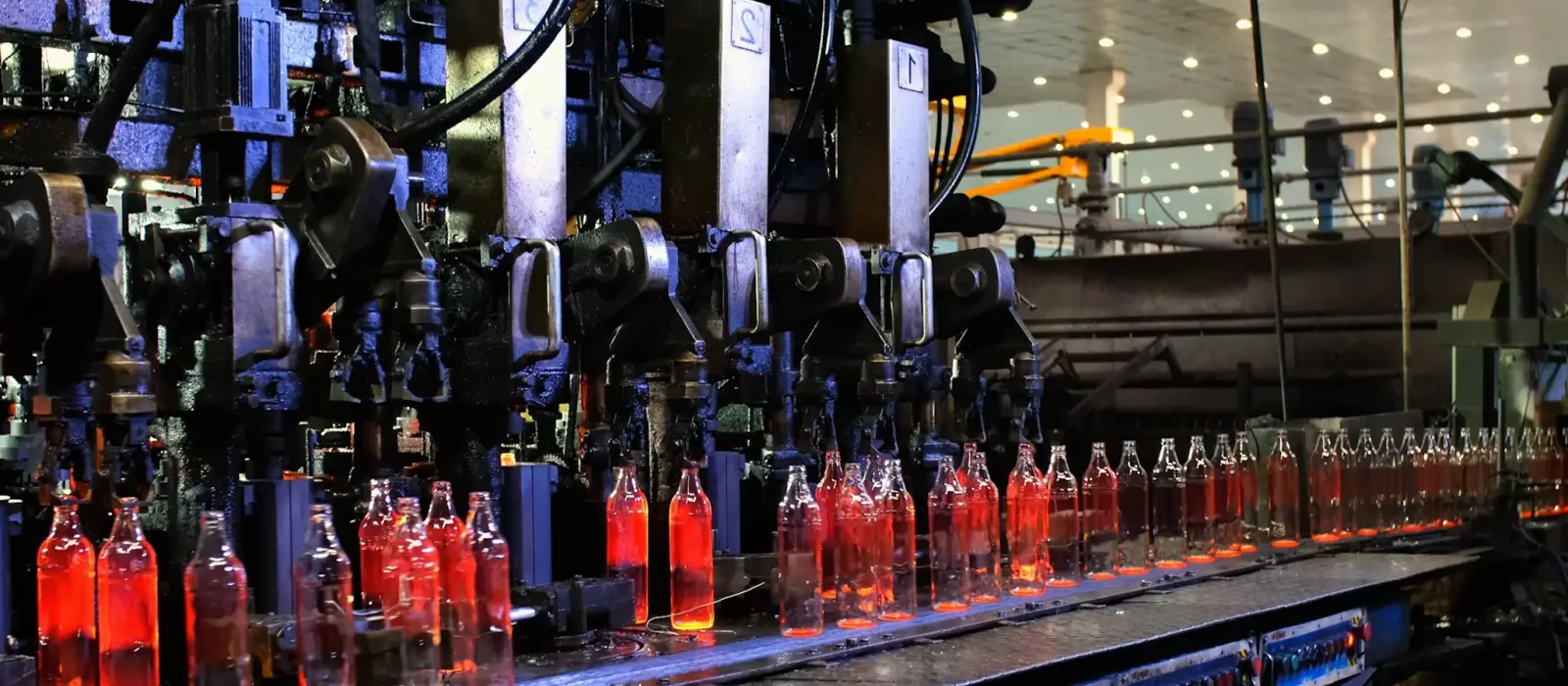
In glass and ceramics, calcium carbonate is not a filler; it is the oxide source that builds the chemistry of the body. Soda-lime-silica glass carries 8.5–12 wt% CaO, and that CaO is what makes the glass resistant to water. Without it the sodium silicate system becomes, in practice, a water-soluble material — water glass. Limestone enters the batch for chemical durability, not to cheapen the mix.
In ceramics, calcite does something entirely different. It decomposes around 800–900 °C during firing, and the CaO released reacts with clay-derived metakaolin and free silica to form anorthite (CaAl₂Si₂O₈) and, locally, wollastonite (CaSiO₃). These crystalline phases stabilise firing shrinkage in a wall-tile body, keep porosity under control and lower moisture expansion, which is what prevents the glaze from crazing months later. The same raw material sits inside two quite different mechanisms.
This page is about the decision rather than the product: why the Fe₂O₃ tolerance narrows for one glass type and not another, how particle size drives melting rate and cord formation, why calcite fineness prevents lime popping, and which measurement misleads you on the floor. For the technical data of the raw material itself, see natural calcium carbonate.
Why the tolerance is so narrow in a glass batch
Glass is the one industrial material that cannot hide the iron in its raw materials. In colourless (flint) container glass, total Fe₂O₃ in the body is typically held at 0.03–0.05%; in low-iron float and solar glass the target is below 0.010%. Since limestone accounts for 8–12 wt% of the batch, every 0.01 point of extra iron in the limestone shows up as roughly 0.001 point in the glass. The number is small, but at this scale it decides the outcome: the greenish cast, the few-nanometre shift in dominant wavelength and the measurable yield loss in solar glass all start here.
This is also the measurement that misleads most. A single Fe₂O₃ figure on a certificate says nothing about the valence the iron takes in the melt. Fe³⁺ absorbs in the ultraviolet and blue end and gives a yellowish tint, while Fe²⁺ absorbs very strongly around 1050 nm. The second is not merely a colour problem: as Fe²⁺ rises, infrared transmission through the melt falls, heat stays in the upper layers, the tank bottom cools, convection weakens and pull capacity drops. The defect then looks like a furnace problem rather than a raw-material one, gets chased with burner settings and is never found. On top of that, the selenium and cobalt used to mask iron cost money and cost light transmission.
The second trap is that chemical analysis does not show mineralogy. XRF gives you an average, but in glass the defect is made by a single grain, not by the average. Chert or coarse free quartz grains in limestone will not dissolve within the residence time and turn directly into stones. Likewise Cr₂O₃ and NiO produce green-black specks even at ppm level, and their source is usually not the rock but crusher jaws, mill wear parts and belt transfer points. Raw-material assessment therefore cannot be separated from the preparation circuit on the mining and ore beneficiation side.
The third difficulty is particle size, and it cuts both ways. Coarse limestone dissolves late; a locally CaO-rich zone survives around the partly melted grain and produces cord and stones. Too fine and the batch dusts during handling, is carried over the flame into the regenerator at charging, and raises both stack dust load and blockage risk. On the ceramic side the logic reverses: there a coarse calcite grain cannot react fully during firing, leaves free CaO in the body, and months later that CaO takes moisture from the air, hydrates and blows a crater in the surface — lime popping. That is why the same raw material demands opposite finenesses in the two industries.
What limestone actually does in the batch and in the body
In a glass batch, limestone is the primary CaO source and in most plants it shares that duty with dolomite, which brings both CaO and MgO. CaO raises hydrolytic resistance, surface hardness and chemical durability — but the benefit is not linear. Above about 12% CaO in the glass, devitrite (Na₂O·3CaO·6SiO₂) and wollastonite nucleate more readily and the glass becomes short: viscosity changes more steeply with temperature and the forming window narrows. On a container line that shows up as cold checks in the mould and wandering base thickness. In practice, moving MgO into the 3.5–4% band (typical for float) breaks the devitrification tendency and reopens the working range.
A specification cannot be written as a single grade of glass-quality limestone; it is derived from the target glass. For colourless container glass, Fe₂O₃ ≤ 0.05% in the limestone works in most furnaces. For low-iron float and solar glass the limit drops to ≤ 0.012%, which implies selective quarrying, separate stockpiles and a separate grinding line. Conversely, in green and amber containers 0.15–0.30% iron is not merely tolerated — it is counted as part of the colour charge. The same material can be rejected in one plant and preferred in another; what decides is the process, not the rock.
Particle size is the other half of the specification. The typical target for a glass batch is 0.1–0.8 mm, with below 0.1 mm held at ≤ 5% and above 1.0 mm at ≤ 2%. The band is chosen because of the sand: when the limestone distribution sits close to the sand distribution, the batch does not segregate during transport or silo residence, and the recipe that was weighed is the recipe that reaches the furnace. Calcination completes inside the blanket at around 800–900 °C, releasing roughly 44% of the CaCO₃ mass as CO₂. That loss sets batch-to-glass yield, and it also lifts the blanket and feeds bubble nucleation, contributing to sulphate fining.
On the ceramic side, calcite is not a flux but a phase builder. A single-fired porous wall-tile body (monoporosa) carries 6–15 wt% calcite. At a peak of 1100–1140 °C, anorthite formation makes shrinkage almost independent of temperature — which is the only practical way to hold dimensional tolerance in a 35–50 minute fast-firing cycle. The same phase fixes water absorption in the band EN 14411 group BIII requires (>10%) and, more importantly, lowers moisture expansion of the body. If the glaze is not crazed six years on, the reason is usually not the glaze but the anorthite underneath it. To get there, calcite residue on a 63 μm sieve must be ≤ 2%, i.e. no coarse grain left to leave free CaO behind.
In glaze and frit recipes CaCO₃ is both a CaO source and a matting agent: at high CaO loading, wollastonite or anorthite crystals precipitate on cooling to give a silky matt surface, while hardness and chemical resistance rise. The limit is gas evolution — in fast firing a late-decomposing calcite grain releases CO₂ when the glaze has already become viscous and leaves a pinhole. Around the plant, calcium chemistry appears a second time: dry sorbent injection of hydrated lime is the standard answer to SOx, HF and HCl in glass furnace flue gas, a process covered separately on the flue gas treatment side.
Operating ranges
| Parameter | Value | |
|---|---|---|
| CaCO₃ in limestone | ≥ 97.0% | CaO 54.3–55.5% |
| Fe₂O₃ — colourless container | ≤ 0.05% | Total Fe₂O₃ in glass 0.03–0.05% |
| Fe₂O₃ — low-iron / solar glass | ≤ 0.012% | Target in glass < 0.010% |
| Cr₂O₃ + NiO | ≤ 10 ppm | Green-black specks; from crusher wear |
| Particle size — glass batch | 0.1–0.8 mm | < 0.1 mm ≤ 5%; > 1.0 mm ≤ 2% |
| Free silica / chert | Trace | Main source of stone defects |
| Moisture — as delivered | ≤ 0.3% | Silo flow and weighing accuracy |
| Loss on ignition (LOI) | 43.0–44.0% | Batch-to-glass yield ≈ 0.83 |
| CaO in glass | 8.5–12.0 wt% | > 12%: devitrification risk |
| Calcination — inside the blanket | 800–900 °C | CaCO₃ → CaO + CO₂ |
| Calcite in ceramic body | 6–15 wt% | Monoporosa; anorthite formation |
| Calcite fineness — ceramics | 63 μm residue ≤ 2% | Prevents lime popping |
CaCO₃ in limestone
≥ 97.0%
CaO 54.3–55.5%
Fe₂O₃ — colourless container
≤ 0.05%
Total Fe₂O₃ in glass 0.03–0.05%
Fe₂O₃ — low-iron / solar glass
≤ 0.012%
Target in glass < 0.010%
Cr₂O₃ + NiO
≤ 10 ppm
Green-black specks; from crusher wear
Particle size — glass batch
0.1–0.8 mm
< 0.1 mm ≤ 5%; > 1.0 mm ≤ 2%
Free silica / chert
Trace
Main source of stone defects
Moisture — as delivered
≤ 0.3%
Silo flow and weighing accuracy
Loss on ignition (LOI)
43.0–44.0%
Batch-to-glass yield ≈ 0.83
CaO in glass
8.5–12.0 wt%
> 12%: devitrification risk
Calcination — inside the blanket
800–900 °C
CaCO₃ → CaO + CO₂
Calcite in ceramic body
6–15 wt%
Monoporosa; anorthite formation
Calcite fineness — ceramics
63 μm residue ≤ 2%
Prevents lime popping
Application steps
- 01
Defining the target glass and the defect history
A specification is written backwards from the product. Colourless container glass, green containers, float, low-iron solar glass and a porous wall-tile body correspond to five different tolerance sets. The first step is to put three numbers on paper: CaO percentage in the target body, the acceptable upper limit for Fe₂O₃, and the colour target — dominant wavelength and light transmission at 4 mm. Without those three, a raw-material discussion collapses into a price discussion.
The second input is the defect history. Which defect dominated the last six months: stones, cord, bubbles or colour drift? If stones and cord dominate, the problem is most likely particle size and mineralogy; if colour drift dominates, it sits with iron and redox. Changing raw material before making that distinction usually does not solve the problem, it relocates it. Talking through glass type, furnace type and defect history before requesting samples therefore saves time — a conversation with our technical team starts from those three headings.
- 02
Chemical and mineralogical verification of the source
XRF establishes CaCO₃, MgCO₃, SiO₂, Al₂O₃, Fe₂O₃, K₂O + Na₂O and loss on ignition; XRD looks for free quartz, chert and clay minerals. Chemical analysis gives the average, but in glass a single grain makes the defect. So a representative 3–5 kg sample is screened, the coarse fraction is scanned under a stereo microscope, and the magnetic separation residue is examined separately. A hundred ppm of chert in a consignment is invisible on a certificate but means dozens of stone defects per shift.
Cr₂O₃ and NiO are measured at ppm level, and their source is almost never the rock itself but the preparation circuit: crusher jaws, hammers, mill liners, belt transfer points. Raw-material specification and the wear metallurgy of the line are therefore assessed together. Material from the same quarry can be excellent for the pulp and paper industry in brightness and fineness while being entirely unsuitable for a glass batch on particle size; the two industries want opposite things.
- 03
Matching the size distribution to the batch
The sieve analysis of the limestone is overlaid on the sieve analysis of the sand. The aim is for the two curves to track each other; the wider the gap, the more segregation occurs on conveyors, in silos and in the charging machine. Once segregation starts, a correctly working weighing system means nothing: the recipe is weighed right and enters the furnace wrong. The field signature is colour and defect rate oscillating within a shift on a furnace running at fixed settings.
Homogeneity is a measurable quantity. Samples taken at the mixer outlet and at the charging point are used to track the standard deviation of CaO; on a well-run batch house it stays below 0.15 percentage points absolute. The dusting behaviour of the fine fraction is checked as well: once the sub-0.1 mm share exceeds 5%, batch carryover over the flame into the regenerator and a rising stack dust load follow.
- 04
Batch calculation: balancing CaO, MgO and LOI
The calculation starts from the target glass composition. CaO is placed in the 8.5–12% band and MgO around 1–2% for containers and 3.5–4% for float; the split between limestone and dolomite falls out of the intersection of those two targets. Limestone converts to CaO at a factor of roughly 0.56: 100 kg of limestone delivers 56 kg of CaO to the furnace and sends 44 kg of CO₂ up the stack. Batch-to-glass yield is therefore around 0.83, and stock, silo and haulage planning are built on that number.
A carbonate input supplies gas as well as oxide. The CO₂ released lifts the batch blanket, feeds bubble nucleation in the melt and contributes to sulphate fining. That is why feeding CaO directly as burnt lime — despite the theoretical energy saving — is not standard practice. The comparison is instructive: in iron, steel and metallurgy the same calcium source is used as a slag former, and there Fe₂O₃ is not a defect but usually a neutral component. What sets the specification is the process, not the material.
- 05
Measuring and tracking melting behaviour
A gradient-furnace trial is run in the laboratory with the candidate limestone, and the time for the batch to clear completely — batch free time — is measured. A 0.2 mm shift in mean particle size changes that time noticeably; this is where the difference between two materials with identical chemistry becomes visible. The trial counts not only time but also residual bubble count and undissolved grains.
On the floor the indicators are foam blanket length, bottom-to-crown temperature difference, stones and cord per unit of production, and colour measurement of the glass (dominant wavelength, %Fe²⁺/ΣFe). A falling bottom temperature as iron rises is a classic pattern, and it is routinely mistaken for a furnace problem rather than a raw-material one, triggering unnecessary burner work. Colour and thermal data therefore belong on the same chart, not in separate reports.
- 06
Calcite in the ceramic body: fineness and anorthite control
Calcite entering the body recipe is wet ball-milled together with clays and feldspar; the target is a residue below 2% on a 63 μm sieve. A rise in that residue is not just a number, it is a future warranty claim: a coarse calcite grain that cannot fully react during firing leaves free CaO in the body, that CaO draws moisture within weeks, expands and blows a crater in the surface. Because the defect appears on site rather than in the plant, and months later, it is the most expensive defect class there is.
Verification rests on three measurements: firing shrinkage and size distribution, water absorption (EN ISO 10545-3) and moisture expansion by autoclave. If anorthite formation is complete at a 1100–1140 °C peak in a 35–50 minute cycle, the shrinkage curve shows a flat plateau against peak temperature — and that plateau is the only safety margin that keeps the unavoidable ±10 °C spread across the kiln from turning into a dimensional defect.
- 07
CaCO₃ on the glaze, engobe and frit side
In a glaze recipe CaCO₃ carries CaO into the melt; at low levels it lifts gloss and hardness, at high levels wollastonite or anorthite crystals precipitate on cooling and produce a silky matt texture. The quality of a matt glaze depends on a narrow crystal size distribution, which means the cooling regime and the fineness of the CaCO₃ have to be set together. CaO also raises resistance to acids and detergents, making it a direct performance parameter for bathroom and kitchen applications.
The limit is gas evolution. In fast firing, a late-decomposing calcite grain releases CO₂ once the glaze surface has already turned viscous, and leaves a pinhole. The usual answer is finer grinding and a re-balanced fritted fraction; in critical recipes wollastonite is chosen as a gas-free CaO source, though the cost gap only justifies it where the problem has been proven.
- 08
Around the plant: flue gas and glaze-line effluent
Glass furnace flue gas carries SOx from the sulphate fining agent and fuel sulphur, plus HF and HCl from the raw materials. The common answer is dry sorbent injection of Ca(OH)₂ at 140–200 °C upstream of the bag filter. The point to watch is that if filter dust is returned to the batch, it must also be counted as a calcium and sulphate input; otherwise the batch recipe drifts quietly. At high consumption, feeding quicklime to an on-site hydrator lowers cost per unit of active substance.
On the ceramic side, glaze-line washwater and press filtrate carry high suspended solids, traces of zinc and lead and a colour load. pH adjustment with lime, settling, and recovery of part of the sludge back into the body are standard practice; the dosing calculation and sludge behaviour follow the same logic as in water and wastewater treatment. Calcium chemistry thus works at three connected points in the same plant: in the batch, at the stack and at the effluent plant.
Products used in this field
Frequently asked questions
What is the Fe₂O₃ limit for limestone in a glass batch?
There is no single limit; the target glass sets it. For colourless container glass, ≤ 0.05% in the limestone works in most furnaces, while low-iron float and solar glass push the limit down to ≤ 0.012%. In green and amber containers 0.15–0.30% iron is tolerated and even counted as part of the colour charge.
Can I use quicklime (CaO) directly instead of limestone?
In theory it saves the calcination energy; in practice it is not done. CaO picks up moisture and CO₂ in storage, partly hydrating and recarbonating, so the composition drifts, the batch agglomerates and dust and safety burdens rise. The CO₂ from the carbonate also lifts the batch blanket and assists fining; without that gas the bubble removal behaviour changes.
Why does the limestone size have to match the sand?
When the two distributions separate, the batch segregates on conveyors, in silos and in the charger. Past that point the accuracy of the weighing system stops mattering: the recipe is weighed correctly but enters the furnace in the wrong proportion. Colour and defect rate oscillating within a shift on a fixed-setting furnace is the classic sign.
Does more CaO always mean a more durable glass?
No — past a point it reverses. Above about 12%, devitrite and wollastonite nucleate more easily, the glass becomes short and the forming window narrows. On a container line that reads as cold checks in the mould and drifting base thickness; moving MgO into the 3.5–4% band breaks the tendency.
Is MgO in limestone harmful for glass?
Not harmful, but a variable that has to be controlled. MgO reduces the devitrification tendency and widens the working range; float glass targets 3.5–4% anyway. What matters is not the presence of MgO but its batch-to-batch swing — if the dolomite share is not held steady, the viscosity curve moves.
Where do green-black specks in glass come from?
Usually from Cr₂O₃ and NiO at ppm level. The source is more often the preparation circuit than the rock itself: crusher jaws, hammers, mill liners and belt transfer points. The fix is to treat the raw-material specification together with the choice of wear metallurgy, and to place magnetic separation at the critical transfer points rather than only at the end of the line.
Why does lime popping happen in ceramic tile and how is it prevented?
A coarse calcite grain that cannot fully react during firing leaves free CaO in the body; over weeks or months that CaO takes up moisture, hydrates, expands and blows a crater in the surface. The prevention comes down to a single number: calcite residue on a 63 μm sieve must stay below 2%. A rise in mill residue shows up not in the quality report but as a site claim months later.
How does raising the calcite level affect water absorption in wall tile?
More calcite means more porosity from CaCO₃ decomposition and a more rigid anorthite crystal network, so water absorption rises. For wall tile that is the desired direction — EN 14411 group BIII already requires above 10% — but breaking strength and glaze fit set an upper bound; the practical band is 6–15%.
Are glaze pinholes related to calcite?
Frequently, yes. In fast firing a late-decomposing calcite grain releases CO₂ when the glaze surface has already gone viscous, and the hole freezes before it can heal. Finer grinding, a higher fritted fraction, or switching to gas-free wollastonite in critical recipes are the working answers.
Can the same limestone serve both glass and ceramics?
If the chemistry fits, yes — but not at the same particle size. A glass batch wants coarse material in the 0.1–0.8 mm band; a ceramic body wants fine material with 63 μm residue below 2%. In practice one quarry feeds both products, but the grinding and screening lines are separated and iron control is tightened to the glass side's requirement.
Sample and dose recommendation for this process
Describe your current usage and target; our technical team will come back with a suitable specification and a starting dose.