Products
Moisture & Gas Absorbent
Lime-based industrial desiccant that permanently binds condensation and acid gases in container shipping through chemical reaction.
Overview
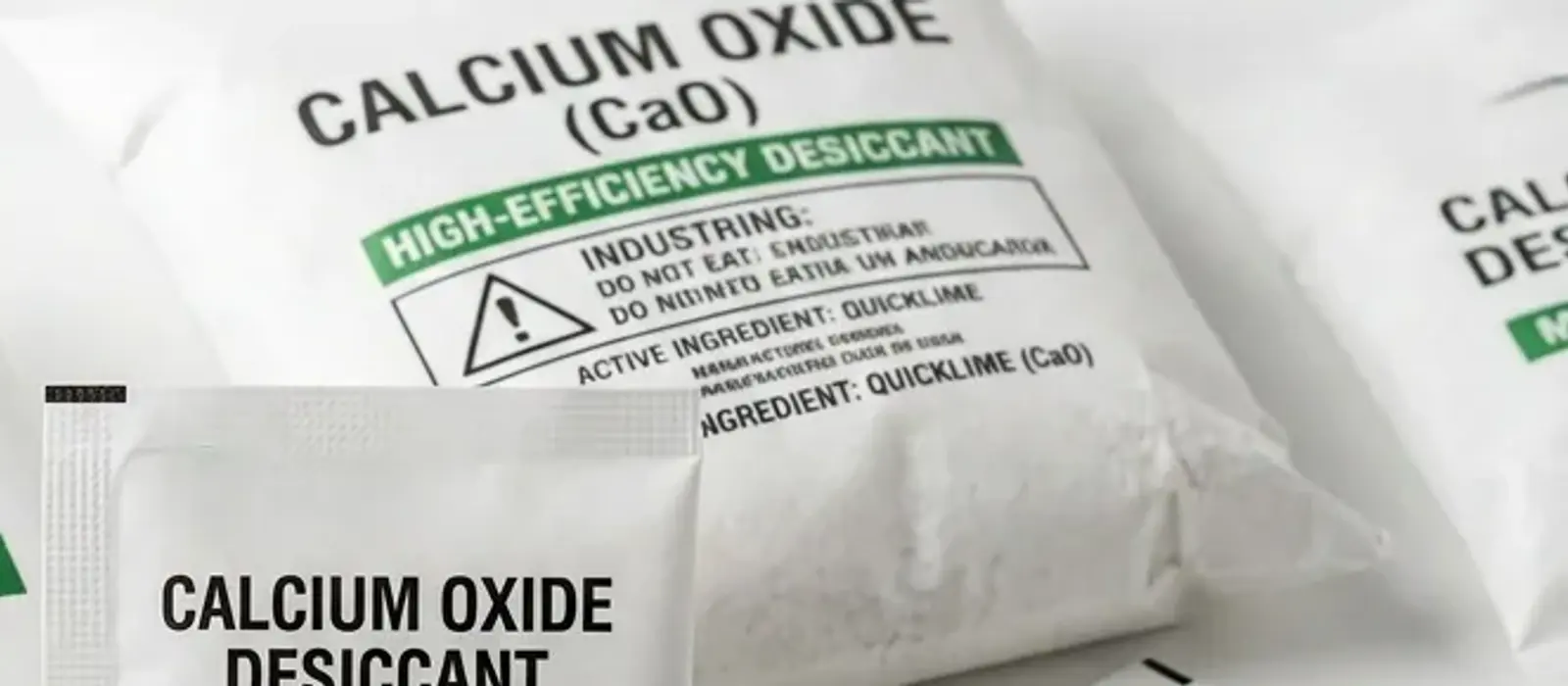
The moisture and gas absorbent is an industrial desiccant made by dosing highly reactive calcium oxide (CaO) granules into a moisture-permeable membrane. It does not hold water vapour on its surface; it binds it chemically through the reaction CaO + H₂O → Ca(OH)₂. That single difference separates its behaviour in sea freight from silica gel and clay-based desiccants from the outset.
Inside a closed container the real problem is not average humidity but the daily temperature swing. In a box whose deck-side skin reaches 45 °C by day, the roof panel falling to 8 °C at night condenses the moment it drops below dew point, and it drips. In what the trade calls “container rain”, the water that wets the cargo does not leak in from outside; it comes out of the cargo, the pallets and the packaging themselves.
This page explains the selection logic rather than praising the product: how many kilograms of water sit in the cargo and its packaging, what capacity survives a 30-day voyage, whether pouches or hanging strips are needed. For fixed warehouse and production environments, the approach on the industrial moisture and humidity control page is complementary.
Technical specifications
| Parameter | Value | |
|---|---|---|
| Active substance | CaO ≥ 92% | EN 459-1 CL 90-Q grade feedstock |
| Reactivity (t₆₀) | 2–5 min | EN 459-2 wet slaking test |
| Nominal absorption capacity | 28–35% of own weight | 25 °C, 90% RH, 30 days |
| Theoretical stoichiometric limit | 32.1% | 18.02 / 56.08 molar ratio |
| Equilibrium relative humidity | 35–45% | In a closed container volume |
| Granule size | 2–6 mm | Fines (< 0.5 mm) ≤ 2% |
| Inner membrane | Non-woven PP / microporous film | Vapour permeable, dust tight |
| Outer barrier bag | Aluminium foil laminate | MVTR < 0.1 g/m²·day |
| Unit weights | 125 / 250 / 500 / 1000 / 1200 g | Pouch and hanging formats |
| Service temperature | −10 … +60 °C | Container interior |
| Shelf life | 24 months | In unopened barrier bag |
| Spent content | Ca(OH)₂ + CaCO₃ | Solid phase — no liquid leakage |
Active substance
CaO ≥ 92%
EN 459-1 CL 90-Q grade feedstock
Reactivity (t₆₀)
2–5 min
EN 459-2 wet slaking test
Nominal absorption capacity
28–35% of own weight
25 °C, 90% RH, 30 days
Theoretical stoichiometric limit
32.1%
18.02 / 56.08 molar ratio
Equilibrium relative humidity
35–45%
In a closed container volume
Granule size
2–6 mm
Fines (< 0.5 mm) ≤ 2%
Inner membrane
Non-woven PP / microporous film
Vapour permeable, dust tight
Outer barrier bag
Aluminium foil laminate
MVTR < 0.1 g/m²·day
Unit weights
125 / 250 / 500 / 1000 / 1200 g
Pouch and hanging formats
Service temperature
−10 … +60 °C
Container interior
Shelf life
24 months
In unopened barrier bag
Spent content
Ca(OH)₂ + CaCO₃
Solid phase — no liquid leakage
Highlights
Binds water chemically: even at 50 °C it does not release the moisture it has taken up.
The reaction product is a solid — none of the brine leakage risk of calcium chloride desiccants, so cargo and packaging stay unstained.
Alongside moisture it binds CO₂, SO₂, H₂S and the organic acid vapours released by timber and cardboard, cutting mould and corrosion risk together.
28–35% of its own weight over 30 days; a single loading covers voyages stretching to 40 days.
Hanging pouches, container poles, in-carton sachets and pallet blankets fit any stowage plan.
Equilibrium humidity sits in the 35–45% band: it does not over-dry and crack timber, leather or tobacco cargoes.
Use
Container rain does not come from outside
The free air volume of a 20-foot container is roughly 33 m³. At 30 °C and 80% relative humidity air carries about 24 g of water per m³, so the air alone brings some 0.8 kg of water into the box. That is the smallest part of the problem. The real mass sits in timber and paper: a 25 kg wooden pallet at 18% moisture content holds several kilograms of bound water, and corrugated board carries 8–10% of its own weight as moisture.
When temperature falls, that water cannot stay airborne. The container roof is the surface that cools fastest at night; the moment the dew point of the internal air passes the roof temperature, condensation starts and drops fall onto the cargo. Damage does not show up in one form: carton stacking strength collapses and pallets slump, labels lift, textiles stain with mould, metal parts start to rust, hygroscopic powders cake.
Ventilation does not break this chain. Open-sea air already has a high absolute moisture content; on most routes a ventilated container keeps taking water in from outside. What works in practice is binding the water inside the box irreversibly; getting the capacity calculation right gives a far more reliable result than trying to raise air exchange.
Chemical binding and physical adsorption are not the same thing
Silica gel, bentonite clay and molecular sieves hold water physically. How much they hold follows an equilibrium curve set by temperature and relative humidity, and when the space warms up and relative humidity drops they give part of that water back. In a container that swings 20 °C over a day, that means the same water is taken up and released again and again, and the condensation cycle at the roof continues.
In a lime-based product the water enters the calcium hydroxide crystal structure. Dehydration of Ca(OH)₂ only begins above 400 °C, so at transport temperatures there is effectively no release. The reaction product — hydrated lime — is a solid, stable phase and stays inside the pouch as a powder.
Calcium chloride desiccants quote higher gravimetric figures, but they dissolve the water into a liquid phase. A punctured or crushed pouch means brine leaking directly onto the cargo, and for textiles, paper and food that is a far more expensive problem than capacity. The same chemical binding principle is also used on the process side: in plastics recycling, CaO is dosed as a masterbatch and binds residual moisture in recycled PE/PP, preventing voids and bubbles during extrusion.
Under what conditions is absorption capacity measured
Stoichiometry sets a hard ceiling: 56.08 g of CaO binds 18.02 g of water. The theoretical capacity of pure calcium oxide is therefore 32.1% of its own weight. The upper end of the 28–35% range measured in service is reached with a contribution from carbonation; figures such as 50% point either to a different active substance or to hidden test conditions.
A capacity number is meaningless unless temperature, relative humidity and duration come with it. Our reference condition is 25 °C, 90% RH and 30 days. The same product works far more slowly at 60% RH — that is not a defect but self-limiting behaviour: as the space dries, reaction rate falls, and the product does not over-dry to the point of cracking timber or leather. The typical equilibrium band is 35–45%.
What decides performance in the first days is the reactivity of the feedstock. A soft-burnt quicklime with a t₆₀ of 2–5 minutes in the EN 459-2 wet slaking test binds noticeably more water in a 30-day window than a hard-burnt lime of identical purity. That is why the specification states reactivity, not just the CaO percentage.
How many kilograms does one container need
The calculation does not run off a single line item. The total water load is the sum of four contributions: moisture in the air of the box, free moisture in the cargo, bound moisture in packaging and wooden pallets, and residual moisture left in the container floor. Once that total is known, a safety factor is applied for voyage length and temperature swing; a short Mediterranean leg and a Far East route crossing the equator do not carry the same factor.
The starting ranges we work with are these: 8–10 kg per 20-foot container for dry general cargo, and 12–16 kg for hygroscopic cargoes such as coffee, cocoa, grain, spices, hides and tobacco. The multiplier for a 40-foot HC is about 1.7. The more wooden pallets in the load, the closer you move to the upper bound; for all-steel crates or machinery the lower bound may be enough.
Letting the dose approach saturation is an insidious mistake. A set that fills 90% of its capacity by day 25 does no work in the last two weeks of a 38-day voyage; humidity climbs again and damage occurs right before arrival. So the calculation should follow the worst case with delay allowance, not the historical transit time. For a cargo-specific dosing study, sample and voyage data can be shared through contact.
Moisture is not the only problem: acid gases are bound too
Water vapour is not the only vapour that builds up in a closed container. Respiration and fermentation of organic cargo produce CO₂; heat-treated wooden pallets and corrugated board release acetic and formic acid vapour; some cargoes generate H₂S and SO₂; degradation of PVC components gives off HCl. Acetic acid vapour attacks lead, zinc and copper alloys quickly — it is often the source of surface staining that humidity alone cannot explain.
As the lime surface inside the pouch takes on moisture, it forms an alkaline interface that binds these gases: CO₂ → CaCO₃, SO₂ → CaSO₃, H₂S → CaS, HCl → CaCl₂. Apart from temperature and concentration, the chemistry is the same as dry sorbent injection on the flue gas treatment side; here the reaction runs at ambient temperature and very low concentration, but with weeks of contact time.
There is a price for this and it should be stated plainly: carbonation consumes alkalinity and the reaction Ca(OH)₂ + CO₂ → CaCO₃ + H₂O releases water. Remaining CaO re-binds that water, but on CO₂-heavy shipments — fresh produce, fermenting agricultural goods — net capacity falls and the dose should be raised by 15–20%. At the end of the voyage the pouch content is in practice a mixture of calcium carbonate and calcium hydroxide.
Which format fits which stowage plan
Hanging pouches of 1000–1200 g are hooked onto the lashing rings or corrugation channels of the side wall; because they take no floor volume they are the standard answer for palletised general cargo. The container pole format is shaped to sit in the vertical corrugation and can be fitted from the door end after loading is complete — which shortens exposure time and therefore reduces capacity loss.
Sachets of 125–500 g go inside cartons, crates and machine cases. In spare parts, tooling, electronic boards and chemical and pharmaceutical industry packaging, used together with VCI film, the corrosion inhibitor protects the vapour phase while the desiccant lowers water activity. The blanket format is laid over the top of the stack and catches drips from the roof directly.
The placement rule is simple, and most failed applications trace back to it: moisture rises and condenses at the ceiling, so the bulk of the capacity belongs in the upper third of the box. Leave 20–30 cm of air circulation around each pouch; a pouch squeezed between two stretch-wrapped surfaces does nothing, because no air exchanges around it. The two metres nearest the doors and the roof bows are where the temperature swing is largest.
The clock starts the moment the barrier bag is opened
The product ships inside an aluminium foil laminate barrier whose water vapour transmission rate is below 0.1 g/m²·day, giving a 24-month shelf life while unopened. From the moment the barrier is opened the product starts working on warehouse air: at 25 °C and 70% RH roughly 5–10% of capacity is consumed in the first two hours, and up to a quarter if it is left out for a full shift.
The field instruction therefore reduces to one sentence: open the carton at the container door, hang the pouches, close the doors. Pouches laid out on a table before loading and then forgotten are the most common cause of capacity loss we see in the field. In storage, a dry, palletised area raised off the floor and out of direct sun is enough; keep it away from acid vapours and standing water.
Weighing is a practical incoming-check method. A unit whose barrier has been opened or punctured and which has gained more than 5% over its declared weight should not be shipped. Granules that have hardened and lumped, a pouch that has stiffened and swollen, or one that feels warm to the touch all indicate the reaction has begun. These units are not scrap; with reduced capacity they can still serve low-risk domestic movements.
Safety, regulation and disposal of the spent pouch
Calcium oxide is classified under CLP for skin irritation (H315), serious eye damage (H318) and respiratory irritation (H335). An intact pouch is dust tight and creates no exposure in normal handling, but a torn unit must be collected with gloves and eye protection. On eye contact, rinse with plenty of water for at least 15 minutes and seek medical attention — lime burns develop with a delay, so “it feels fine now” is not a reason to stop.
In transport, the product shipped as a packaged desiccant does not require a dangerous goods declaration on most routes; that said, requirements can differ by destination country, carrier and service. Stating the content on the bill of lading and packing list heads off customs questions. Ask for the current safety data sheet and certificate of analysis before shipment; both are issued for inclusion in the shipping file.
The content of a spent pouch is a mixture of calcium hydroxide and calcium carbonate: not toxic, but alkaline. It can be handed over as ordinary industrial waste in line with local regulation, and where regulation permits the content is also used as a soil pH conditioner. Do not empty it into drains in bulk — it lifts discharge pH and generates unexpected sludge at the treatment plant.
Packaging and delivery
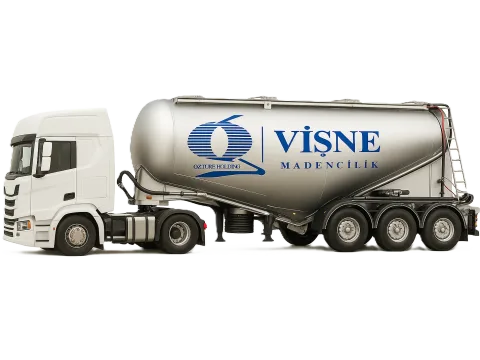
Silo truck — bulk
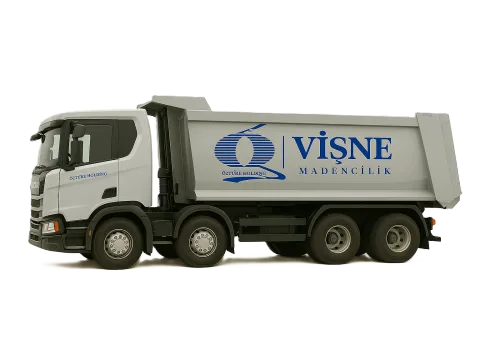
Tipper — bulk
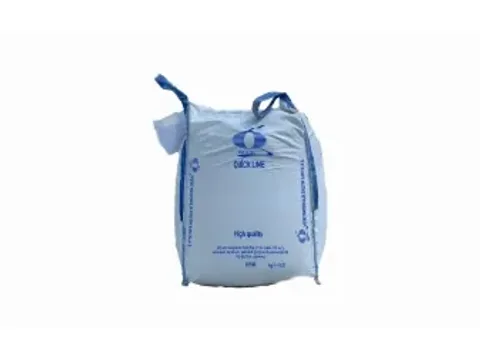
Big bag (1000 kg)
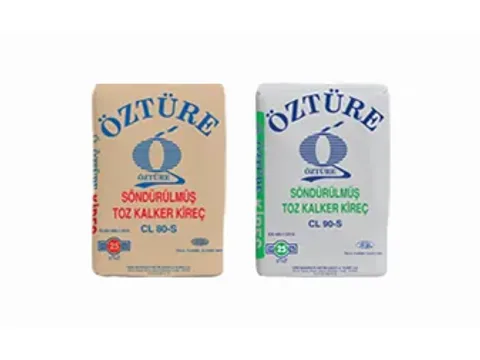
Bag (25 kg)
1000 g hanging pouch — 12 per carton in barrier packaging (20-ft container set)
1200 g container pole — fits the wall corrugation, can be hung from the door end
125 / 250 / 500 g sachets — for cartons, crates and machine cases
Cargo blanket — 1.2 × 1.2 m and 2.4 × 2.4 m
Bulk CaO desiccant granules — 25 kg bags and 1000 kg big bags (process drying)
Custom unit weights, carton counts and private labelling on request
Where this product is used

Frequently asked questions
Why a lime-based desiccant instead of silica gel?
Silica gel holds water physically and gives part of it back when temperature rises and relative humidity falls. In a lime-based product the water binds into the Ca(OH)₂ crystal and is not released below 400 °C. In a container swinging 20 °C over a day, that is exactly where the difference shows.
Calcium chloride desiccants claim “300% of own weight”, lime claims 30%. Is that a fair comparison?
The figures are correct but they do not measure the same thing. CaCl₂ dissolves the water into a liquid phase; capacity is high, but a punctured bag means brine running onto the cargo. In a lime-based product the reaction product is solid. For textiles, paper and food, where staining is unacceptable, the choice changes for that reason.
How many kilograms should I put in a 20-foot container?
8–10 kg is a typical starting point for dry general cargo and 12–16 kg for hygroscopic cargoes such as coffee, cocoa, grain, hides and tobacco; the multiplier for a 40-ft HC is about 1.7. Pallet count, quantity of corrugated board and voyage length shift that range directly.
How long can I wait after opening the barrier bag?
The product starts working on ambient air the moment the bag is opened. At 25 °C and 70% RH roughly 5–10% of capacity goes in the first two hours, and a quarter if it is left out for a shift. Keep the rule simple: open the carton at the container door, hang the pouches, close the doors.
Can it be used in the same container as food cargo?
Yes, that is one of the most common uses; but the pouch goes into the container volume, not inside the food packaging. The membrane is dust tight, yet positions where it could be crushed or come into direct contact are avoided. On food and sugar industry shipments, customer specification and traceability requirements are assessed together.
Does performance drop on cold winter routes?
Reaction rate falls with temperature, but absolute humidity is also lower in cold air, so the total water load is already smaller. The real risk is not northern routes but containers moving from a cold port into a warm climate: the cargo is still cold while the box warms, and condensation starts on top of the cargo. In that scenario go to the upper end of the dose.
How are spent pouches disposed of?
The content is a mixture of calcium hydroxide and calcium carbonate: not toxic, but alkaline. It can be handed over as ordinary industrial waste under local regulation. Do not empty it into drains in bulk, as it raises discharge pH.
Does it need a dangerous goods declaration under IMDG?
Shipped as a packaged desiccant the product does not require a dangerous goods declaration on most services, though this can differ by destination country and carrier. Stating the content on the packing list heads off customs questions; request the current safety data sheet through contact.
Does the product heat up — is there a fire risk?
The heat generated by moisture taken from the air is not at a measurable level; pouches may feel slightly warm in transit and that is normal. The real risk is a pouch submerged in liquid water, which produces local heating. Keep packaging away from standing water, wash-down areas and ramps exposed to rain.
What relative humidity should I be targeting inside the container?
60% RH is the ceiling for stopping mould and microbial spoilage, 50% for arresting corrosion on metal parts, and 40% for hygroscopic powders and electronics. A lime-based desiccant typically equilibrates in the 35–45% band, so there is no over-drying risk.
Sample and dose recommendation for this process
Describe your current usage and target; our technical team will come back with a suitable specification and a starting dose.