
Applications
Soil Improvement & Stabilisation
Reducing plasticity, raising bearing capacity and controlling swell in clay soils: choosing lime percentage and curing time.
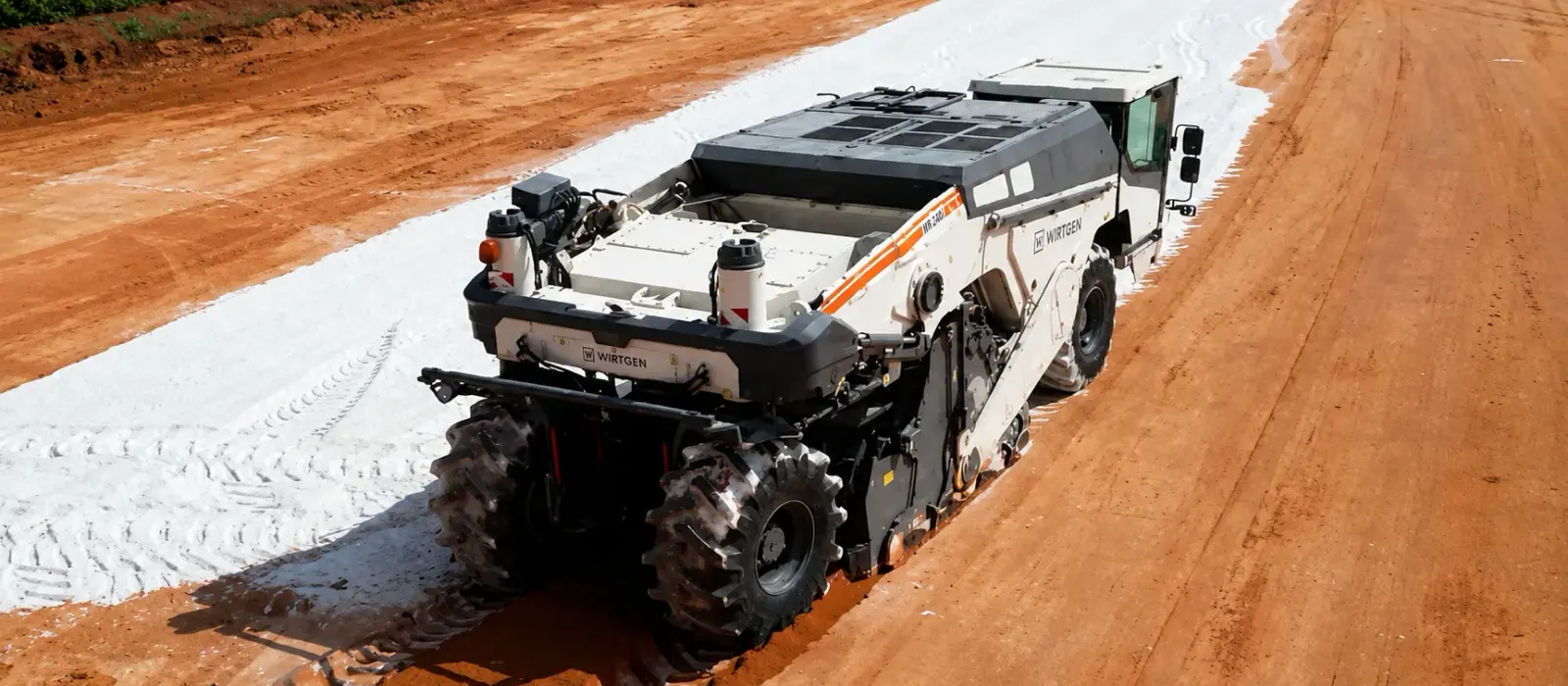
Overview
In a clay subgrade your real counterpart is not the soil itself but the relationship clay has with water. Water entering between the layers of clay minerals lowers interparticle shear resistance; on drying it pulls the soil apart into cracks, on wetting it swells. The CBR measured on the same embankment can fall from 8% in summer to 2% in winter. The pavement above never sees that swing as a number, only as cracking.
Lime does two distinct jobs inside clay, and they run on completely different time scales. Within minutes to hours, cation exchange and flocculation take place: the plastic limit rises, the plasticity index drops, the soil becomes workable. Over weeks to months the pozzolanic reaction takes over; silica and alumina dissolved out of the clay at high pH combine with calcium to form calcium silicate and aluminate hydrates, and strength increases permanently.
In practice 2–3% lime targets only the first mechanism, while 4–6% targets both. But those percentages are not a recipe — they are the output of a decision chain. This page describes that chain: in which soils lime works, which test answers which question, why the mellowing period cannot be shortened, and which number misleads during acceptance testing. For the specification of the product itself, see the quicklime page.
Clay, water and volume: what actually happens on site
Active clay minerals — the smectite group above all — take water between their layers and grow in volume. Free swell can reach 8–15% and swelling pressure 150–400 kPa. In the drying season the same soil shrinks and opens deep cracks; at the next rainfall those cracks carry water straight down to the formation level. The result is a seasonal volume oscillation, and the pavement records it as differential settlement, waviness and longitudinal cracking.
The second problem is compaction itself. A clay whose natural moisture is above optimum does not compact under a roller, it kneads. As the compactor passes, the surface pumps, the layer beneath loosens, and measured dry density stops increasing past a point. The classical answer is to wait for the soil to dry; but in a 40–60 cm lift that means weeks depending on climate, and it stalls the most expensive item in the programme.
The third point — and the most frequently misread — is measurement. An Atterberg test taken immediately after mixing reports the plasticity index higher than it truly is, because cation exchange is not yet complete; the same sample tested after 24 hours of mellowing gives a far lower PI. Likewise, if compaction is checked against the Proctor curve of the untreated soil, the result comes out perpetually “failing”: lime lowers maximum dry density by 0.05–0.15 g/cm³ and shifts optimum moisture 2–4 points upward. The reference curve must be the treated soil's own curve.
The fourth is chemical risk. If water-soluble sulfate exceeds 0.3% (3000 ppm SO₄), lime together with clay alumina and water can form ettringite — and thaumasite at low temperature. These minerals expand as they crystallise; the treated section heaves more than the untreated one, and it does so weeks after the work. Above 2% organic matter a different mechanism applies: organic acids tie up calcium, pH never rises far enough, and the pozzolanic reaction never starts. In neither case does raising the dose solve the problem; you measure first.
What lime does inside clay, and on what time scale
The first mechanism is cation exchange. On contact with water, lime releases Ca²⁺ and OH⁻; the Na⁺ and K⁺ ions on the clay surface are replaced by calcium, the diffuse double layer thins, and particles flocculate into agglomerates. The measurable outcome is this: the plastic limit rises by 5–15 points, the liquid limit falls somewhat, and the plasticity index drops from a 30–45% band to a 5–12% band. The soil no longer behaves like clay but like a silty granular material — it can be cut, spread and compacted.
The second effect is on moisture content, and this is where product selection becomes explicit. Quicklime (CaO) chemically binds roughly 32% of its own weight in water for hydration, and the heat released drives additional evaporation. In practice 1% CaO lowers moisture content by 0.5–1.5 points. On wet sites that alone is decisive. Hydrated lime (Ca(OH)₂) is preferred where dosing precision matters, where a low exotherm is required, and particularly as a slurry for dust control; against that, it needs roughly 1.3 times more tonnage for the same active calcium.
The third and permanent effect is the pozzolanic reaction. Once the mix pH reaches about 12.4, the silica and alumina sheets of the clay minerals dissolve and combine with available calcium to form calcium silicate hydrate (C-S-H) and calcium aluminate hydrate (C-A-H). These phases bind the particles together. Unconfined compressive strength reaches 0.3–0.7 MPa at 7 days and 0.7–1.5 MPa at 28 days; CBR can rise from the untreated 2–4% to 20–60% at 7 days and 40–100% at 28 days. The reaction is temperature dependent and effectively stops once soil temperature falls below 5 °C.
Lime percentage is not estimated but established through a two-stage test chain. First the Eades–Grim pH test (ASTM D6276) finds the lowest percentage that carries the mix pH to 12.4; that is the point at which the clay's calcium demand is satisfied, and it sets the lower bound of the modification dose. Then UCS and CBR series are cured around that value (−1%, +1%, +2%) to select the stabilisation dose. Raising the dose beyond need does not help: lime that cannot enter the pozzolanic reaction remains as a soft phase in the mix and lowers strength.
A lime-treated layer is not a pavement on its own; it works as a subgrade with acquired bearing capacity and is designed together with the granular layer above it. At this point the aggregate grading and the stiffness of the treated layer must be considered together — a thin granular course over a very stiff platform carries a reflective cracking risk. In road infrastructure and asphalt work that balance is part of the design; on the construction and building materials side the same chemistry serves fill and platform preparation. It should not be confused with agricultural liming: in agriculture and soil improvement the target is to bring pH to about 6.5, not to break down plasticity.
Operating ranges
| Parameter | Value | |
|---|---|---|
| Lime dose — modification / stabilisation | 2–3% / 4–6% | Of dry soil weight, as CaO |
| Eades–Grim pH target | ≥ 12.4 (25 °C) | ASTM D6276 — lime saturation point |
| Plasticity index — target | PI ≤ 10–12 | ASTM D4318, untreated 30–45% |
| Pulverisation | ≥ 60% < 4.75 mm | After first mixing pass |
| Mellowing period | 1–48 h | 48–72 h in sulfate-bearing soil |
| Compaction moisture | wopt +1 … +3 points | On the treated soil's own Proctor curve |
| Degree of compaction | ≥ 95% | Standard Proctor, EN 16907-4 |
| CBR — 7 / 28 day cure | 20–60% / 40–100% | EN 13286-47, untreated 2–4% |
| Unconfined compressive strength | 0.3–0.7 / 0.7–1.5 MPa | EN 13286-41, 7 and 28 days |
| Free swell | < 1–2% | ASTM D4546, untreated 8–15% |
| Water-soluble sulfate limit | < 0.3% (3000 ppm SO₄) | Above this, ettringite heave risk |
| Soil temperature at placing | ≥ 5 °C and rising | Lower bound of pozzolanic reaction |
Lime dose — modification / stabilisation
2–3% / 4–6%
Of dry soil weight, as CaO
Eades–Grim pH target
≥ 12.4 (25 °C)
ASTM D6276 — lime saturation point
Plasticity index — target
PI ≤ 10–12
ASTM D4318, untreated 30–45%
Pulverisation
≥ 60% < 4.75 mm
After first mixing pass
Mellowing period
1–48 h
48–72 h in sulfate-bearing soil
Compaction moisture
wopt +1 … +3 points
On the treated soil's own Proctor curve
Degree of compaction
≥ 95%
Standard Proctor, EN 16907-4
CBR — 7 / 28 day cure
20–60% / 40–100%
EN 13286-47, untreated 2–4%
Unconfined compressive strength
0.3–0.7 / 0.7–1.5 MPa
EN 13286-41, 7 and 28 days
Free swell
< 1–2%
ASTM D4546, untreated 8–15%
Water-soluble sulfate limit
< 0.3% (3000 ppm SO₄)
Above this, ettringite heave risk
Soil temperature at placing
≥ 5 °C and rising
Lower bound of pozzolanic reaction
Application steps
- 01
Site investigation: does lime work in this soil?
The decision comes before the percentage. Grading, Atterberg limits, natural moisture content and clay fraction are the basic set; but they do not on their own establish lime suitability. Clay activity — plasticity index divided by the fraction finer than 2 µm — above 0.75 indicates a soil that responds well to lime. Where activity is below 0.4 and the clay fraction below 10%, the reaction stays weak; a hydraulic binder or a granular mix is the sounder choice there.
Two exclusionary parameters must be measured in the same investigation: water-soluble sulfate and organic matter. Sulfate is determined as SO₄ by 1:2 or 1:10 water extraction; values above 0.3% change the design outright. If organic matter exceeds 2%, the Eades–Grim test will show pH never reaching 12.4 — that is not a dosing problem but a soil problem.
Samples are not taken from a single point. Sampling runs along the alignment at 50–100 m intervals and through the full depth of the layer. Clay fraction and sulfate content can change markedly over a few hundred metres of the same route; dosing a whole section from one borehole is the most common and most expensive field error.
- 02
Establishing the lime percentage in the laboratory
The first step is the Eades–Grim pH test (ASTM D6276). Increasing percentages of lime are added to dried soil, mixed with distilled water, and pH is read at 25 °C after one hour. The lowest percentage at which pH reaches 12.4 and stops rising with further lime is the point where the clay's calcium demand is satisfied. That is the floor of the modification dose — not the final design dose.
The second step builds a series around that value. A separate Proctor curve is produced for each dose (remember that lime lowers maximum dry density and shifts optimum moisture upward), the same waiting time as the site mellowing period is applied, and 7- and 28-day CBR and UCS specimens are then cured. Where sulfate risk exists, a 7-day soaked swell test joins the series; if swell exceeds 1%, it is the method that must change, not the dose.
- 03
Site preparation, spreading and dose verification
The section is brought to level, topsoil and roots are stripped, and the layer is pre-pulverised with a rotary stabiliser. If pre-pulverisation is poor, lime only touches the outer face of hard clay lumps; the interior stays untreated and produces scattered results in acceptance testing. Moisture is measured before spreading and water addition is planned if required.
Spreading takes two forms. Dry spreading uses a metered spreader and is verified in kg/m²: a cloth of known area is laid on the spread zone, the lime landing on it is weighed and compared with the target rate. Slurry spreading uses a suspension at 30–35% solids; it brings dust loss close to zero on windy sites and improves dose uniformity, but because it raises soil moisture it is not the choice on wet ground.
- 04
First mixing and mellowing
After spreading, the layer is mixed to full depth with a rotary stabiliser and water is brought 2–3 points above optimum. The excess is deliberate: it provides the medium cation exchange needs and carries the allowance that will evaporate during mellowing. Pulverisation is checked after mixing; at least 60% of the material must pass the 4.75 mm sieve.
Mellowing is not a wait that can be trimmed. Completing cation exchange and letting lime penetrate the clay lumps typically takes 24 hours; in high-plasticity or sulfate-bearing soils it extends to 48–72 hours with a second water addition in between. Cut the period short and the plasticity index will not reach target — the same soil turns unexpectedly sticky after the second mixing pass.
The layer is not left open during mellowing. It is closed with a light roller and the surface is sealed: this prevents both rain washing the lime out and carbonation. Finely spread lime left exposed reacts with atmospheric CO₂, reverts to calcium carbonate and cannot take part in the pozzolanic reaction at all — one of the common reasons behind the site complaint that “the dose was right but the strength never came”.
- 05
Final mixing, trimming and compaction
At the end of mellowing a second mixing pass completes homogeneity and brings moisture to the compaction target. Moisture is checked at several points through the depth rather than at one spot — a 2–3 point difference between surface and base of the layer is normal after mellowing.
Compaction must be completed inside a time window. With hydrated lime that window is typically 2–4 hours from the final mixing pass; with quicklime it is somewhat longer because hydration is still running. Miss the window and the bonds that have begun forming are broken, agglomerates harden and no number of roller passes reaches target density. The sequence usually starts with a padfoot roller working the lower part of the lift, continues with a pneumatic tyred roller, and finishes with a smooth drum to seal the surface.
- 06
Curing, protection and managing runoff
The pozzolanic reaction runs on water; a layer left to dry at the surface dusts and never gains strength. A moist cure of at least 7 days is applied: light water spraying or a bituminous emulsion seal. During curing the layer is closed to heavy construction traffic; if light service traffic must be allowed, the surface has to be sealed first. Where frost is expected, the works are scheduled to finish at least four weeks before the first freeze.
Surface water and drainage from a lime-treated layer can reach pH 11–12.5. That water is not discharged directly to the receiving environment; it is held in a settling pond and its pH lowered before release. In principle this is the same neutralisation logic used on the water and wastewater treatment side — smaller in scale on a construction site, identical in chemistry.
- 07
Acceptance testing and what each number really says
Acceptance runs on three headings: geometry, compaction and strength. After thickness and level checks, dry density is determined with a nuclear gauge or sand cone. The reference must be the Proctor curve of the treated soil, prepared with the same mellowing period used on site; comparison against the untreated curve systematically reports low compaction and drives unnecessary roller passes.
On the strength side, a DCP penetrometer or a plate load test (Ev2) gives a fast reading of layer stiffness, while 7- and 28-day UCS results from cores or moulded specimens are compared with the design criterion. Whether lime actually distributed through the layer is easy to see with phenolphthalein solution: zones on a fresh face that do not turn pink are where lime never arrived or has carbonated. A plasticity index check, on the other hand, only means something after mellowing is complete.
Every result is recorded with its curing age; a UCS or CBR value without an age is uninterpretable. If results scatter, check pulverisation and mixing depth first and change the dose last. For a dosage and testing programme matched to your own soil, reach the technical team through the contact page.
Products used in this field
Frequently asked questions
What percentage of lime should I add?
The percentage is found by test, not by estimate. The Eades–Grim pH test gives the lowest percentage that carries mix pH to 12.4; that is typically around 2–3% and is enough for modification. Where bearing capacity and strength are the target, CBR and UCS series are cured above that value in the 4–6% range to select the design dose.
Should I use quicklime or hydrated lime?
If soil moisture is clearly above optimum, quicklime is preferred: it binds roughly 32% of its own weight in water during hydration and drives further drying with the heat of reaction. Where dust control, dosing precision or slurry application matters, hydrated lime suits better; but it needs about 1.3 times more tonnage for the same active calcium.
Lime or cement?
Clay fraction and plasticity decide. In clays with a plasticity index above 15, lime is the only correct starting point because it first breaks down the lumps cement cannot be mixed into. In low-plasticity, silty or granular soils, cement builds strength faster. For high-PI soils with demanding strength targets, a two-stage approach — lime modification first, then cement stabilisation — is the common solution.
How far does the plasticity index drop, and when should I measure it?
Typically a PI in the 30–45% band falls to 5–12% at the right dose. But do not test immediately after mixing: cation exchange is incomplete and the result reads high. The specimen must be held for the same mellowing period used on site — typically 24 hours — before testing.
Can lime be used in sulfate-bearing soil?
Below 0.3% water-soluble sulfate (3000 ppm SO₄), normal practice applies. Between 0.3 and 0.8%, mellowing is extended to 48–72 hours, lime is applied in two increments, and generous water is used so that ettringite formation completes before compaction. Above that, a sulfate-resistant binder or material replacement should be evaluated instead of lime.
What happens if it rains after mixing?
A layer sealed at the surface during mellowing tolerates short rainfall. If the surface was left open, part of the lime washes out and the top 3–5 cm ends up underdosed; that section is either stripped or remixed with additional lime. On a compacted and sealed layer, rain is usually not a problem but a benefit for curing.
Can lime stabilisation be carried out in cold weather?
The pozzolanic reaction is temperature dependent and effectively stops below 5 °C soil temperature. Work should proceed while soil temperature is above 5 °C and trending upward. A layer not finished at least four weeks before the first frost enters freeze–thaw cycling before it has gained adequate strength and ravels from the surface.
Which Proctor curve should compaction be checked against?
The treated soil's own curve. Lime lowers maximum dry density by 0.05–0.15 g/cm³ and shifts optimum moisture 2–4 points upward. Referenced to the untreated curve, degree of compaction reads systematically low. The laboratory specimen must be prepared with the same mellowing period as the field layer.
When can the granular layer or surfacing be placed over a lime-treated layer?
The design criterion is usually 7-day unconfined compressive strength or CBR. In practice a moist cure of at least 7 days is observed, and if a specimen taken at that age meets the design value, work moves to the upper layer. Placing the pavement before curing is complete leaves the layer short of final strength and it deforms under traffic.
Does more lime always mean more strength?
No — there is a clear optimum. Once the soluble silica and alumina in the clay are consumed, additional lime cannot enter the pozzolanic reaction; it remains in the mix as a soft, low-strength phase and pulls overall strength down. The dose is therefore always chosen at the peak of the UCS or CBR curve, never at the highest percentage.
Sample and dose recommendation for this process
Describe your current usage and target; our technical team will come back with a suitable specification and a starting dose.