
Applications
Chemical & Pharmaceutical Industry
Selecting purity grade and impurity profile for calcium salt synthesis, neutralisation and drying processes.

Overview
In the chemical and pharmaceutical industry calcium compounds appear in two roles that are constantly confused with each other. In the first they are a reagent: they neutralise an acid, precipitate an anion, drive a conversion, and largely end up in the waste phase. In the second they are the product itself: calcium carbonate, calcium hydroxide or an organic calcium salt goes straight into the formulation and stays in the tablet the patient swallows. The same chemical formula is purchased against two entirely different specification sets; often the only thing the two purchase decisions share is the name of the substance.
What separates the two roles is not, as is commonly assumed, the assay figure. A technical-grade carbonate comes in around 98%, a pharmacopoeial grade at 98.5–100.5%; that is a point and a half. The real difference sits in the tail: iron, barium, strontium, magnesium, lead, cadmium, acid-insoluble residue, microbial load, and how much all of these move from batch to batch. What lifts natural calcium carbonate into the pharmaceutical class is narrowing that tail and — more importantly — holding it steady across batches.
This page treats the field as a decision chain rather than a product display: which calcium source is chosen for which duty, at which purity class, on what grounds; how the stoichiometry of a neutralisation is set up and why an excess is run in practice; what the choice between carbonate and hydroxide changes in the control of a calcium salt synthesis; how an elemental impurity limit is derived from the daily dose. For the reactivity and fineness data of a directly dosable alkali source, the hydrated lime page should be read alongside this one.
What the purity figure does not tell you
The number printed in the largest type on a certificate of analysis is usually the assay, and it is also the number that correlates most weakly with process success. In calcium carbonate the assay is measured by dissolving the sample in excess acid and back-titrating; the method sees calcium, it does not see the 200 ppm of iron, the 40 ppm of strontium or the traces of barium that come with it. Two batches returning the same 99.2% can behave differently in a light-coloured finished product, one rejected and the other passing without comment.
On the heavy-metal side the logic of measurement changed fundamentally in the mid-2010s. The classical heavy-metals limit test based on sulfide precipitation was not element-specific, relied on visual colour comparison and in practice could not resolve individual elements reliably at low ppm level. ICH Q3D, implemented through Ph. Eur. 5.20 and USP <232>/<233>, replaced it with element-specific ICP-MS measurement and a risk assessment built on permitted daily exposure (PDE). That means the specification is no longer derived from the raw material but from the daily dose of the product.
The practical consequence: a ppm limit on a raw material means nothing on its own. Oral PDE values are of the order of 5 µg/day for lead, 5 µg/day for cadmium, 15 µg/day for arsenic and 30 µg/day for mercury. In a tablet carrying 50 mg of filler per day, 2 ppm of lead is entirely irrelevant; in an antacid or calcium supplement taken as 2 × 1250 mg of calcium carbonate per day, that same 2 ppm consumes half the PDE on its own and leaves no room for the other components of the formulation. The same arithmetic applies in lime-based water and wastewater treatment lines; there the limit sits at the discharge point rather than with the patient.
On the neutralisation side the misleading measurement is pH. Milk of lime does not dissolve instantly; the pH read at the probe reflects a moment when part of the dosed alkali is still solid, and the operator, seeing no rise, keeps adding. When the mixture reaches equilibrium the pH overshoots, the surplus calcium precipitates as gypsum or carbonate, and sludge volume and filter cycles go with it. The correct approach is to limit dosing rate to the dissolution kinetics, read pH at the reactor outlet after sufficient residence time, and where necessary work with two reactors in series.
Choosing the calcium source by duty and by class
In acid neutralisation the choice lies between hydrated lime and quicklime, and the criterion is alkalinity density. Per kilogram, CaO delivers 1.32 times the alkalinity of Ca(OH)₂; haulage, silo volume and dosing equipment shrink in the same proportion. In exchange the site needs a slaking unit, heat control and slurry density management. The stoichiometric requirement is 0.76 kg Ca(OH)₂ or 0.57 kg CaO per kg of pure sulfuric acid, 1.02 kg Ca(OH)₂ or 0.77 kg CaO per kg of hydrochloric acid, and 0.59 kg Ca(OH)₂ per kg of nitric acid. In practice a 5–15% excess is run to cover dissolution kinetics and mixing efficiency.
Lime's real advantage over caustic soda is not price but the fact that the salt it forms is solid. In sulfuric acid neutralisation lime removes sulfate from the water as gypsum (CaSO₄·2H₂O) and lowers discharge conductivity; NaOH leaves soluble sodium sulfate behind and does nothing for the salt load. The same logic is even sharper with fluoride: the low solubility of CaF₂ brings fluoride down to the 10–20 mg/L band with lime alone, and lower still with combined calcium–aluminium precipitation. Against that, the tendency of gypsum to scale reactor walls and heat-transfer surfaces has to be designed for from the outset.
In calcium salt synthesis — calcium propionate (E282), lactate (E327), acetate (E263), citrate (E333), formate, gluconate, stearate — the real decision is carbonate or hydroxide. The carbonate route is self-limiting: the reaction runs with CO₂ evolution, when bubbling stops the acid is spent, and there is practically no risk of running alkaline; the price is a longer reaction time and foam management. The hydroxide route is fast and gas-free, but the pH overshoots easily, and residual free Ca(OH)₂ turns into taste, colour and solubility problems in the finished product. In preservative salt production on the food and sugar industry side, this choice decides product colour and residual free acid directly.
Precipitated calcium carbonate (PCC) is a production process in its own right: CaO is slaked under control and the resulting milk of lime is carbonated with a metered CO₂ flow. Temperature, slurry concentration, CO₂ rate and additive choice set crystal morphology — scalenohedral, rhombohedral, aragonite needle — and BET surface area, typically landing in the 5–25 m²/g range. That morphology control is what makes PCC usable both as a pharmaceutical filler and as an opacifier in the paper and pulp industry; it is also why ground natural carbonate, with its irregular grain shape, cannot do the same job.
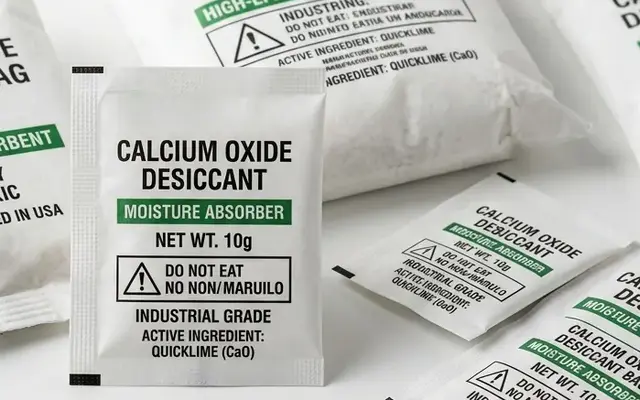
On the desiccant side, what sets CaO apart is that it is irreversible. The reaction CaO + H₂O → Ca(OH)₂ is chemical; theoretical water uptake is 32% of its own weight, and the water taken up is not released again even if temperature rises. Silica gel works by physical adsorption and can give part of its load back when humidity and temperature change; next to a moisture-sensitive active, that release is unacceptable. In container, drum, in-pack and equipment protection this difference is decisive; for uptake capacity and exposure-time data in ready-to-use form see the moisture and gas absorbent page.
Operating ranges
| Parameter | Value | |
|---|---|---|
| CaCO₃ assay — pharmacopoeial grade | 98.5–100.5% | Ph. Eur. monograph, on the dried substance |
| Ca(OH)₂ assay — pharmacopoeial grade | ≥ 92.0% | Ph. Eur. Calcii hydroxidum |
| Loss on drying | ≤ 2.0% | 200 °C, 4 h |
| Chloride / sulfate | ≤ 330 ppm / ≤ 0.25% | Monograph limit tests |
| Iron (Fe) | ≤ 200 ppm | Colour and oxidative degradation risk |
| Elemental impurities — oral PDE | Pb 5 · Cd 5 · As 15 · Hg 30 µg/day | ICH Q3D · Ph. Eur. 5.20 · USP <232>/<233> |
| Microbial load | TAMC ≤ 10³ · TYMC ≤ 10² CFU/g | Ph. Eur. 5.1.4, oral use |
| Neutralisation stoichiometry | 0.76 kg Ca(OH)₂ / kg H₂SO₄ | 0.57 kg as CaO; 1.02 kg for HCl |
| Stoichiometric excess | 5–15% | Per dissolution kinetics and mixing efficiency |
| Reactor temperature / residence time | 40–70 °C / 20–60 min | Exothermic; jacket or external cooling |
| pH end point | 7.5–9.0 | 9.0–10.0 for fluoride precipitation |
| CaO desiccant capacity | 32% w/w theoretical | CaO + H₂O → Ca(OH)₂; 20–25% in practice |
CaCO₃ assay — pharmacopoeial grade
98.5–100.5%
Ph. Eur. monograph, on the dried substance
Ca(OH)₂ assay — pharmacopoeial grade
≥ 92.0%
Ph. Eur. Calcii hydroxidum
Loss on drying
≤ 2.0%
200 °C, 4 h
Chloride / sulfate
≤ 330 ppm / ≤ 0.25%
Monograph limit tests
Iron (Fe)
≤ 200 ppm
Colour and oxidative degradation risk
Elemental impurities — oral PDE
Pb 5 · Cd 5 · As 15 · Hg 30 µg/day
ICH Q3D · Ph. Eur. 5.20 · USP <232>/<233>
Microbial load
TAMC ≤ 10³ · TYMC ≤ 10² CFU/g
Ph. Eur. 5.1.4, oral use
Neutralisation stoichiometry
0.76 kg Ca(OH)₂ / kg H₂SO₄
0.57 kg as CaO; 1.02 kg for HCl
Stoichiometric excess
5–15%
Per dissolution kinetics and mixing efficiency
Reactor temperature / residence time
40–70 °C / 20–60 min
Exothermic; jacket or external cooling
pH end point
7.5–9.0
9.0–10.0 for fluoride precipitation
CaO desiccant capacity
32% w/w theoretical
CaO + H₂O → Ca(OH)₂; 20–25% in practice
Application steps
- 01
Defining the quality class and the regulatory frame
Before a material is selected, what the material legally is has to be defined. The same calcium carbonate may be a plain reagent on one line, a processing aid on the second, a food additive on the third, a pharmaceutical excipient on the fourth and an active substance on the fifth. Each role answers to a different text: a technical specification, food-additive purity criteria, a Ph. Eur. or USP monograph, excipient GMP guidance, or ICH Q7 on the active side.
This is an expensive decision to revisit. Changing the excipient class or the supplier in an authorised product triggers change control, comparative dissolution work and, more often than not, fresh stability data. The class therefore has to be fixed in the first week of formulation design, not at pilot scale; deciding later to move from technical to pharmaceutical grade usually means a new development cycle.
The same step produces the document list to be requested from the supplier: monograph compliance statement, certificate of suitability or master file reference where applicable, TSE/BSE statement, allergen and GMO declarations, elemental impurity data, microbiological monitoring results and the excipient GMP audit record. That list belongs in the contract annex — it is not something you start assembling when the first delivery arrives.
- 02
Mapping the impurity profile of the raw material
Natural carbonate is a mined product; its impurity profile drifts with the quarry face, the seam and the season. An ICP-MS scan of one batch is a photograph, whereas what you need is the film. A dataset of at least 10–20 batches gives a mean and a standard deviation for each element; the specification is then written against the upper tail of the distribution rather than the mean, because the batch that gets rejected is never the average batch.
Which elements to track depends on the finished product. Barium and strontium travel with calcium in carbonate deposits and are not easily separated from it. Iron and manganese impart colour and behave catalytically next to oxidation-sensitive actives, shortening shelf life. Magnesium shifts both the assay value and the rate of dissolution in acid. Lead and cadmium are geological in origin; grinding, washing or calcination do not reduce them meaningfully, so the control point is the choice of quarry.
- 03
Neutralisation: stoichiometry, heat and sludge character
The calculation starts from the acid load. A stream of 500 kg/h of 30% sulfuric acid is 150 kg of pure H₂SO₄; the stoichiometric requirement is 114 kg Ca(OH)₂, or 125 kg with a 10% excess. As a 15% milk of lime that is roughly 830 kg/h of slurry, and storage, agitator, pump and pipe diameter are sized against that flow. Doing the same duty with CaO means 95 kg/h of solids feed, and the slaker is selected accordingly.
Heat management is the second leg of the design. Strong acid–strong base neutralisation is exothermic, and where CaO is used the heat of slaking is added on top. Above 70 °C the crystal habit of gypsum changes, shifting towards fine acicular growth, and filterability drops noticeably. If the jacket or external exchanger is sized on average rather than peak load, temperature excursions at shift start-up are inevitable.
Sludge character is largely set by dosing rate. Fast dosing creates high supersaturation, and the result is a fine, gelatinous crystal population that blinds the filter cloth. Slow dosing combined with partial recycle of seed sludge to the reactor gives coarse, well-draining crystals. Two plants with identical chemistry end up with two different filter cycle times and two different cake moistures on this difference alone.
- 04
Calcium salt synthesis and the crystallisation window
In organic calcium salt synthesis the reaction typically runs at 60–90 °C with a pH end point of 6.5–8.0. The specification is bounded from both sides: residual free acid spoils hygroscopicity and odour, residual free alkali spoils taste and solution clarity. The end point is therefore not a single pH value but a narrow window in which both the free-acid and the free-alkali limits are met.
Fineness and reactivity of the calcium source act directly on that window. Finely ground carbonate or hydroxide shortens reaction time but raises filter load and foaming tendency. Coarse grains that never dissolve give a gritty mouthfeel in the finished product and show up in the acid-insoluble matter test. In practice reaction time and particle fineness are optimised together; improving one alone degrades the other.
At the crystallisation step, cooling rate and nucleation control determine particle size distribution. Drying temperature then determines the water of hydration; drying a pentahydrate salt too hot causes partial dehydration and pushes the assay above specification. Dryer outlet temperature here is not an energy parameter but a quality parameter.
- 05
Drying, milling and functional particle properties
The monograph asks for assay and impurities; the tablet press asks for flow and compressibility. That second group appears nowhere in the monograph: D10/D50/D90, bulk and tapped density, Carr index, Hausner ratio, specific surface area. A powder that meets the monograph but will not flow passes QC and then stalls production; in projects that fail to separate the two, the problem is always found late.
Direct-compression lines call for granulated carbonate, with D50 typically held in the 100–250 µm band and a Carr index kept below 18. On a wet granulation line finely ground carbonate is acceptable, because the granulation step solves the flow problem. The wrong choice comes back as tablet weight variation, capping and hardness scatter.
With derivative salts, fineness turns one compound into two different products for two different industries. In calcium stearate, particle fineness governs both tablet lubricant performance and the acid-scavenging and lubricating behaviour on a plastics recycling line; chemically the same substance is sold at different fineness and different bulk density for the two applications.
- 06
Elemental impurity risk assessment
The ICH Q3D calculation is done component by component, not raw material by raw material. The elemental contribution of each component at the daily dose is computed in micrograms per day, all components — and where relevant contributions from equipment and packaging — are summed, and the result is compared with the PDE. The ppm value of a single raw material is only one term in that sum.
For high-dose products the picture changes: in a 1250 mg calcium carbonate tablet the carbonate fills almost the entire elemental impurity budget on its own. There the raw material specification is written far tighter than the monograph limit and that limit is written into the supply contract. In the opposite case, a product using 20–50 mg of filler per day is comfortably covered by the monograph limit, and full screening of every batch is unnecessary cost.
The control strategy follows from the same arithmetic. Where the risk assessment shows a wide safety margin, periodic verification (say every tenth batch) plus supplier data is enough; where the margin is narrow, batch-by-batch measurement becomes mandatory. That decision is documented, because what an auditor asks about is not the result itself but why the result is trusted.
- 07
Moisture control, packaging and storage
Calcium hydroxide slowly carbonates with atmospheric CO₂, and calcium oxide takes up both moisture and CO₂. Storage practice is therefore directly a question of protecting the assay value: a big bag left open or a silo whose lid does not seal produces a measurable loss of active content within weeks. In pharmaceutical grade that loss is not merely a yield issue, it is a non-conformity.
For desiccant duty the calculation rests on four variables: the volume to be protected, the target relative humidity, the water vapour transmission rate of the packaging and the exposure time. The theoretical 32% capacity of CaO is used at around 20–25% in practice; the remainder becomes inaccessible as the reaction product seals the grain surface. The safety margin is set against the uncertainty of transit time, not against that gap.
- 08
Documentation, traceability and change control
In the pharmaceutical and food chain, the validity of a batch rests not on the analytical result but on the traceability of that result. The certificate of analysis must link through the batch number to the production record, the production record to the raw material lot, and the raw material lot to the quarry and shipment records. Retention samples and batch records are kept for a period that outlasts the product's shelf life.
Change control is the link most often overlooked. A change of quarry face, grinding line, screen configuration or packaging material may be invisible on the certificate of analysis and highly visible in the finished product. The obligation to notify such changes in advance belongs in the contract. Specification alignment work, sampling and batch-level data sharing can be run as a project through the contact page.
Products used in this field
Frequently asked questions
What is the real difference between technical and pharmacopoeial grade calcium carbonate?
The difference is not in the assay but in the impurity tail and how stable that tail is. Technical grade assays around 98%, pharmacopoeial grade 98.5–100.5%; the real distinction lies in iron, barium, strontium, lead and cadmium levels, microbial load and how much these move batch to batch. Traceability, retention samples and an auditable production record come on top.
Is the classical heavy-metals test still enough now that ICH Q3D is in force?
No. The classical sulfide-precipitation test was not element-specific and could not discriminate at low ppm level. What is expected today is element-specific ICP-MS measurement plus a risk assessment built on permitted daily exposure (PDE). A certificate carrying only a generic heavy-metals statement is no longer accepted in the pharmaceutical chain.
Should I neutralise acid with lime or with caustic soda?
Lime moves the resulting salt into the solid phase and therefore lowers the salt load at discharge — gypsum with sulfuric acid, CaF₂ with fluoride — cutting conductivity noticeably. Caustic soda leaves a soluble salt and changes the salt load not at all, but produces no sludge and needs simpler dosing equipment. If your discharge consent covers conductivity or sulfate, choose lime; if sludge disposal is your bottleneck, caustic is the better fit.
Carbonate or hydroxide for calcium salt synthesis?
The carbonate route is self-limiting: the reaction advances with CO₂ evolution, the end of bubbling signals that the acid is spent, and there is practically no risk of going alkaline. The hydroxide route is faster and gas-free, but pH overshoots easily. Choose carbonate where the product is sensitive to residual free alkali, hydroxide where cycle time is the binding constraint.
Why does gypsum sludge sometimes refuse to filter after neutralisation?
Because crystal size depends on dosing rate and temperature, not on the chemistry. Fast dosing creates high supersaturation and yields fine, gelatinous crystals that blind the filter cloth; letting the reactor exceed 70 °C does the same thing. Slowing the dose and recycling part of the seed sludge to the reactor recovers the filter cycle in most cases.
Is monograph compliance enough for tablet manufacture?
Necessary but not sufficient. The monograph covers assay, impurities and identity; the tablet press cares about flow and compressibility. Particle size distribution, bulk and tapped density, Carr index and surface area are absent from the monograph yet decisive in production. These functional parameters must be written into the supply agreement separately.
Why are iron and barium limited separately in calcium carbonate?
Iron imparts colour in light-coloured formulations and behaves catalytically next to oxidation-sensitive actives, shortening shelf life. Barium travels with calcium in carbonate deposits, is not easily separated chemically, and is tied to a dedicated limit test in the monographs for toxicological reasons. Neither of them shows up in the assay figure at all.
When does it make sense to use quicklime as a desiccant?
When the captured moisture must not be released back under any condition. The CaO + H₂O reaction is chemical and irreversible; silica gel gives part of its load back when temperature and relative humidity change. CaO is preferred for long sea freight, in-container protection and packaging of moisture-sensitive actives; its theoretical 32% capacity is used at around 20–25% in practice.
How far can lime take fluoride down in an acidic waste stream?
With lime alone the practical floor is around 10–20 mg/L, set by the solubility of CaF₂. Going lower requires combined calcium–aluminium precipitation or two-stage pH control. On such a stream the pH end point is held at 9.0–10.0 rather than the 7.5–9.0 used for plain neutralisation.
Is a single certificate of analysis enough to qualify a supplier?
It is not; one certificate is a photograph, whereas what you need is the variation itself. Mean and standard deviation should be derived from at least 10–20 batches, and the specification written against the upper tail of the distribution. The obligation to notify changes — quarry face, grinding line, screen configuration, packaging — should also be added to the contract.
Sample and dose recommendation for this process
Describe your current usage and target; our technical team will come back with a suitable specification and a starting dose.