
Applications
Livestock & Disinfection
Moisture and ammonia control in barn and poultry bedding, pathogen suppression through high pH, and safe application.
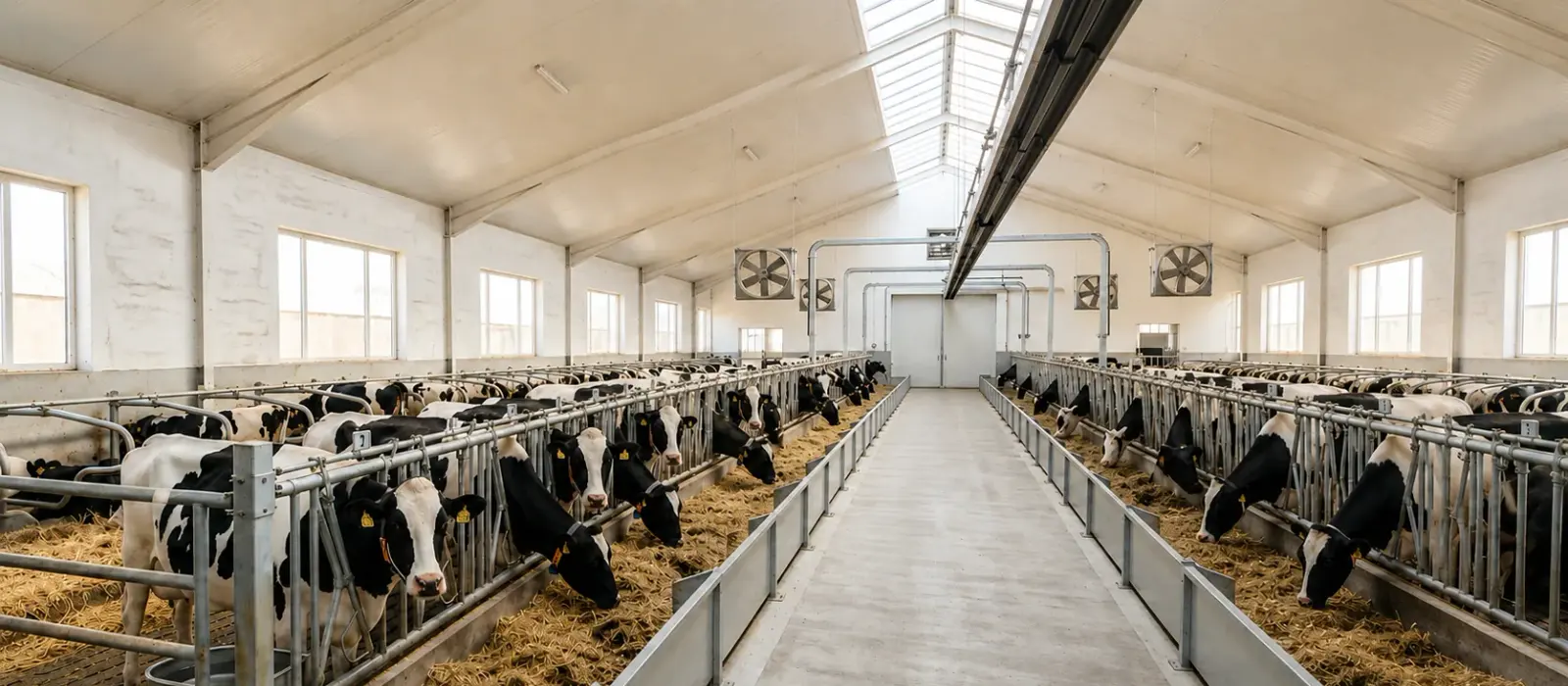
Overview
The ammonia measured inside a barn or a poultry house is really the last output of a water problem. Urea excreted in urine does not turn into ammonia by itself; the conversion is done by urease, an enzyme produced by ureolytic bacteria in the manure, and that enzyme only works when it finds enough water activity. Below 20% litter moisture urea hydrolysis all but stops; above 35% the enzyme accelerates while footpad dermatitis, breast lesions and the survival time of coccidial oocysts rise together. Looking for where the water comes from is therefore a more productive starting point than looking for where the smell comes from.
Lime enters this chain at three separate points, and the three are not covered by one product. Quicklime (CaO) binds water chemically and evaporates part of it with the heat of hydration; hydrated lime (Ca(OH)₂) takes the saturated surface solution to pH 12.4 and collapses both vegetative pathogens and the urease-producing flora; ground carbonate conditions the litter physically while keeping pH below the critical threshold. What goes wrong in the field is usually not the choice of product but the use of the right product in the wrong window.
The most widespread belief is that lime “binds” ammonia. It does not; by raising pH it converts the ammonium ion dissolved in the litter into volatile ammonia and pushes ambient concentration up in the first hours. The gain from lime shows not in those hours but in the weeks that follow, once urease activity has been cut at its source. This page sets out which product goes where, at what dose and contact time, which measurement misleads and when, and the general logic of moisture management in an enclosed volume — alongside the same logic on the industrial moisture and humidity control side.
The ammonia paradox: why raising pH makes the smell worse first
Urea hydrolysis is the reaction CO(NH₂)₂ + H₂O → 2NH₃ + CO₂, and because it is enzymatic its rate is set by three variables: water activity, temperature and the size of the microbial population producing the enzyme. Between 25 and 35 °C and above 35% litter moisture, much of the urea in fresh urine is hydrolysed within hours. Bring the same litter down to 20% moisture and the rate falls by a large multiple. The first intervention in ammonia control is therefore physical, not chemical: until drinker leakage, ventilation rate, dew point and litter depth are corrected, no dose produces a lasting result.
The second variable is pH. Nitrogen in litter sits on the equilibrium NH₄⁺ ⇌ NH₃ + H⁺, whose pKa is 9.25 at 25 °C. At pH 7 only about six parts per thousand of that nitrogen is free volatile ammonia; at pH 9.25 half of it, at pH 11 roughly 98%, at pH 12 almost all. Spreading hydrated lime on the surface pushes the equilibrium right in one step and releases the ammonium pool accumulated up to that moment within a few hours. The ppm spike measured after application is not a failure but an expected transition — it does mean the animals should not be in the building while it happens.
The measurement itself can also mislead. Litter moisture cannot be represented by a single sample: a zone above 50% under the drinker line and an 18% zone behind the feeder sit side by side in the same house, and their average describes neither. The caked layer usually looks dry while the layer beneath it is saturated. A reliable reading comes from zone samples dried at 105 °C for 24 hours and weighed; handheld capacitive probes drift by several points with cake density. Height matters in ammonia too: a reading taken at animal head height, 20–30 cm off the litter, can differ by a factor of two from one taken at 1.5 m in the passage.
The fourth and most frequently skipped point is that “disinfection” does not describe a single target. Two hours of contact at pH 12 gives a 4–5 log reduction in vegetative bacteria such as Salmonella, E. coli and Campylobacter; Clostridium spores, Cryptosporidium parvum oocysts and Mycobacterium avium subsp. paratuberculosis largely survive the same conditions. Against oocysts, the heat released by quicklime is more decisive than pH. On top of that, organic matter consumes alkali: lime applied over a floor still carrying manure and litter residue cannot hold the target pH for more than a few minutes. A dose calculated without pre-cleaning is correct on paper and void in the house.
Which product, where, in which window
The most productive window in the biosecurity calendar is the empty period after the flock leaves and the litter is removed. Onto a floor still damp from mechanical cleaning and washing, hydrated lime classified CL 90-S to EN 459-1, with Ca(OH)₂ above 90% and finely ground, is spread at 300–600 g/m² or sprayed as a 15–20% milk of lime. A saturated calcium hydroxide solution reads pH 12.4 at 25 °C, enough to denature vegetative cell membranes and enzyme proteins. Hydrated lime is preferred in this window for a simple reason: it is already hydrated and produces no sudden heat or steam on contact with a wet floor.
Quicklime is reserved for heavier work: manure pit and lagoon stabilisation, burial after culling, treatment aimed at Cryptosporidium, and drying out saturated patches in an empty building. The stoichiometry is plain — 56 g of CaO binds 18 g of water, so 1 kg of CaO chemically holds about 0.32 kg. The practical effect is larger: hydration releases roughly 1140 kJ per kilogram, and with a latent heat of vaporisation of 2260 kJ/kg that energy can evaporate a further 0.4 kg or so. Total effect is of the order of 0.6–0.7 kg of water per kg of CaO. The same heat, for the same reason, produces serious burns on contact with wet skin; CaO is never used with animals present.
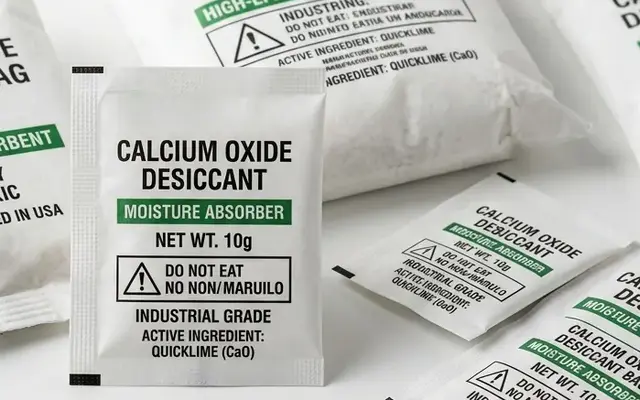
With the flock inside, no product that takes pH above 9.25 is the right choice. The material for this window is ground calcium carbonate: its low solubility keeps litter pH from rising past the 8.3–9.0 band, leaves the ammonium equilibrium below the pKa, and takes up moisture not chemically but by capillary retention across its surface area. It also improves slip resistance on the floor. Part of what is sold as “bedding lime” is in fact carbonate; what to read on the label is not the trade name but the Ca(OH)₂ and CaCO₃ percentages. In small enclosed volumes — feed stores, hatchery equipment cabinets, medicine cupboards — a sachet of moisture and gas absorbent is a cleaner answer than spreading anything.
In manure stabilisation the aim is to take pH above 12 and hold it there for at least two hours — the same logic accepted for alkaline treatment of animal by-products. In slurry the CaO dose is typically 5–15% of dry solids, moving to the upper end for highly buffered liquids rich in volatile fatty acids. A deliberate trade-off is made here: high pH strips ammonia and lowers the nitrogen value of the manure, but it holds sulphide species in solution as HS⁻ (pKa₁ ≈ 7.0 for H₂S) and markedly reduces the H₂S release that can be lethal during agitation. The stripped ammonia need not be lost; in a covered store it can be captured in an acid scrubber and recovered as ammonium sulphate.
Stabilised manure and limed litter end up on the field, and they carry there not only nitrogen and phosphorus but a substantial neutralising value. If that contribution is not counted into the lime requirement calculation on the agriculture and soil improvement side, a few seasons later you meet unwanted over-liming and the zinc–manganese availability problem that follows it. Lagoon supernatant, wash water and parlour effluent are a separate line; the suspended solids, phosphorus and pathogen load of those streams are handled with water and wastewater treatment logic.
Operating ranges
| Parameter | Value | |
|---|---|---|
| Target litter moisture | 20–30% | Broilers; >35% raises pododermatitis risk |
| In-house NH₃ | ≤ 20 ppm | At animal head height, 20–30 cm |
| NH₄⁺ ⇌ NH₃ pKa | 9.25 (25 °C) | At pH 11 about 98% is free NH₃ |
| Target pH — pathogen kill | ≥ 12.0 | Vegetative bacteria, ≥ 2 h contact |
| Contact time — oocysts and spores | 24–72 h | Combined with CaO heat |
| Floor disinfection dose | 300–600 g/m² | Ca(OH)₂, EN 459-1 CL 90-S |
| Litter top-dressing dose | 50–200 g/m² | CaCO₃, with animals present |
| Limewash concentration | 15–20% | Ca(OH)₂ by mass, two thin coats |
| Saturated Ca(OH)₂ solution pH | 12.4 (25 °C) | Solubility ~1.7 g/L |
| CaO water binding capacity | 0.32 kg H₂O/kg | Stoichiometric; 0.6–0.7 with heat |
| Heat of hydration | ~1140 kJ/kg CaO | Surface reaches 60–90 °C |
| Manure stabilisation CaO dose | 5–15% of dry solids | Upper end for high buffering |
Target litter moisture
20–30%
Broilers; >35% raises pododermatitis risk
In-house NH₃
≤ 20 ppm
At animal head height, 20–30 cm
NH₄⁺ ⇌ NH₃ pKa
9.25 (25 °C)
At pH 11 about 98% is free NH₃
Target pH — pathogen kill
≥ 12.0
Vegetative bacteria, ≥ 2 h contact
Contact time — oocysts and spores
24–72 h
Combined with CaO heat
Floor disinfection dose
300–600 g/m²
Ca(OH)₂, EN 459-1 CL 90-S
Litter top-dressing dose
50–200 g/m²
CaCO₃, with animals present
Limewash concentration
15–20%
Ca(OH)₂ by mass, two thin coats
Saturated Ca(OH)₂ solution pH
12.4 (25 °C)
Solubility ~1.7 g/L
CaO water binding capacity
0.32 kg H₂O/kg
Stoichiometric; 0.6–0.7 with heat
Heat of hydration
~1140 kJ/kg CaO
Surface reaches 60–90 °C
Manure stabilisation CaO dose
5–15% of dry solids
Upper end for high buffering
Application steps
- 01
Split the biosecurity calendar into windows
Liming is not a job done whenever someone remembers it. The production cycle divides into three windows: flock present; between emptying and washing (wet, no animals); and between drying and restocking (dry, no animals). The usable product, the dose and the pH target differ in each, and they are not interchangeable.
Writing the windows down removes the most common field error by itself — spreading a high-pH product while the flock is inside. For each window the calendar should carry a target pH, a contact time, a post-application ventilation period and the earliest hour at which animals may return.
- 02
Remove the organic load — alkali only works on a clean surface
Dry cleaning comes first: scrape the caked layer, break it up, sweep it out. Then pressure-wash with a detergent. Organic matter consumes alkali; a few per cent of residual manure neutralises a large share of the hydroxide applied and surface pH falls back below 12 within minutes.
There is no need to wait for the surface to dry completely. A slightly damp floor is an advantage for hydrated lime, because dissolution — and therefore pH — needs water. Standing puddles are a different matter: they dilute the dose and should be squeegeed out.
Ventilation ducts, feeders, drinker lines and the litter margins along the walls are handled separately. Skipped in the cleaning programme, these become the first contamination source for the next flock no matter what was done to the floor.
- 03
Choose product and fineness by window
For the empty, damp window the choice is hydrated lime classified CL 90-S to EN 459-1, with Ca(OH)₂ above 90% and at least 90% passing 90 µm. Fineness sets specific surface, specific surface sets dissolution rate, and dissolution rate decides how quickly pH 12 is actually established on the surface. Coarsely ground material delivers a lower effective pH for the same mass.
Heavy wet spots, manure stabilisation and burial work call for quicklime, crushed 0–3 mm or ground. With the flock inside, the material is ground calcium carbonate at 0–1 mm.
Read three things on the certificate: active content (available CaO or Ca(OH)₂), fineness, and degree of carbonation. Lime left in an open bag has partly reverted to CaCO₃ and will not reach the pH its label promises. Where a product is presented as a veterinary-area disinfectant, bactericidal efficacy is judged by suspension test methods such as EN 1656, not by the calcium figure alone.
- 04
Calculate the dose over area, verify it with pH
The arithmetic is simple: area × dose. A 1,200 m² house at 450 g/m² takes 540 kg of hydrated lime. The arithmetic is not the check, though. Fifteen to thirty minutes after application, place a drop of distilled water on the surface at several points and read the pH with a strip or a flat-probe meter. Below 12 means either residual organic load or an under-dose.
Distribution uniformity matters more than total mass. Lime thrown by shovel heaps in the middle and leaves the perimeter bare; a spreader or a sieve bucket covers far more effective area with the same kilograms.
Spraying as a 15–20% milk of lime gives the most even coverage and suppresses dust. In exchange it needs continuous agitation in the tank and a wide-angle nozzle; a settled slurry blocks the line and delivers water to the floor instead of lime.
- 05
Close the walls and ceiling with limewash
Limewash is a 15–20% Ca(OH)₂ suspension, with 2–3% salt or a casein binder where adhesion is poor. Two thin coats, the second applied only after the first has set. A single thick coat cracks, flakes and lasts less than half as long.
The effect runs two ways. The alkaline film is bacteriostatic and, as carbonation proceeds, it closes the surface pores where organic matter would otherwise lodge. A high-reflectance white surface also raises interior illuminance, so the same lux level is reached with less lighting energy.
Carbonation is also what limits the life of the coat: Ca(OH)₂ + CO₂ → CaCO₃ + H₂O. As the surface carbonates, pH falls from 12.4 towards 8.3, the disinfectant effect ends and only a physical coating remains. Renew each production cycle, or at minimum twice a year.
- 06
Set dry lime beds at transition points
At doorways, pen transitions and the parlour entrance, a dry hydrated lime bed 2 m long and 8–10 cm deep dries the organic matter on boot soles and hooves and holds it against a high-pH surface. It is a barrier of exposure, not a dip.
Its limits should be stated plainly. Once the bed wets through and fills with manure it loses effectiveness quickly; daily renewal is part of the specification, not an option. As a permanently wet footbath solution, lime is not a direct substitute for copper sulphate or formaldehyde products, and for targets such as digital dermatitis it is not considered sufficient on its own.
Prolonged skin contact with dry lime is irritant. Where animals stand in it repeatedly, keep the bed short and the passage brisk, and watch for interdigital irritation.
- 07
Stabilise manure and spent litter
For solid manure the CaO dose is typically 5–15% of dry solids. Homogeneous mixing is the whole job: lime left in local pockets gives a pH reading that flatters the heap while most of the mass sits untreated. After mixing, the target is pH above 12 held for at least two hours.
In slurry, dose as milk of lime with continuous agitation and follow pH with an immersed probe. Ammonia release rises sharply during mixing; in a covered pit that means forced ventilation and a personal gas monitor, without exception.
Storage time and field rate for the stabilised product are planned with its neutralising value counted in. The lime that entered the heap does not disappear; it arrives in the field as agricultural lime.
- 08
Measure, protect, and write down the return hour
Four quantities are worth tracking: litter moisture by zone and gravimetrically, ambient NH₃ at animal height, surface pH immediately after application and again at 24 hours, and airborne dust during application. A ppm reading on its own, especially on the day after treatment, proves nothing.
Both CaO and Ca(OH)₂ dust are irritant to caustic for eyes and airways. Use close-fitting goggles, an FFP2 or FFP3 mask, long sleeves and gloves; contact with sweating skin produces burns that develop slowly and are easily missed. No animal is present during application.
The hour at which animals may return is set by dust settling and by the ammonia peak passing — typically 12 to 24 hours of forced ventilation after a dry spread. Put that hour in the calendar rather than leaving it to judgement. If you want it calculated against your own ventilation capacity, get in touch.
Products used in this field
Frequently asked questions
Does lime really reduce the ammonia smell in a barn?
Not directly and not immediately; by raising pH it increases ambient ammonia in the first hours. The gain appears over the following days, as the urease enzyme driving urea hydrolysis and the flora producing it are inactivated at high pH. If you want to bind ammonia chemically, the product you need is acidic, not alkaline; lime's job is to cut the source and take out the moisture.
Can I spread quicklime with the animals inside?
No. On contact with a wet surface CaO releases about 1140 kJ per kilogram; that heat produces chemical burns on wet skin, teat ends and footpads, and the dust irritates the airways. Quicklime is used only in an empty building, in the manure pit and in burial work. The material that can be used with the flock present is ground calcium carbonate.
Hydrated lime or carbonate for bedding?
With the flock inside, carbonate. Hydrated lime takes litter pH to 12 and releases the ammonium pool in one go; in a closed house that is a serious respiratory exposure. Carbonate takes up moisture without pushing pH past the 8.3–9.0 band, and it improves slip resistance. The place for hydrated lime is the floor after clear-out.
How long do I have to hold pH 12?
For vegetative bacteria such as Salmonella, E. coli and Campylobacter, two hours of contact at pH ≥ 12 is generally accepted as enough for a 4–5 log reduction. For Clostridium spores, Cryptosporidium oocysts and the paratuberculosis agent it is not; those need 24–72 hours and preferably the exothermic heat of quicklime. The clock starts not when the dose is spread but when pH 12 is actually measured at the surface.
Does a dry lime footbath replace formalin or copper sulphate?
For general biosecurity — drying the organic load on the sole and exposing it to high pH — it works. For specific targets such as digital dermatitis it is not accepted as an equivalent on its own. A dry lime bed also loses effectiveness quickly once it wets through and fills with manure; without daily renewal it is not a disinfection barrier but simply a floor covering.
Is lime effective against Cryptosporidium and Clostridium spores?
Not by pH alone. Oocysts and spores are markedly alkali-resistant and can survive a long time at pH 12.4. The route that works is quicklime raising surface temperature to 60–90 °C through its heat of hydration, combined with high pH and held for more than 24 hours. That is how product choice is decided in calf pens and in manure stabilisation.
Will liming my manure lower its nitrogen value?
Yes, it will. At pH 12 most of the ammonium nitrogen turns into volatile ammonia and is stripped off; phosphorus and potassium remain. That loss is a plannable cost — in a covered store it can be captured in an acid scrubber and recovered as ammonium sulphate. In return, the same high pH keeps sulphide in solution as HS⁻ and cuts the H₂S risk during agitation.
How often should limewash be renewed?
Every production cycle, and at minimum twice a year. Ca(OH)₂ carbonates with atmospheric CO₂ and reverts to CaCO₃; once surface pH has fallen from 12.4 to 8.3 the disinfectant effect is over and only a physical coating remains. Two thin coats at 15–20% last markedly longer than one thick coat.
How do I work out the dose per m²?
For disinfection of a cleaned floor, 300–600 g/m² of Ca(OH)₂ is the typical range, moving to the upper end on porous concrete and compacted earth floors. Do not leave the calculation on paper: 15–30 minutes after application, drop distilled water on the surface at several points and read the pH. Below 12 means either residual organic load or uneven distribution.
Can limed litter and manure go straight to the field?
They can, but the lime they carry has to be counted into the field's lime requirement. The CaO that went into the heap does not disappear; it works in the soil as neutralising value. Applying it for years without counting it pushes pH above 7 and reduces the availability of zinc, manganese and iron. Assess it together with a buffer pH test in your soil analysis.
Sample and dose recommendation for this process
Describe your current usage and target; our technical team will come back with a suitable specification and a starting dose.