
Products
Quicklime
High-reactivity calcium oxide used as a process reagent in slag formation, desulphurisation and soil stabilisation.
CaO
Overview
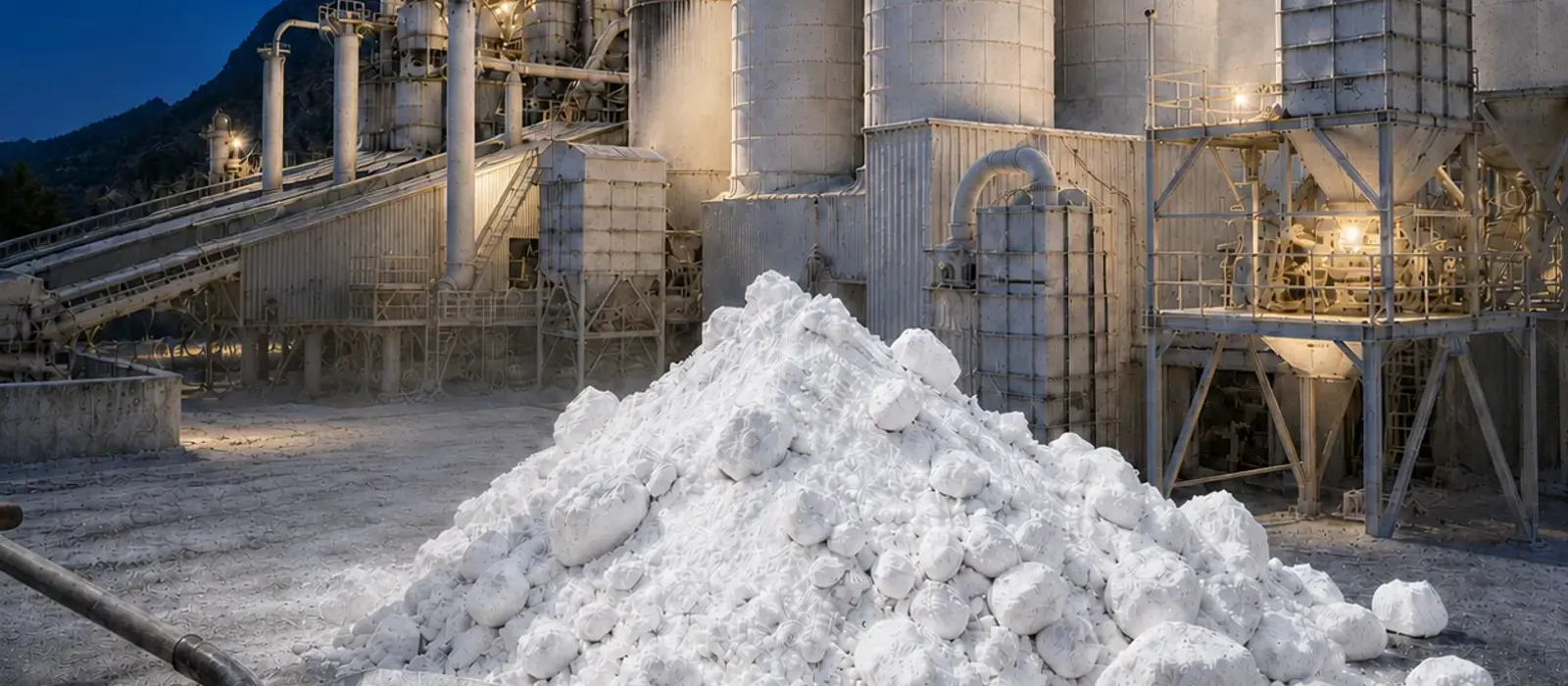
Quicklime is calcium oxide (CaO) produced by calcining high-purity calcium carbonate between 900 and 1250 °C. The reaction CaCO₃ → CaO + CO₂ advances from the outside of the grain inwards; what comes out of the kiln is defined by how far that front travelled and how long the grain stayed at temperature.
No single purity figure tells you how it will behave in a process. Reactivity, available CaO and particle size distribution have to be read together; if one of the three does not match the contact time of your process, the other two will not compensate. Two batches carrying the same certificate can perform differently in two different slakers.
This page treats CaO as an operating variable rather than a specification list: which property drives which result, what the dose is calculated against, which size fraction belongs in which piece of equipment. For the slaked, directly dosable form see hydrated lime.
Technical specifications
| Parameter | Value | |
|---|---|---|
| Available CaO | ≥ 92% | EN 459-2, sucrose titration |
| Total CaO | 93–96% | XRF |
| MgO | ≤ 1.5% | Calcitic lime |
| SiO₂ + Al₂O₃ + Fe₂O₃ | ≤ 2.0% | Total impurities |
| Loss on ignition (LOI) | ≤ 3.0% | Indicator of residual CO₂ |
| Reactivity t60 | 1–4 min | EN 459-2 wet slaking test |
| Total temperature rise | ≥ 45 K | Plateau of the slaking curve |
| Size — lump | 10–40 / 40–90 mm | Furnace charge, batch slaking |
| Size — crushed | 0–3 / 3–15 mm | Continuous slaker feed |
| Size — ground | ≥ 90% < 90 µm | Dry injection, soil spreading |
| Bulk density | 0.9–1.1 t/m³ | Lump; ground 0.7–0.9 |
| Designation | CL 90-Q | EN 459-1 building lime |
Available CaO
≥ 92%
EN 459-2, sucrose titration
Total CaO
93–96%
XRF
MgO
≤ 1.5%
Calcitic lime
SiO₂ + Al₂O₃ + Fe₂O₃
≤ 2.0%
Total impurities
Loss on ignition (LOI)
≤ 3.0%
Indicator of residual CO₂
Reactivity t60
1–4 min
EN 459-2 wet slaking test
Total temperature rise
≥ 45 K
Plateau of the slaking curve
Size — lump
10–40 / 40–90 mm
Furnace charge, batch slaking
Size — crushed
0–3 / 3–15 mm
Continuous slaker feed
Size — ground
≥ 90% < 90 µm
Dry injection, soil spreading
Bulk density
0.9–1.1 t/m³
Lump; ground 0.7–0.9
Designation
CL 90-Q
EN 459-1 building lime
Highlights
Available CaO ≥ 92% and t60 of 1–4 min: the two numbers your dose calculation rests on do not drift batch to batch.
Four size fractions — 0–3, 3–15, 10–40, 40–90 mm and ground powder — chosen against the equipment, with the band narrowed on request.
Every shipment reported to EN 459-2: available CaO, reactivity (t60 and Δt) and particle size distribution.
Loss on ignition ≤ 3%: fewer raw cores, less residual CO₂, less grit and residue in the slaker.
PE-lined big bags and closed bulk tankers as a moisture barrier — available CaO decays more slowly in store.
Selection starts from the process, not the certificate: slaking test, jar test and Eades–Grim pH test for confirmation.
Use
Why reactivity alone is not enough
In the EN 459-2 wet slaking test, 150 g of lime is stirred into 600 mL of water at 20 °C and the time taken to reach 60 °C is recorded; that time is t60. One to two minutes indicates a soft-burnt, highly reactive product; above six minutes points to a hard-burnt, slow one. The test is simple, but the result is sensitive to the size fraction tested — if the fraction is not stated, the number cannot be compared.
Which reactivity is right is decided by the process. Hot metal desulphurisation gives the injected lime an 8–15 minute window in which it must dissolve; a continuous slaker making milk of lime works with 10–20 minutes of residence. A calcium carbide furnace or a batch slaker, by contrast, does not want an over-reactive product: it produces sudden boiling, spitting and a vapour load the equipment was never sized for.
The common mistake is to specify t60 on its own. The same t60 can come with a very different total temperature rise: a product low in available CaO starts fast and stops early, its curve flattening before 45 K. A reactivity assessment means reading t60 and Δt together; demanding only one of the two lets the wrong batch look contractually compliant.
How calcination temperature sets the character of the product
Calcite decomposition reaches equilibrium around 898 °C at one atmosphere; in practice kilns run at 950–1150 °C. If the temperature is low or residence too short, undecomposed CaCO₃ remains in the core of the grain — a raw core. It raises loss on ignition and lowers available CaO: dead weight that is transported, ground and invoiced without contributing anything to the process.
At the other extreme is overburning. A grain held too long at high temperature grows its CaO crystals, closes its pore structure and drops from 1–3 m²/g of specific surface to below 0.5 m²/g. Hard-burnt lime reacts slowly with water and ends up as residue in the slaker. Impurities accelerate the process: SiO₂ and Al₂O₃ in the natural calcium carbonate feed start sintering at lower temperatures and cut reactivity to a degree chemical analysis will not reveal.
Raw cores and overburnt grains can coexist in the same batch; with a wide band such as 0–90 mm passing the same time in the same kiln, that is unavoidable. The practical consequence is simple: narrowing the size band narrows the reactivity band. Asking for 10–40 mm in a specification is not only about handling — it is a demand for consistency within the batch.
What the gap between available and total CaO costs you
Total CaO is the elemental calcium content measured by XRF, and it counts calcium locked in carbonate or sulphate just the same. Available CaO is determined by sucrose extraction and titration and gives the fraction that can actually hydrate and react. The gap between the two is, quite literally, raw cores, carbonated surface and hard-burnt grains.
Dosing must always be calculated on available CaO. A product with 96% total CaO but 88% available CaO is consumed roughly 4.5% faster than one at 92% available to do the same work. If the price per tonne is equal, the real cost is not: the unit of comparison between suppliers is not the tonne but the tonne of available CaO. In most plants this single correction shows up as a visible line in the annual reagent budget.
Stoichiometry starts from the same number: 56 g/mol of CaO becomes 74 g/mol of Ca(OH)₂, so 1 kg of available CaO is equivalent to 1.32 kg of hydrated lime and neutralises 2 moles of H⁺. Leave headroom for storage losses: a surface that hydrates and then carbonates in the silo loses available CaO over months, so a 3–5% safety margin is normal working practice.
Which particle size fits which equipment
Lump lime (10–40 and 40–90 mm) is charged directly into electric arc furnaces and converters, fed to batch slakers, and creates the least dust in bulk handling. Crushed 0–3 mm is the standard feed for continuous slakers and milk of lime lines. Ground powder (≥ 90% below 90 µm) belongs to dry sorbent injection, soil spreading and dry mortar blends.
The wrong fraction penalises you in two different ways. Material that is too fine heats very quickly in the slaker, agglomerates, and hydrates on the outer surface before water reaches the core — this is what is called burning during slaking, and it yields a coarse, low-surface hydrate. Material that is too coarse never slakes to the centre; grit and residue rise, and screened-out material that still carries available CaO goes to waste.
Fraction also decides silo and conveying design. Ground lime does not flow freely and bridges in the cone; fluidising air, a vibrating discharger and the right cone angle have to be in the design. Lump lime flows easily but slakes if it takes up moisture, expands to roughly twice its volume and forms a hard crust welded to the silo wall. In both cases keeping the silo vent filter dry is the cheapest precaution the plant can take.
Slaking is first a heat management problem
The reaction CaO + H₂O → Ca(OH)₂ releases about 65 kJ/mol, that is 1150 kJ per kg of CaO. Slaking one tonne of lime liberates 1.15 GJ — enough to take roughly 3.4 m³ of water from 20 °C to boiling. The real job of a slaker design is not to start the reaction but to remove that heat in a controlled way.
For milk of lime the water-to-lime ratio is typically 3.5–5:1; for dry hydrate 0.4–0.6:1, with a target slaking temperature of 80–95 °C. Below that ratio you get local boiling, steam release and coarse crystalline hydrate. Slaking too cold (under 40 °C) produces coarse, low-surface Ca(OH)₂ that settles fast and dulls the dosing curve — more product for the same pH. Slaking temperature is therefore a measured and logged parameter, not an observational detail.
Every slaking leaves an unreacted residue — grit — typically 2–5% with a good lime, separated by hydrocyclone or screening. If the grit figure jumps, check slaking water temperature and feed rate before blaming the lime. Milk of lime made on site does the same job in water and wastewater treatment lines as a purchased hydrate slurry; the difference is that its fineness depends on your slaking conditions — the variable stays on your side of the fence.
What limits desulphurisation through the slag
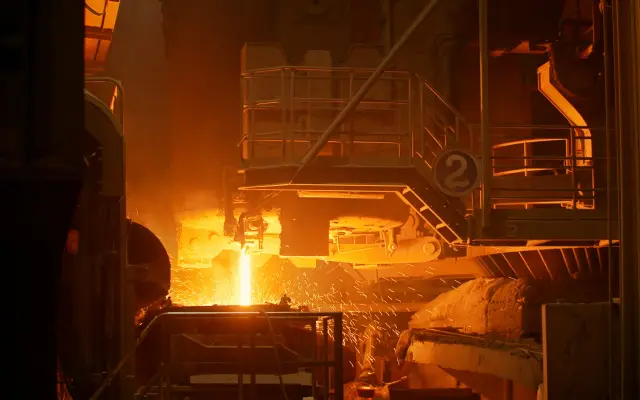
In iron, steel and metallurgy lime is the slag former: it takes slag basicity (CaO/SiO₂) into the typical 2.8–4.0 band and binds sulphur and phosphorus out of the metal. But the sulphur distribution ratio depends not only on basicity — oxygen activity in the slag and temperature matter as much. In an oxidising slag, adding more lime past a point no longer lowers sulphur; it only grows slag volume and metal loss.
Reactivity and size act here through dissolution rate. Hard-burnt lime dissolves late in the converter, slag forms late, and slopping and refractory wear increase early in the blow. In hot metal desulphurisation the injected fine lime (0–1 mm) is used blended with magnesium or calcium carbide, and contact time is measured in minutes; in that process reactivity is efficiency, and efficiency is lime consumption.
The impurity line is often more decisive than price. Every extra point of SiO₂ inside the lime demands extra lime to hold the basicity target — one percentage point translates into several kilograms more lime, and the slag that goes with it, per tonne of steel. Low impurity also means less slag, less heat loss and less entrained metal; this is where lime selection enters the cost per heat.
Two separate jobs in soil: drying and stabilising
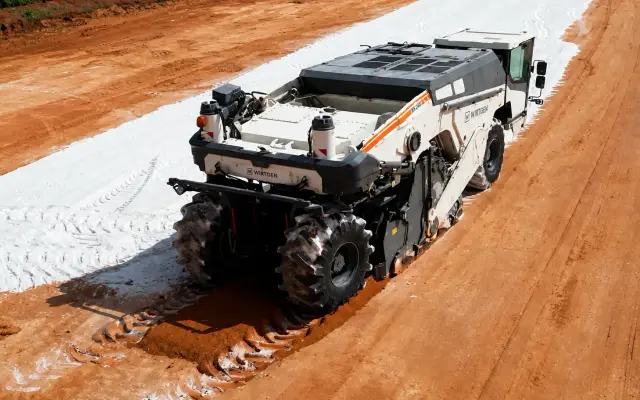
In soil improvement and stabilisation CaO first works as a drying agent. It binds water chemically in hydration, the released heat accelerates evaporation, and the workability of a clay soil changes within hours. In practice 1% CaO lowers moisture content by roughly 0.5–1.5 points; after rain, this first effect is often what saves the site programme.
The second job is slower and delivers the actual strength. Once pore-water pH reaches 12.4, silica and alumina dissolve out of the clay minerals and combine with calcium into calcium silicate and aluminate hydrates. This pozzolanic gain plays out over days and weeks; performance is judged on 7- and 28-day unconfined compressive strength or CBR, and a measurement taken right after mixing is misleading. Dosing starts with the Eades–Grim method (ASTM D6276) and typically lands in the 2–5% range.
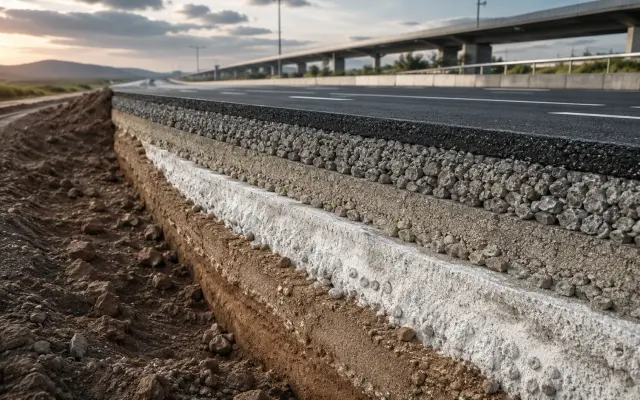
In road infrastructure and asphalt work three site variables decide the outcome: mixing fineness, curing time and the compaction window. On lime-treated soil compaction should normally be finished within 2–4 hours of mixing; delay costs compacted density. And where sulphate content exceeds 0.3%, no lime decision should be taken without laboratory confirmation, because of ettringite formation and the heave that follows it.
Flue gas: dry injection or semi-dry
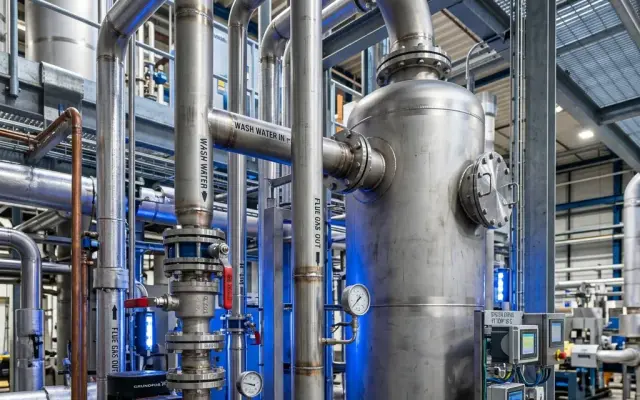
In flue gas treatment quicklime rarely meets the acid gases directly. Two routes dominate: CaO is fed to an on-site hydrator, converted to Ca(OH)₂ and injected as a dry sorbent; or it is slaked into milk of lime and atomised into the gas stream in a spray dryer absorber. In both routes what the plant stores and hauls is CaO — more active substance per tonne, and a smaller storage volume.
Efficiency is set by the surface of the sorbent, not by its chemistry. In dry injection a hydrate of 20–40 m²/g specific surface captures 70–90% of SO₂ at a Ca/S molar ratio of 2–3; a low-surface hydrate needs a markedly higher ratio for the same result. In a spray dryer absorber water vapour speeds the reaction, so Ca/S drops to 1.2–1.6 — but now the approach temperature, the 10–20 K left to adiabatic saturation, becomes the critical parameter.
Acid gas composition enters the choice as well. HCl and HF are captured distinctly more easily than SO₂; where HCl dominates, high removal is achieved even at low Ca/S, whereas where SO₂ dominates, sorbent quality and reactor temperature come to the front. Dosing should be feedback-controlled from stack measurement rather than fixed: when load shifts, a fixed dose either breaches the limit or wastes sorbent and creates residue.
Packaging and delivery
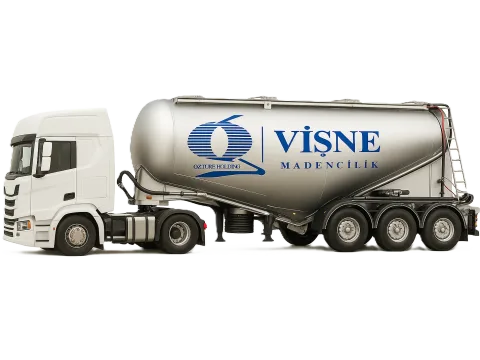
Silo truck — bulk
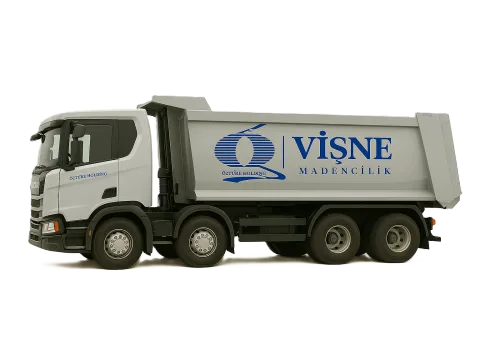
Tipper — bulk
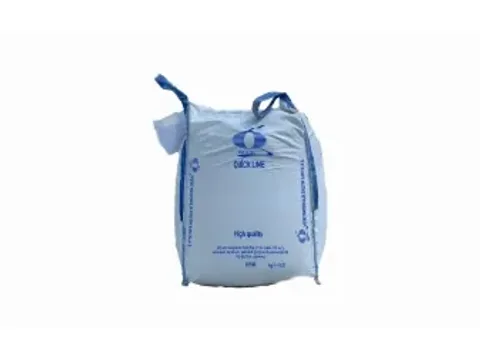
Big bag (1000 kg)
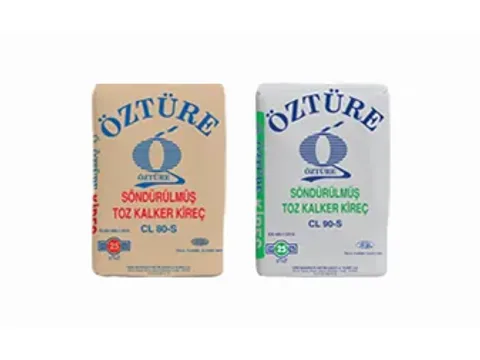
Bag (25 kg)
25 kg PE-lined kraft bags; 1,000–1,200 kg per pallet, stretch-wrapped and suitable for closed storage.
1,000–1,250 kg big bags with inner PE liner and bottom discharge spout — the standard format for feeding a site slaker.
Bulk tanker, 25–28 t; pneumatic discharge, silo filter and level measurement must be in place on the plant side.
For export, lined big bags inside the container with desiccant sachets; on sea freight a moisture barrier is mandatory, not optional.
Packaging and size fraction are chosen together: ground product ships in tankers or big bags, lump product in bulk or big bags.
Where this product is used



Frequently asked questions
Is quicklime or hydrated lime the right choice for my process?
CaO pays off in plants that can install a slaker, run continuously and consume more than a few tonnes a day: more active substance per tonne, smaller storage volume, lower freight per unit of reagent. Without a slaker, or with small and intermittent dosing, directly dosable hydrate carries less operating risk. The decision is operational rather than economic: do you have the people to manage slaking heat and grit?
What is reactivity t60 and what exactly should the specification say?
t60 is the time it takes 150 g of lime to bring 600 mL of water at 20 °C up to 60 °C in the EN 459-2 wet slaking test. Specify not only t60 but also the total temperature rise (Δt) and the size fraction the test was run on. Without all three, two laboratories cannot be compared and a batch that looks compliant on paper can underperform on site.
Should I calculate dosing on total CaO or available CaO?
Always on available CaO. Total CaO also counts calcium locked as carbonate or sulphate, and that fraction does no work in your process. Compare offers in tonnes of available CaO, not tonnes of lime — the gap between 88% and 92% available can amount to several hundred tonnes a year at industrial consumption.
How long can quicklime be stored?
In a sealed silo or a PE-lined big bag the practical limit is 3–6 months. In humid air the surface first hydrates and then carbonates; available CaO can fall by roughly 1–3% per month and lumping begins. Keeping the silo vent filter dry and controlling the store atmosphere with moisture and gas absorbers slows that loss appreciably.
How do I calculate the slaking water?
Stoichiometric demand is 0.32 kg of water per kg of CaO, but in practice you use 3.5–5 times that for milk of lime and 0.4–0.6 times for dry hydrate, with a target slaking temperature of 80–95 °C. Below the right ratio you get local boiling and a coarse, low-surface hydrate; far above it, the reaction cools and unslaked residue increases.
Which size fraction should I order?
The equipment decides: 0–3 mm for continuous slakers, 0–6 mm for batch slakers, 10–40 mm for EAF and converter charging, ground powder for dry sorbent injection and soil spreading. A wide band such as 0–40 mm produces both residue in slaking and segregation in handling; asking for a narrow band also tightens reactivity consistency.
What are the safety points we must observe?
Under CLP, CaO is classified for skin irritation, serious eye damage and respiratory irritation; sealed goggles, nitrile or leather gloves and FFP2–FFP3 respirators are mandatory. On contact with water the temperature can exceed 100 °C and steam is released, so never hose down spilled lime; timber and organic material in contact with wetted lime can ignite. For eye contact, rinse 15 minutes with plenty of water and seek medical attention.
How is the dose determined in soil stabilisation?
The Eades–Grim method (ASTM D6276) finds the lowest lime percentage that holds pH at 12.4, then 0.5–1% is added as a construction allowance; the typical result falls between 2 and 5%. Confirm the figure with 7- and 28-day UCS or CBR tests. Where soil sulphate exceeds 0.3%, a separate laboratory assessment is essential because of ettringite formation and heave.
Is it regulated under ADR, and what documents come with a delivery?
Quicklime is not classified as dangerous goods under ADR and travels in standard bulk tankers or closed vehicles. It is, however, a hazardous substance under CLP, so a safety data sheet and labelling are mandatory. Every shipment is accompanied by a certificate of analysis covering available CaO, reactivity (t60 and Δt), loss on ignition and particle size distribution.
For flue gas, CaO or Ca(OH)₂, and what Ca/S ratio?
What actually meets the gas in dry injection is hydrate; CaO is converted in an on-site hydrator. Typical molar Ca/S is 2–3 in dry injection and 1.2–1.6 in a semi-dry absorber. Efficiency is driven more by sorbent specific surface and approach temperature than by Ca/S itself; share your gas flow, SO₂/HCl profile and reactor temperature through contact and we can work out the dosing range together.
Sample and dose recommendation for this process
Describe your current usage and target; our technical team will come back with a suitable specification and a starting dose.