
Products
Hydrated Lime
Calcium hydroxide for pH control in water and wastewater treatment, acid capture in flue gas and binding in construction mortars.
Ca(OH)₂
Overview
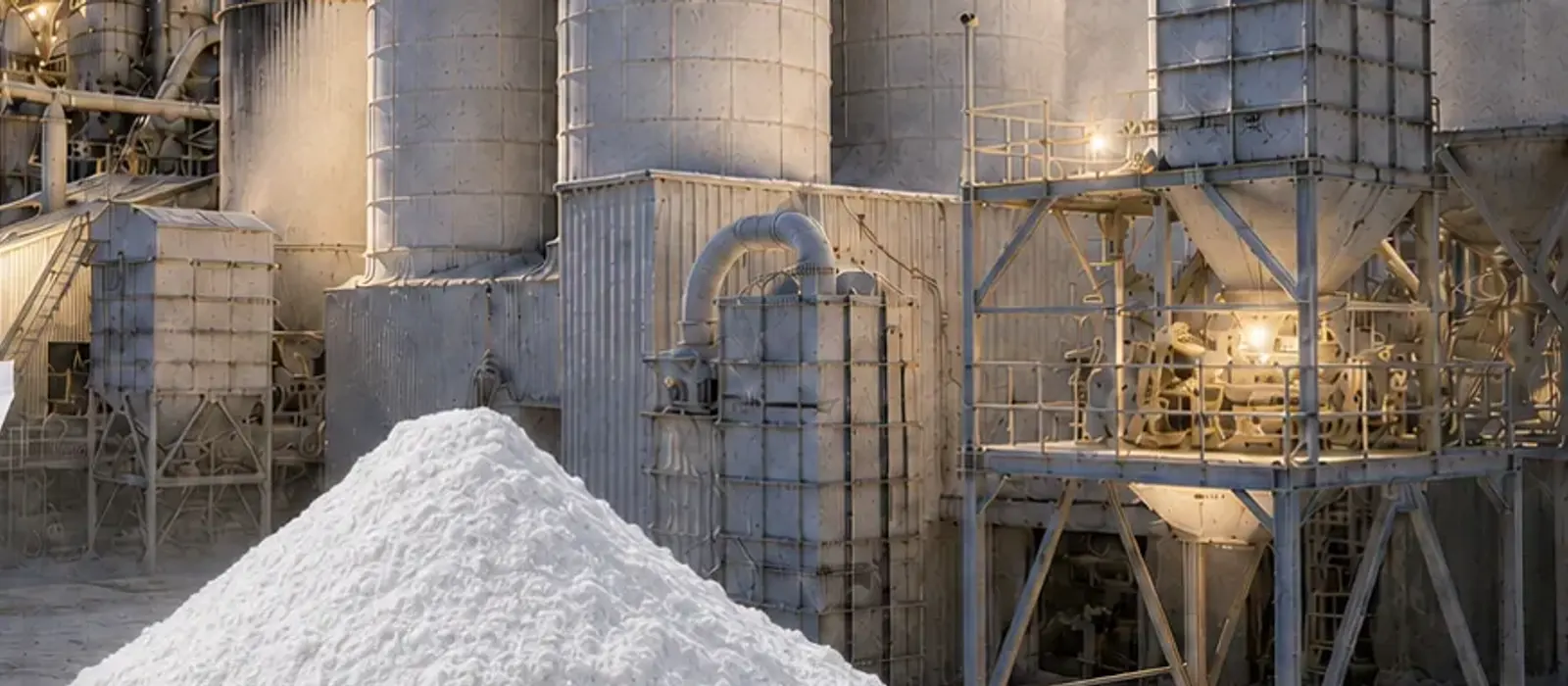
Hydrated lime is calcium hydroxide (Ca(OH)₂) produced by slaking quicklime with a controlled amount of water. EN 459-1 places it among the air limes as class CL 90-S: a dry hydrated powder with CaO+MgO ≥ 90%. It can be dosed dry straight into the process or mixed with water and fed as milk of lime.
What decides performance is not the Ca(OH)₂ figure but how much of that hydroxide is actually reachable by the reaction. Two batches both assaying 92% Ca(OH)₂ behave completely differently in dry sorbent injection when their BET specific surface areas are 18 m²/g and 40 m²/g. The choice against quicklime likewise follows from whether you have slaking infrastructure, not from purity.
This page describes the product through its behaviour in four processes rather than through a certificate: pH and precipitation in water, acid capture in hot gas, water retention and workability in mortar, bitumen-aggregate bond in asphalt. All four call for different specifications of the same product.
Technical specifications
| Parameter | Value | |
|---|---|---|
| Chemical formula | Ca(OH)₂ | Calcium hydroxide |
| CAS / EC No | 1305-62-0 / 215-137-3 | REACH registered |
| Class | CL 90-S | EN 459-1 air lime, hydrated |
| Ca(OH)₂ content | ≥ 92% | Determined per EN 459-2 |
| CaO + MgO | ≥ 90% | EN 459-1 CL 90 limit |
| CO₂ | ≤ 4% | EN 459-1 — carbonation indicator |
| SO₃ | ≤ 2% | EN 459-1 |
| Free moisture | ≤ 2% | Critical for flow and caking |
| Fineness — residue on 0.090 mm | ≤ 7% | EN 459-2 |
| BET specific surface area | 18–22 / 35–45 m²/g | Standard / high-surface grade |
| Bulk density | 350–450 / 500–650 kg/m³ | Aerated / settled |
| Solubility and pH | 1.73 g/L (20 °C) — pH 12.4 | Retrograde: falls as temperature rises |
Chemical formula
Ca(OH)₂
Calcium hydroxide
CAS / EC No
1305-62-0 / 215-137-3
REACH registered
Class
CL 90-S
EN 459-1 air lime, hydrated
Ca(OH)₂ content
≥ 92%
Determined per EN 459-2
CaO + MgO
≥ 90%
EN 459-1 CL 90 limit
CO₂
≤ 4%
EN 459-1 — carbonation indicator
SO₃
≤ 2%
EN 459-1
Free moisture
≤ 2%
Critical for flow and caking
Fineness — residue on 0.090 mm
≤ 7%
EN 459-2
BET specific surface area
18–22 / 35–45 m²/g
Standard / high-surface grade
Bulk density
350–450 / 500–650 kg/m³
Aerated / settled
Solubility and pH
1.73 g/L (20 °C) — pH 12.4
Retrograde: falls as temperature rises
Highlights
Ca(OH)₂ content and BET surface area are reported together for the same batch — high purity combined with low surface area lowers dry sorbent efficiency.
Standard CL 90-S and the high-surface grade (≥ 35 m²/g) are stocked separately; a flue gas duct and a masonry mortar do not want the same product.
Free moisture is held at ≤ 2%; drift in this single figure is the most common field cause of silo arching and feeder blockage.
The ≤ 4% CO₂ limit describes the value at dispatch; batch production date appears on the delivery note, so the carbonation allowance is data rather than guesswork.
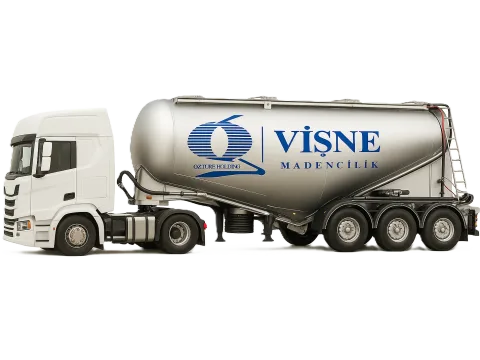
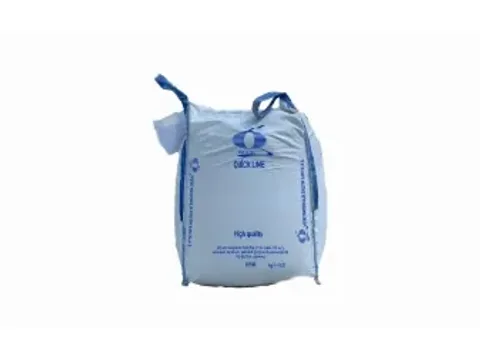
Bulk silo truck, big bag and 25 kg sack ship from the same batch — a change of packaging is not a change of specification.
Sampling, batch analysis to EN 459-2 and dose-tuning support during commissioning come with the product.
Use
Ca(OH)₂ content and surface area answer different questions
Ca(OH)₂ content answers “how many grams of active material are there”. BET specific surface area and pore volume answer “how quickly can that material be reached”. Standard hydrate typically sits at 18–22 m²/g; high-surface grades reach 35–45 m²/g with pore volume above 0.1 cm³/g.
The difference shows up wherever contact time is short. In a flue gas duct the sorbent meets the gas for one or two seconds; what reacts in that window is the outer shell of the particle, and the core travels to the filter unused. Double the surface area and removal efficiency rises appreciably at the same stoichiometric ratio.
In aqueous systems with long contact time the relationship reverses. A milk of lime tank stirs for minutes and the particle has time to dissolve completely; there the surface area difference is largely erased and what matters is insoluble residue and particle size distribution. There is no single “best lime”, only the best one for a given process.
In flue gas the dose is set by approach temperature, not stoichiometry
Dry sorbent injection starts from a theoretical Ca/S ratio, or Ca/(S+2Cl) when all acid gases are counted. Practice runs at 1.5–2.5. That excess is not chemistry but physics: the reaction happens at the gas-solid interface and only a limited amount of acid gas reaches the interior of the particle.
The real lever is temperature. Bring the approach to saturation temperature down to 15–20 °C and a film of moisture a few molecules thick forms on the particle surface, at which point HCl and SO₂ capture jumps. In flue gas treatment plants it is common to add duct cooling and cut the dose by a third with the same sorbent.
The bag filter sets the limit: thicken that moisture film and the cake sticks, differential pressure climbs and cleaning frequency rises. This is why 140–180 °C is the typical operating window, and why sorbent selection is made together with it — optimising dose without watching filter behaviour is half a job.
Milk of lime, saturated limewater, or dry dosing
The solubility of Ca(OH)₂ in water is only 1.73 g/L at 20 °C, and it falls rather than rises with temperature. This retrograde solubility has two consequences: the alkalinity that saturated limewater can carry is low, and dissolved lime re-precipitates as scale wherever lines warm up.
That is why water and wastewater treatment works in practice with milk of lime at 5–20% solids; what travels through the pipe is a suspension, not a solution. Choosing the concentration is a hydraulic decision, not a chemical one: above 20% the slurry is abrasive and blocking, below 5% it inflates storage and agitation volume.
Saturators producing saturated limewater are still preferred for drinking water remineralisation and low-flow dosing points. The advantage is a clear, non-blocking solution and fine dose control; the drawback is large equipment volume and limited capacity. Flow rate and target alkalinity increase decide between them.
In mortar, lime's job is behaviour rather than binding
CL 90-S is added to cement mortar not to gain strength; lime's strength contribution is limited and slow. Lime changes the water retention and workability of the fresh mortar: applied on absorbent brick, aerated concrete or a dry block, the mortar does not lose its water in an instant, cement hydration is not cut short and adhesion holds.
Once hardened, two properties stand out: vapour permeability and autogenous healing. Lime mortar carbonates with atmospheric CO₂ at crack faces and closes hairline cracks on its own. That is why restoration work on the building materials side prefers lime: letting a historic wall manage its moisture balance beats sealing it in with cement render.
A typical mix is 1:1:6 by volume (cement:lime:sand). Raising the lime fraction improves workability and water retention but lowers early strength and changes shrinkage behaviour. The right ratio is set by the absorbency of the wall material and the exposure class, not by a product leaflet.
Why lime does the anti-stripping job more durably than a liquid additive
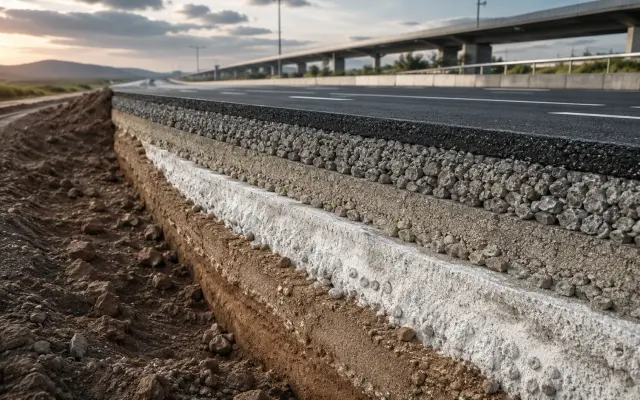
Stripping is the separation of the bitumen film from the aggregate surface under the action of water, and it is most pronounced on siliceous, acidic aggregates. Applied to the aggregate at 1–1.5% of dry weight, hydrated lime lets Ca²⁺ ions bond with the carboxylic acids in the bitumen; the bitumen that would otherwise let go is chemically anchored to the surface.
Liquid amine additives do the same job chemically but degrade over time at storage and mixing temperatures. Lime does not degrade. It also stays in the mastic as filler: it slows oxidative ageing of the bitumen and adds rutting resistance. In road and asphalt work the TSR measured to AASHTO T283 is typically carried above the 0.80 threshold.
The application method changes the result. Dusting dry lime onto dry aggregate is the weakest route; part of the powder leaves through the stack without ever touching a surface. Applying dry lime or lime slurry to aggregate at around 3% moisture gives a markedly more even coating — the same dose, different performance.
Which fineness suits which equipment
Hydrated lime is a fine, light and cohesive powder. Aerated bulk density runs 350–450 kg/m³, settled 500–650 kg/m³. Sizing a silo on the aerated figure overstates stock capacity; setting up weighing on the settled figure introduces error during filling. Both numbers have to be used together.
Cohesion is the source of arching and line blockage. Cone angle, aeration pad layout, vibration and feeder type are chosen as a set. Free moisture drifting past 2% triggers all of these problems at once, which is why moisture is an operating parameter in the specification rather than a cosmetic line.
Fineness is likewise equipment-driven. Dry sorbent injection and asphalt filler want the fine fraction; in milk of lime preparation excessive fineness raises viscosity and pump load. A residue of ≤ 7% on 0.090 mm is a practical balance between the two ends, though a narrower band can be defined for special grades.
Shelf life is governed by CO₂, not by moisture
Hydrated lime left exposed reacts with atmospheric carbon dioxide and a layer of calcium carbonate forms on the grain surface. That layer both consumes active Ca(OH)₂ and closes access to the hydroxide beneath it. A rising CO₂ figure in the analysis is therefore not a simple impurity indicator but a direct performance indicator.
The ≤ 4% CO₂ limit EN 459-1 sets for CL 90-S describes the value at dispatch; it is not an open-ended field guarantee. In a closed silo or a sealed big bag, 6–12 months is untroubled in practice; a torn sack, an open silo hatch or a pallet left in the rain shortens that to weeks.
Moisture is a separate problem. Hydrated lime does not react with water — it is already hydrated — but moisture causes caking and loss of flow. Caked material cannot be dosed without screening and makes the feeder rate fluctuate. The storage rule is simple: closed, dry, first in first out.
Classification, exposure limits and which document is required where
Under CLP, Ca(OH)₂ is classified as Skin Irritation 2 (H315), Serious Eye Damage 1 (H318) and specific target organ toxicity STOT SE 3 (H335). It is neither flammable nor explosive; the real risk is to the eye, because the saturated solution sits at pH 12.4 and corneal damage develops quickly.
The EU indicative occupational exposure limit is 1 mg/m³ for respirable dust (8 h TWA) and 4 mg/m³ for inhalable dust. Enclosed transfer, local extraction at the filling point and a P2/P3 filter mask keep operation below these values in practice. An eyewash station belongs in the dosing area.
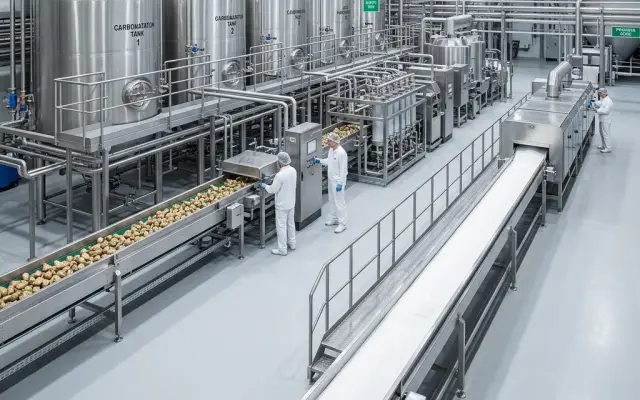
The product is registered under REACH. Drinking water applications call for conformity with EN 12518 (calcium hydroxide for water intended for human consumption); in food and sugar the E526 additive purity is a separate criterion and separately documented. The point of use, not the product, decides which document is needed; our technical team will map the required document set to the application.
Packaging and delivery
Silo truck — bulk
Tipper — bulk
Big bag (1000 kg)
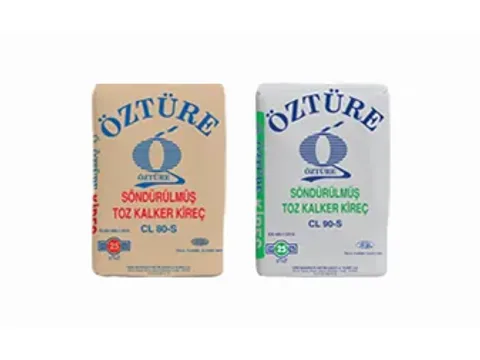
Bag (25 kg)
Bulk — silo truck, pneumatic discharge (25–28 t)
1000 kg big bag — palletised, PE-lined
25 kg PE-lined kraft sack — palletised and stretch-wrapped
High-surface grade ships as a separate batch, BET value printed on the label
Custom packaging and labelling on request
Where this product is used







Frequently asked questions
What does the difference between CL 90-S and CL 80-S mean in practice?
Under EN 459-1 the difference is the CaO+MgO floor: 90% versus 80%. In the field that means roughly 10–12% more product for the same pH or the same acid removal. The decision should come not from price per tonne but from the sum of extra consumption, freight, storage and the sludge volume produced.
Should I buy hydrated lime or slake quicklime on site?
Consumption sets the threshold. Up to a few hundred tonnes a year the hydrated product is more practical: no slaking unit, no heat control, no added maintenance. At high consumption on-site slaking lowers cost per unit of active substance, since 1 kg of CaO corresponds to about 1.32 kg of Ca(OH)₂ — provided the unit can control heat and slurry density.
Which grade should I choose for dry sorbent injection?
The high-surface grade with BET ≥ 35 m²/g. Reaching the same removal efficiency with standard hydrate typically takes 30–50% more product. The correct comparison is not sorbent price alone but sorbent cost plus disposal cost of the reaction product generated.
How do I reduce scaling in milk of lime lines?
Ca(OH)₂ has retrograde solubility, so dissolved lime precipitates as scale wherever lines run warm. Keeping line temperature low, leaving no dead legs, agitating continuously and flushing with water regularly are the basics. For established scale, plan a periodic dilute acid wash.
How can I tell whether stored lime is still usable?
The reliable route is Ca(OH)₂ and CO₂ determination to EN 459-2. A quick field indicator: if the material has formed hard lumps and the pH of a saturated suspension sits noticeably below 12.4, carbonation has progressed. A rise in sieve residue points the same way.
Can hydrated lime be used for soil stabilisation?
Yes, but it does not do the same job as quicklime. CaO consumes water while slaking and lowers soil moisture; Ca(OH)₂ does not, it only drives cation exchange and the pozzolanic reaction. In soil improvement work it is preferred where moisture is already suitable and, as a lime slurry, where dust control matters near housing.
What documentation is required for drinking water use?
Conformity with EN 12518 is the essential one; the standard defines purity and heavy-metal limits for calcium hydroxide used in water intended for human consumption. Batch analysis and traceability are expected. Local regulation may add its own approval — settling that at project start saves time at commissioning.
What dose and precautions apply in animal housing?
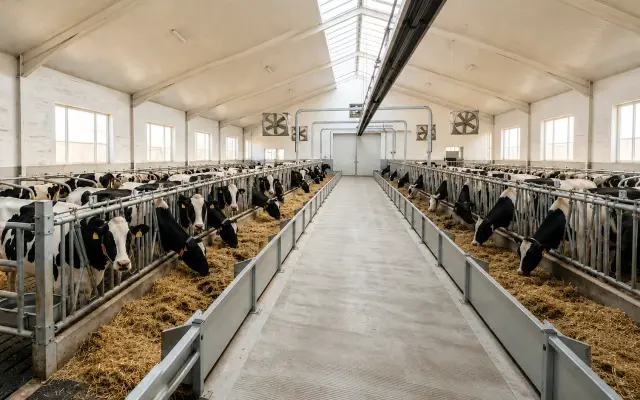
In livestock and disinfection use, the common practice is dry spreading of 200–400 g/m² on a cleaned floor; the high pH lowers pathogen load. Apply with the animals out and keep the building closed until dust settles. In dairy, wait for full drying before bedding to protect udder health.
Should I calculate dose as Ca(OH)₂ or as CaO equivalent?
State which one explicitly in the contract and in the recipe. The conversion factor is 1.32: 1 kg of CaO is equivalent to 1.32 kg of Ca(OH)₂. Where one side speaks in CaO and the other in Ca(OH)₂, a systematic 32% dosing error appears and usually goes unnoticed for months.
Does the packaging format change the specification?
No; bulk, big bag and 25 kg sack ship from the same batch and carry the same analysis report. The difference is operational: bulk delivery brings aeration and slight segregation during pneumatic conveying, big bags suit intermediate consumption, and 25 kg sacks are for site work and small dosing points.
Sample and dose recommendation for this process
Describe your current usage and target; our technical team will come back with a suitable specification and a starting dose.