
Applications
Food & Sugar Industry
The carbonatation cycle in beet juice purification and purity requirements for food-contact use.
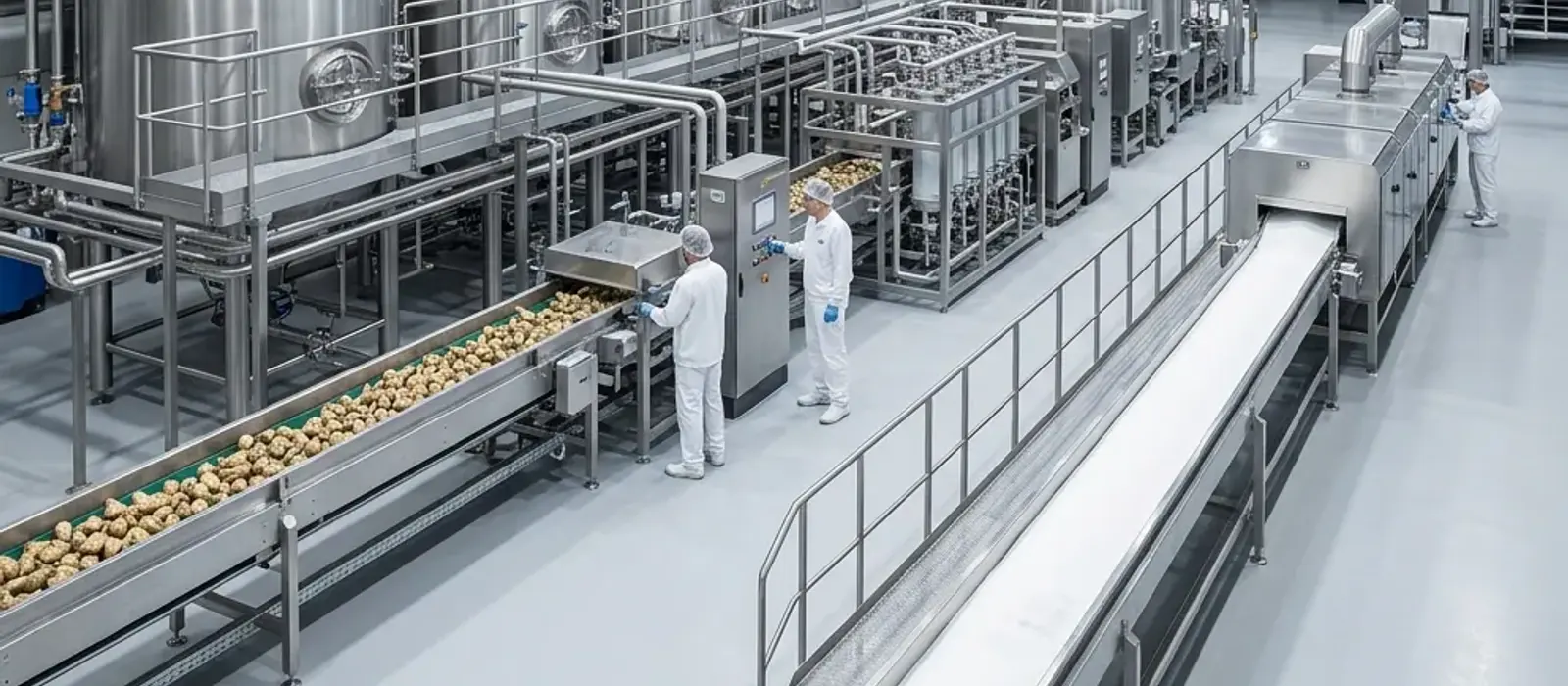
Overview
Raw juice from sugar beet carries, alongside its sucrose, proteins, pectins, amino acids, invert sugar, saponins, colour precursors and a whole set of anions and cations. What decides crystal yield over a campaign is not how much sugar the juice holds but how much of these non-sugars can be taken out of it. Lime–carbonatation purification is still the only industrial answer, because it simultaneously coagulates colloids at high pH and creates a vast adsorption surface of calcium carbonate crystals.
The two ends of the process are locked to each other. At one end sits the limestone burned in the kiln: the quicklime leaving calcination supplies alkalinity to the juice, while the CO₂ in the gas leaving the same kiln precipitates that alkalinity back as carbonate crystal. At the other end sit the filterability and the lime-salt content of the thin juice — these two figures decide whether the evaporators will scale and how much sugar will escape into molasses at crystallisation. Every setting in between is an exercise in balancing those two ends.
This page treats the juice purification station as an operating problem rather than a specification list: which impurity in the limestone leads to which consequence, how the shape of the pH curve in preliming changes floc structure, why the “optimum alkalinity” of first carbonatation is not one number but a point re-located for every beet consignment, and how food-contact purity is actually evidenced. For other uses that demand food-additive grade, the chemical and pharmaceutical industry page describes the same documentation logic in a different process.
What makes the juice difficult is not the sugar but the non-sugars
Raw juice leaving diffusion typically has a purity of 85–88%, meaning roughly a seventh of the dry substance is not sugar. Part of that fraction can be precipitated at high pH (proteins, pectins, saponins, citrate–oxalate–phosphate); part cannot. At the head of the non-precipitable group stand potassium, sodium and betaine, which pass through purification almost untouched and form the melassigenic load at crystallisation. The measure of a purification station is therefore not absolute purity but purity rise: 2–4 points from raw to thin juice is the normal expectation, and a station below that is misadjusted somewhere regardless of lime dose.
The second difficulty is that some juice constituents do not simply sit still at high pH — they generate new problems. Invert sugar degrades in alkali into organic acids and coloured decomposition products; amides (glutamine, asparagine) hydrolyse and release ammonia. These reactions are deliberately wanted, because left undone they will occur later under worse conditions in evaporation and boiling, but they must be driven to completion. An unfinished amide breakdown returns as a pH drop in the thin juice and as colour formation in the evaporators. What main liming is really after is therefore not simply a high pH but sufficient residence time at that pH.
The third and most expensive difficulty is filtration. If the pH curve in preliming is raised too fast, the floc that forms is fine, gelatinous and thixotropic; it appears to settle in the clarifier but blinds the filter cloth immediately. The same floc, formed under a stepwise pH rise, becomes dense and irreversible. The most common field mistake is to sample the preliming pH profile at one point once a week and declare “pH is fine”; the information is in the shape of the profile, not in its end value. When the filtration coefficient (FK) starts to fall, the first thing to examine is not the lime dose but the number of preliming stages and the recycle ratio.
The fourth difficulty is measurement itself. Carbonatation alkalinity is measured in hot juice and depends strongly on temperature; a pH read at 85 °C and the same sample read after cooling to 20 °C can differ by more than a full unit. Most laboratory-versus-plant arguments start here. That is why sugar factories report alkalinity by titration in g CaO/100 mL rather than as pH; the pH probe is a trend indicator, not the arbiter. The same discipline applies to lime salts: a comparison made without reducing to dry substance, in mg CaO per 100 °Bx, will mis-compare two juices sitting at different Brix.
The three separate jobs lime does in the juice
The first job is chemical precipitation. Hydrated lime dosed as milk of lime supplies hydroxide ions; as pH rises, colloids such as proteins and pectins pass their isoelectric point, lose their charge and flocculate. At the same time calcium ions form sparingly soluble salts with oxalate, citrate, sulphate and phosphate. Because these two mechanisms work together, the target pH band in preliming (10.8–11.2 at 20 °C) is a compromise: lower and colloid precipitation stays incomplete, higher and the floc peptises again, destroying the filterability of the precipitate.
The second job is chemical decomposition, and main liming performs it. In this stage, held at high free-lime concentration, amides hydrolyse, invert sugar is broken down in a controlled way and pectins are saponified. What decides the outcome here is not dose but the temperature–time pair: cold main liming (25–35 °C for 20–30 minutes) drives amide breakdown without generating colour, while the hot stage (82–88 °C for 8–12 minutes) completes the reaction. Plants that collapse these two into a single hot stage save on lime consumption and pay for it in thin-juice colour.
The third job is adsorption, and it happens in first carbonatation. When kiln-gas CO₂ is fed into the juice, Ca(OH)₂ + CO₂ → CaCO₃ + H₂O precipitates calcium carbonate crystals; but the real gain is not the calcium removed, it is the colorants, saponins and high-molecular-weight colloids that attach to the crystal surface. The surface area and crystal morphology of the first-carbonatation sludge are therefore purification efficiency itself. Recycling part of that sludge back to preliming supplies fresh CaCO₃ nuclei and improves both the floc structure and this surface.
All three jobs rest on limestone quality. For food-grade limestone the typical expectation is CaCO₃ ≥ 97%, MgCO₃ ≤ 1.5%, SiO₂ ≤ 1% and low iron and aluminium. MgCO₃ converts to MgO in calcination, and MgO slakes slowly in the juice to gelatinous Mg(OH)₂; it blinds filter cloth and, not being precipitated in carbonatation, travels all the way to the evaporators. Reactivity matters as much as available CaO: overburnt grains leave insoluble grit in the slaker, underburnt grains are carried as residual CO₂ for nothing.
The station's output is not only thin juice: the carbonatation sludge leaving the filters is pressed to 35–45% dry substance and becomes a fine-grained liming material with a high neutralising value. It is used as a liming agent on acid soils, and the logic of that use is set out on the agriculture and soil improvement page. Placing the campaign's sludge into agriculture lowers disposal cost and lets the limestone do a second job; it requires, however, that dry substance, pH and the heavy-metal profile of the cake be recorded regularly.
Operating ranges
| Parameter | Value | |
|---|---|---|
| Limestone CaCO₃ | ≥ 97% | Sugar grade; MgCO₃ ≤ 1.5% |
| Limestone size | 40–80 mm | Top/bottom ratio ≤ 2, vertical shaft kiln |
| Kiln gas CO₂ | 32–40% v/v | Carbonatation feed gas |
| Available CaO (kiln exit) | ≥ 88% | Sucrose titration, EN 459-2 |
| Milk of lime density | 15–20 °Bé | ≈ 200–280 g CaO/L |
| Total lime dose | 0.8–1.5% CaO on beet | Per raw juice purity |
| Preliming | pH 10.8–11.2 / 50–60 °C | Stepwise, 6–10 min |
| Main liming | 82–88 °C / 8–12 min | Cold stage 25–35 °C, 20–30 min |
| 1st carbonatation | 0.08–0.12 g CaO/100 mL | 80–85 °C; optimum FK point |
| 2nd carbonatation | pH 9.0–9.3 (90 °C) | Lime-salt minimum |
| Thin juice lime salts | ≤ 0.030 g CaO/100 mL | ICUMSA method |
| Lead (Pb) | ≤ 2 mg/kg | Reg (EU) 231/2012, E 526 |
Limestone CaCO₃
≥ 97%
Sugar grade; MgCO₃ ≤ 1.5%
Limestone size
40–80 mm
Top/bottom ratio ≤ 2, vertical shaft kiln
Kiln gas CO₂
32–40% v/v
Carbonatation feed gas
Available CaO (kiln exit)
≥ 88%
Sucrose titration, EN 459-2
Milk of lime density
15–20 °Bé
≈ 200–280 g CaO/L
Total lime dose
0.8–1.5% CaO on beet
Per raw juice purity
Preliming
pH 10.8–11.2 / 50–60 °C
Stepwise, 6–10 min
Main liming
82–88 °C / 8–12 min
Cold stage 25–35 °C, 20–30 min
1st carbonatation
0.08–0.12 g CaO/100 mL
80–85 °C; optimum FK point
2nd carbonatation
pH 9.0–9.3 (90 °C)
Lime-salt minimum
Thin juice lime salts
≤ 0.030 g CaO/100 mL
ICUMSA method
Lead (Pb)
≤ 2 mg/kg
Reg (EU) 231/2012, E 526
Application steps
- 01
Limestone selection and calcination
In a sugar factory limestone is not only a source of lime, it is also the source of CO₂. That double role governs size selection: a vertical shaft kiln runs on a narrow band such as 40–80 mm, with the ratio of top to bottom size kept at or below 2. Widen the band and fines close the voids of the bed, gas flow channels, and large stones leave the kiln unburnt at the core. The result is over- and under-burnt material coming out of the same kiln at the same time.
The chemical expectation is CaCO₃ ≥ 97% and MgCO₃ ≤ 1.5%. Silica and alumina combine with calcium at calcination temperature to form low-melting phases; they show up as ring formation inside the kiln and as insoluble residue in the lime. Mechanical strength matters as much as chemistry: stone that degrades during handling and charging enters the kiln as fines and upsets the gas composition. When selecting a quarry, therefore, ask for degradation (tumbler/LA) behaviour alongside the certificate of analysis.
- 02
Milk of lime preparation, screening and dosing
Lime leaving the kiln is slaked in a rotary drum slaker with sweet water or condensate. The temperature and hardness of the slaking water directly affect crystal size: cold slaking water gives finer, more reactive Ca(OH)₂, while hard water causes premature carbonation on the grain. Chloride in the water means both corrosion and an unwanted anion load in the juice, so the slaking water is controlled separately as process condensate or treated sweet water. The approach used on the water and wastewater treatment side applies here as well.
At the slaker outlet the milk of lime is screened to remove grit — unslaked particles, stone fragments, clinker. A rise in grit is the earliest warning of kiln performance: when overburning starts, grit climbs first and the drop in available CaO only shows in the analysis days later. Milk of lime density is held steady in the 15–20 °Bé range under continuous agitation; if density drifts, the same valve opening delivers a different amount of CaO and the preliming pH profile shifts unnoticed.
- 03
Progressive preliming
The purpose of preliming is not to raise pH but to raise it correctly. The juice is carried from pH 6.2 up to 10.8–11.2 through a series of compartments; in each compartment a fraction of the colloid passes its isoelectric point and deposits onto floc that already exists. This cumulative growth yields a precipitate far denser and more irreversible than any single-step alkali addition can produce. Five to eight stages and a total residence of 6–10 minutes are typical.
Staging works together with recycle: part of the first-carbonatation sludge is returned to the head of preliming. That both delivers alkalinity along a gentle curve and supplies the CaCO₃ nuclei on which new floc grows. The recycle ratio is not a fixed recipe; it is raised when beet quality deteriorates — frozen, rotten or long-stored beet. Deteriorating filtration towards the end of a campaign usually originates in the beet itself, and the answer is not more lime but a re-tuned recycle and stage profile.
- 04
Main liming — cold and hot stages
Main liming delivers most of the lime dose and holds free-lime concentration high. What is wanted here is not precipitation but decomposition: amides hydrolyse, invert sugar degrades in a controlled way in alkali, pectins are saponified. Completing those reactions needs time more than concentration, which is why the cold stage (25–35 °C) is held for 20–30 minutes.
After the cold stage the juice is heated to 82–88 °C and held for a further 8–12 minutes. The hot stage completes the reaction, but it is also where colour formation accelerates; extending it brings no purity gain, only colour and invert degradation products. Collapsing the two stages into a single hot stage looks attractive on capital and heat, but it typically ends in a visible rise in thin-juice colour — and that colour is more expensive to remove downstream.
- 05
First carbonatation and the search for optimum alkalinity
Kiln gas is washed and cooled to a CO₂ content of 32–40% before it enters the carbonatation vessel. As alkalinity falls, CaCO₃ crystals form and colorants, saponins and high-molecular-weight colloids adsorb onto their surface. Temperature is held at 80–85 °C: lower, and the crystal becomes fine and filtration suffers; higher, and foaming becomes a problem in the vessel. Washing the kiln gas is not a side detail — sulphur and dust in the gas both enter the juice and build up in the vessel; the cleaning logic is the same as on the flue gas treatment side.
The optimum alkalinity is the alkalinity at which the filtration coefficient (FK) is best, typically in the range 0.08–0.12 g CaO/100 mL. It is not a constant: it moves as beet quality, preliming profile and recycle ratio change. What the shift laboratory should do is not hold alkalinity at a target but measure FK at several alkalinities and locate the peak of the curve. Dropping below the optimum redissolves calcium and returns precipitated colloids to the juice — noticed as turbidity at the filter outlet.
After carbonatation the juice is separated in a clarifier and the sludge is dewatered on filters. Clarifier overflow rate and sludge density are tracked together: too thin a sludge overruns filter capacity, too thick a sludge raises the sludge bed until it carries over into the clear phase.
- 06
Second carbonatation and the lime-salt minimum
The aim of second carbonatation is not to purify but to finish: to bring the calcium still dissolved in the juice down to the lowest achievable level. Calcium solubility does not change monotonically with pH; at 90 °C it passes through a minimum around pH 9.0–9.3. Below that point bicarbonate formation redissolves calcium; above it, calcium is carried as hydroxide. Second carbonatation pH is therefore not a target but a minimum point re-verified daily.
Residual calcium is reported as “lime salts”, with thin juice aimed below 0.030 g CaO/100 mL. The importance of that figure appears in evaporation: calcium salts scale the heating surfaces, lower the heat-transfer coefficient and shorten the interval between boil-outs. Some plants add soda ash (Na₂CO₃) to reduce lime salts further; this binds calcium as carbonate but raises sodium load and therefore molasses loss. The decision sits between the cost of scaling and the cost of sugar in molasses.
- 07
Filtration, sludge valorisation and juice control
After second carbonatation the juice passes safety filters and goes to evaporation as thin juice. Three figures are reported together at this point: purity (Pol/Bx), colour (ICUMSA IU 420) and lime salts. Read separately they mislead — raising the lime dose may lift purity slightly while raising colour and lime salts together, so that the net result is negative.
The carbonatation sludge leaving the filters is pressed to 35–45% dry substance. This cake is a very fine liming material with a high neutralising value and can be used on acid soils; the requirement is calculated exactly as for ground limestone, from neutralising value and particle fineness. To place the cake as an agricultural product, dry substance, pH, neutralising value and heavy-metal profile must be recorded batch by batch — the same record that turns a disposal cost into revenue.
- 08
Food-contact purity, documentation and storage
The lime and limestone entering a sugar factory are process inputs in contact with food. EN 459-1, the building-lime standard, is not sufficient on its own here: it defines mechanical and chemical performance, not the heavy-metal and impurity limits required for food use. The reference for food-additive purity is Regulation (EU) 231/2012, which lays down specifications for calcium hydroxide (E 526), calcium oxide (E 529) and calcium carbonate (E 170), together with the Codex/JECFA and Food Chemicals Codex monographs. Typical limits are of the order of ≤ 2 mg/kg for lead and ≤ 3 mg/kg for arsenic, with a certificate of analysis and a traceability chain required for each batch.
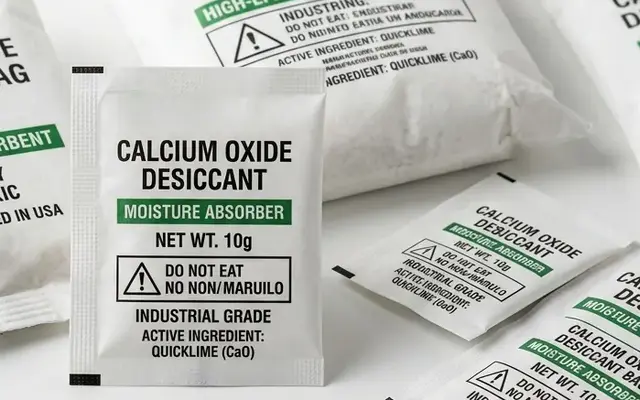
On the storage side, lime's worst enemies are atmospheric moisture and CO₂. Surface carbonation in silos and big-bag stock lowers available CaO and lets the dose quietly fall short; the resulting lumps also disturb flow in feed screws. Moisture control is a separate subject for stock that will sit for a long time before the campaign, addressed by closed storage, dry-air circulation or products such as a moisture and gas absorbent; which method works where is compared on the industrial moisture and humidity control page.
In campaign planning, what should be demanded from supply is not only price but batch consistency: lime produced from the same quarry seam, in the same size band and under the same calcination regime, measurably reduces the number of adjustments needed. To plan size band, available CaO and food-grade documentation together for your campaign, reach us through the contact page.
Products used in this field
Frequently asked questions
How does sugar-grade limestone differ from construction-grade limestone?
The difference is not only purity but the narrowness of the size band and the mechanical strength. A vertical shaft kiln in a sugar factory wants a narrow band such as 40–80 mm; once the top/bottom ratio exceeds 2, gas flow channels and the same kiln produces over- and under-burnt material at once. Because the kiln gas goes straight to carbonatation, the calcination behaviour of the stone also sets CO₂ concentration and therefore vessel capacity.
Why is MgCO₃ limited so tightly?
MgCO₃ converts to MgO during calcination. In juice, MgO slakes slowly to gelatinous Mg(OH)₂, which blinds the filter cloth and, since it is not precipitated in carbonatation, travels to the evaporators and contributes to scaling. This is why sugar-grade limestone is normally specified below 1.5% MgCO₃.
Why does preliming have to be progressive?
Colloids pass their isoelectric points at different pH values. If pH is raised stepwise, each fraction precipitates onto floc that already exists, giving a dense, irreversible precipitate. If pH is raised in one step, the floc is fine, gelatinous and thixotropic; it may look acceptable in the clarifier but blinds the filter cloth immediately.
How do we find the optimum alkalinity in first carbonatation?
Not by locking onto a single set point, but by measuring the filtration coefficient (FK) at several alkalinities and locating the peak of the curve. The typical range is 0.08–0.12 g CaO/100 mL, but the optimum moves as beet quality, preliming profile and recycle ratio change. Falling below it redissolves calcium and shows up as turbidity at the filter outlet.
Why is second carbonatation pH held at 9.0–9.3?
Because calcium solubility does not vary monotonically with pH; at 90 °C it passes through a minimum in that band. At lower pH, bicarbonate formation redissolves calcium; at higher pH, calcium is carried as hydroxide. The target is therefore not a fixed operating value but a minimum point re-verified daily.
Does more lime always mean more purity?
No. Beyond a certain point additional lime contributes almost nothing to purity while increasing sludge volume, heat and filter load, thin-juice lime salts and colour. The dosing decision is made by reading purity, colour and lime salts together; an optimisation that looks at purity alone usually loses money on balance.
What documentation is required for food-contact use?
The building-lime standard EN 459-1 is not sufficient on its own. Food-additive purity is referenced to Regulation (EU) 231/2012, which specifies calcium hydroxide (E 526), calcium oxide (E 529) and calcium carbonate (E 170), together with the Codex/JECFA and Food Chemicals Codex monographs. In practice a per-batch certificate of analysis, heavy-metal results and a traceability record are required.
Which water should be used for slaking?
Preferably process condensate or treated sweet water. Hard water causes premature surface carbonation and lowers reactivity; chlorides mean both corrosion risk and an unnecessary anion load in the juice. Slaking water temperature also affects crystal fineness, so it should be held steady.
What is done with the carbonatation sludge?
It is pressed to 35–45% dry substance and can be used on acid soils as a very fine liming material with a high neutralising value. Doing so requires dry substance, pH, neutralising value and heavy-metal profile to be recorded batch by batch — that record is what turns a disposal cost into revenue.
What happens if kiln gas CO₂ concentration falls?
A longer carbonatation time or a higher gas flow is needed for the same drop in alkalinity; vessel capacity effectively falls and foaming problems increase. The cause of a CO₂ drop is usually excess air, leakage or a degraded size distribution in the kiln — the fix belongs on the kiln side, not in carbonatation.
Sample and dose recommendation for this process
Describe your current usage and target; our technical team will come back with a suitable specification and a starting dose.