Applications
Paper & Pulp Industry
Causticising and the lime cycle in the kraft process; brightness and opacity contribution as filler and coating pigment.
Overview
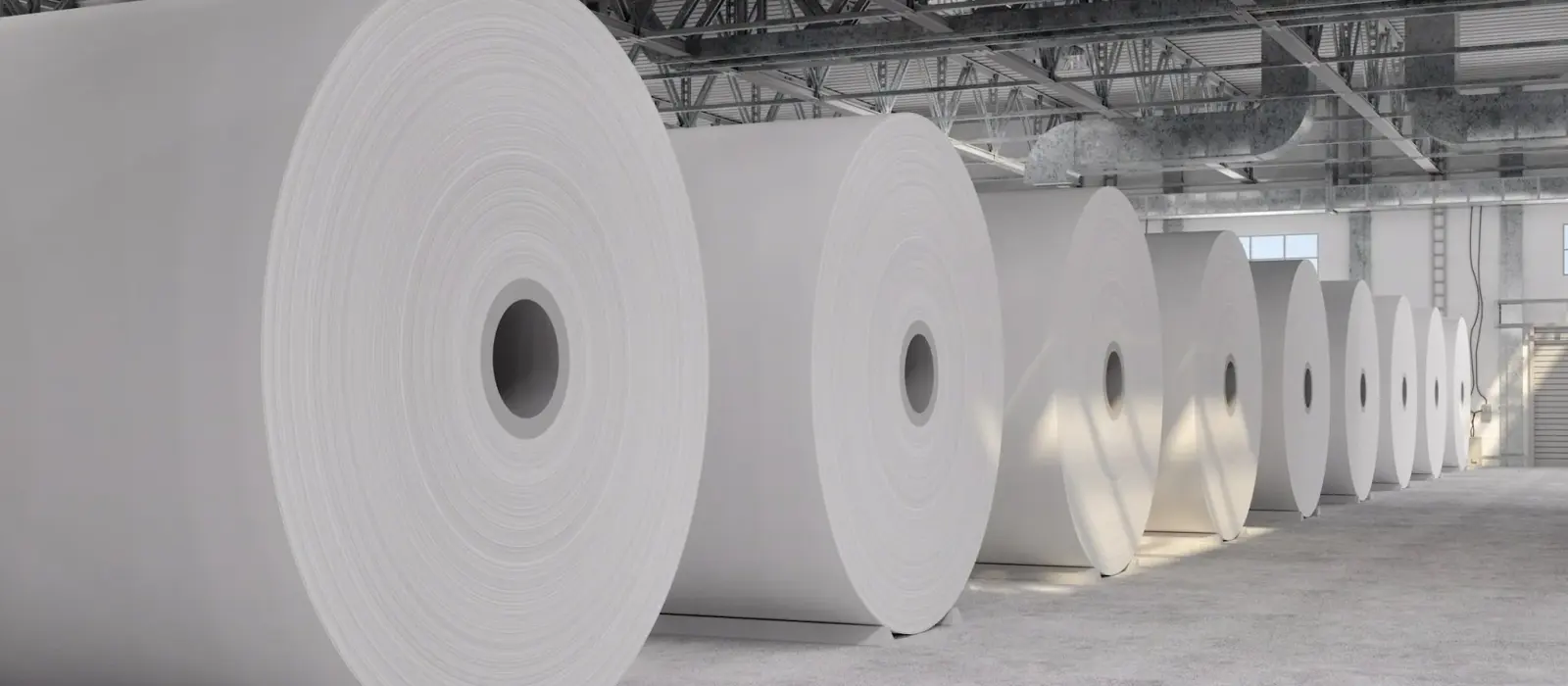
In a kraft pulp mill lime appears in two places with two different identities. The first is the chemical recovery line: there lime is not a consumable but the carrier of a closed loop. It converts the sodium carbonate in green liquor into sodium hydroxide, turns into calcium carbonate itself, is recalcined in the lime kiln and re-enters the loop. The second is the paper itself: calcium carbonate replaces fibre as filler and coating pigment and carries the opacity and brightness of the sheet.
The two identities sit side by side in the same mill but do not share a specification. What the recovery line asks of lime is high reactivity, low inert load and a lime mud that settles and filters; ISO brightness means nothing there. What filler carbonate is asked for is brightness, a narrow particle size distribution and low abrasivity; reactivity there counts as a defect. Two materials with the same chemical formula are two entirely independent purchasing decisions.
This page treats lime in a paper mill as an operating variable: why causticizing efficiency has a peak, why lime mud filterability degrades quietly over months, which analysis line decides the make-up lime, and what really limits filler loading. Product-level detail sits on the quicklime page for the make-up side and on natural calcium carbonate for the filler and coating side.
What the closed lime loop accumulates
At first glance the closed lime loop looks like nothing but an advantage: lime is reused over and over and the purchasing line is small. But like every closed loop it accumulates. Non-process elements entering with wood, green liquor, chemical make-up and wash water — phosphorus, magnesium, silicon, aluminium, manganese — do not leave the lime phase on their own. A little more builds up on every pass; lime that arrived with 92% available CaO on the certificate becomes, after some months, a material circulating at 80–84% available CaO, and the kiln is not the reason.
The most misleading measurement is causticizing efficiency. As the lime charge is raised, efficiency climbs to a point, peaks and then falls, because excess lime does not push the causticizing equilibrium further — it only raises the free lime in the mud. If a shift reads a single number as “efficiency dropped, so lime must be short” and pushes the charge higher, overliming begins. At that point the laboratory can still report a reasonable efficiency; the problem shows up not in the causticizer but at the filter and in the kiln.
Lime mud filterability is the real bottleneck of the line, yet it is rarely looked for as a root cause. Phosphorus forms hydroxyapatite with lime, disturbs the crystal habit of calcium carbonate and produces a fine, gelatinous mud that will not release water. When filter cake dryness falls from 78% to 68%, roughly 100 kg of extra water has to be evaporated with every tonne of mud fed to the kiln — that is a fuel bill and a capacity cut. In most mills the kiln is assumed to be “too small” at this point and the burner is retuned; what changed is the mud.
On the paper side the problem sits on an entirely different axis. Higher filler loading buys opacity and brightness and replaces expensive fibre with cheap mineral; but as fibre-to-fibre bonding sites thin out, tear and burst strength fall and the demand for sizing and retention chemistry rises. Calcium carbonate is also unstable in acid: once wet-end pH drops below about 6.5 the carbonate starts to dissolve, the released CO₂ causes foam and pinholing, and ash falls. A filler decision is therefore not a cost calculation but a decision about the whole wet-end chemistry.
Which lime, to which specification, at each link of the loop
The chemistry of causticizing is one line: Na₂CO₃ + Ca(OH)₂ → 2 NaOH + CaCO₃↓. But that line hides two separate steps. First quicklime is slaked — CaO + H₂O → Ca(OH)₂, releasing roughly 1150 kJ per kg of CaO — and only then does causticizing proceed. The faster and more complete the slaking, the further the reaction goes; coarse grains that pass into the reactor unslaked are rejected as grit and leave the loop as lime loss. That is why the EN 459-2 reactivity curve of the product (t60 and total temperature rise) has to match the slaker retention time of the mill; a hard-burnt batch that does not generate a fast hydrated lime equivalent can double the grit rate while carrying the same certificate.
In choosing make-up lime, available CaO alone is not a sufficient criterion. Because every impurity that enters the loop stays there, the analysis profile of the make-up decides the inert load that will build up over months. The lines that matter in practice are: P₂O₅ ≤ 0.05% (mud filterability), MgO ≤ 1.5% (mud volume and viscosity), SiO₂ + Al₂O₃ ≤ 1.5% (melt phase and ringing in the kiln), loss on ignition ≤ 3% (a marker of incomplete calcination) and t60 of 1–4 minutes (slaking speed). A cheap lime that is off on any one of those five will, within a few months, cost far more than the price gap in kiln fuel and lost production.
On the green liquor side the work starts before causticizing. Green liquor leaving the dissolving tank carries insoluble solids known as dregs — iron sulphide, carbon, silicates and manganese compounds. If those solids are not removed in the clarifier or the green liquor filter they enter the causticizer, join the lime mud, travel to the kiln and become permanent inerts in the loop. When green liquor suspended solids are not held around 20–50 mg/L, every downstream indicator — causticizing efficiency, cake dryness, kiln efficiency — drifts at the same time and slowly; because none of them alarms on its own, the drift is usually noticed months later.
The lime kiln closes the loop, and the aim there is not “as hot as possible”. Residual CO₂ has to be brought below 1.5%, but overburning closes the pore structure of the lime, cuts specific surface area and generates grit in the slaker. The kiln therefore works in a narrow window between residual CO₂ and reactivity, and the position of that window shifts with the dryness of the incoming mud. Kiln flue gas carries both CO₂ and total reduced sulphur compounds; the same logic used in flue gas treatment applies directly to cleaning that stream, and the same gas is the feedstock of the carbonation reactor in a satellite PCC plant.
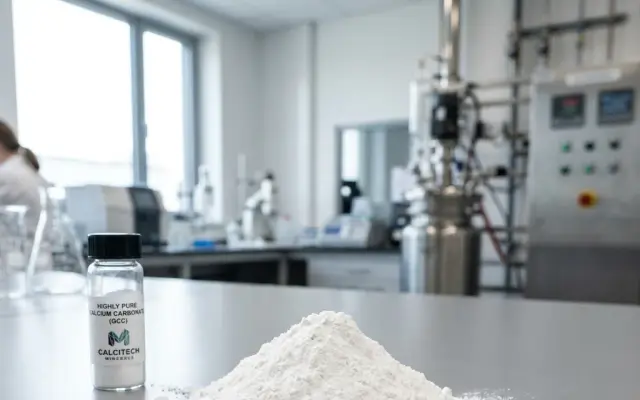
The carbonate that goes into the paper itself is another world. Precipitated calcium carbonate (PCC) is made by controlled carbonation; its scalenohedral crystal habit gives a high light scattering coefficient, so it delivers the most opacity per unit of basis weight and adds bulk to the sheet. Ground natural calcium carbonate (GCC) offers a narrow, tunable particle size distribution, low abrasivity and the ability to be shipped as a 75–78% solids slurry; it is preferred in coating for surface smoothness and gloss. The choice between them is not made on a brightness figure but on the target opacity–strength–cost triangle and on the retention system of the machine.
Operating ranges
| Parameter | Value | |
|---|---|---|
| Green liquor TTA | 110–130 g/L | As Na₂O |
| Green liquor suspended solids | 20–50 mg/L | After dregs removal |
| Sulphidity | 25–35% | On active alkali |
| Causticizing efficiency | 78–85% | NaOH / (NaOH + Na₂CO₃) |
| Lime charge CaO/Na₂CO₃ | 1.05–1.15 mol/mol | On available CaO |
| Slaker temperature | 95–103 °C | From reaction heat |
| Causticizer total retention | 90–150 min | 3–4 reactors in series |
| Lime kiln burning zone | 1150–1250 °C | Rotary kiln |
| Residual CO₂ in reburned lime | ≤ 1.5% | Balanced against overburning |
| Make-up lime available CaO | ≥ 92% | EN 459-2, sucrose titration |
| P₂O₅ in make-up lime | ≤ 0.05% | Mud filterability |
| Lime mud cake dryness | 70–80% | Vacuum / disc filter |
Green liquor TTA
110–130 g/L
As Na₂O
Green liquor suspended solids
20–50 mg/L
After dregs removal
Sulphidity
25–35%
On active alkali
Causticizing efficiency
78–85%
NaOH / (NaOH + Na₂CO₃)
Lime charge CaO/Na₂CO₃
1.05–1.15 mol/mol
On available CaO
Slaker temperature
95–103 °C
From reaction heat
Causticizer total retention
90–150 min
3–4 reactors in series
Lime kiln burning zone
1150–1250 °C
Rotary kiln
Residual CO₂ in reburned lime
≤ 1.5%
Balanced against overburning
Make-up lime available CaO
≥ 92%
EN 459-2, sucrose titration
P₂O₅ in make-up lime
≤ 0.05%
Mud filterability
Lime mud cake dryness
70–80%
Vacuum / disc filter
Application steps
- 01
Preparing green liquor and removing dregs
Smelt from the recovery boiler is dissolved in weak wash to make green liquor. Three quantities measured here set the tone for the whole line: total titratable alkali (TTA, 110–130 g/L as Na₂O), sulphidity (25–35%) and density. If TTA is too high the causticizer is overloaded and efficiency drops; if it is too low the white liquor going to the digester is weak and the target kappa is missed.
Dregs removal is the real job of this step. At the outlet of the clarifier or green liquor filter, suspended solids should be brought to 20–50 mg/L. Every day run above that limit means permanently loading inerts into the loop. The separated dregs are washed counter-currently and taken out of the cycle; the wash water returns to the weak liquor line so alkali loss stays bounded.
A common field mistake is to watch the dregs filter only for whether it “looks clear”. Green liquor is dark to begin with; the eye cannot tell 30 mg/L from 300 mg/L. Clarity has to be followed by regular suspended solids measurement, and the precoat regime and wash frequency set against that number.
- 02
Slaking and grit separation
In the slaker CaO reacts with water and the heat of reaction carries the temperature into the 95–103 °C band. That band is not arbitrary: below it slaking slows and stays incomplete, while too close to boiling brings steam blowback and overflow risk. The temperature rise curve is the most practical indicator of the reactivity of the delivered batch — it tells you how the lot will behave without waiting for a laboratory t60.
A retention of 20–30 minutes in the slaker is typical. Within that time, coarse unslaked grains, sand and inert fragments are rejected by the grit classifier. Grit rate is one of the health indicators of the plant: on a normal line it runs at 1–3% of the lime charge. Above 5% either the delivered lime is hard-burnt or the top size is too coarse for the slaker retention; the third possibility is slaking water that is too cold.
Grit is not only a loss item. The free CaO it carries reacts with water wherever it is dumped, heats up and raises dust. The design of the grit line is therefore a mass balance question and a safety question at once; enclosed conveying, wet quenching and controlled disposal are standard.
- 03
Causticizer stages and mapping the efficiency curve
Causticizing usually runs in 3–4 reactors in series with a total retention of 90–150 minutes. As the reaction approaches equilibrium its rate falls; the efficiency gained in the last stages is small but matters for crystal maturation of the lime mud. Cutting that time costs only a point or two of causticizing efficiency, while filterability degrades visibly — the real price is paid in cake dryness, not in efficiency.
The lime charge is set at 1.05–1.15 mol/mol against Na₂CO₃, calculated on available CaO. The only reliable way to find the right point is to step the charge at constant green liquor composition and measure efficiency together with mud settling rate and filter cake dryness. That maps the peak of the curve and shows which side of it you are working on; a single efficiency number never carries that information.
Causticizing efficiency depends not only on charge but also on green liquor temperature, TTA and sulphidity. High TTA gives lower efficiency at the same charge — which does not mean the lime is bad. Efficiency should therefore always be reported alongside TTA, temperature and sulphidity, and shift-to-shift comparisons made with those three held steady.
- 04
White liquor clarification, mud washing and filtration
The slurry leaving the causticizer is split into white liquor and lime mud. Suspended solids in the white liquor directly affect the quality of the chemistry going to the digester; modern lines with pressurised disc filters reach below 10 mg/L, while classic clarifiers sit several times higher.
Lime mud is washed counter-currently to recover the sodium compounds it holds. Insufficient washing is paid for twice: as alkali loss, and as the ringing and balling that sodium triggers in the kiln. Wash water returns to the loop as weak liquor; the mill's overall water balance, condensates and surplus streams are built on the same logic used in water and wastewater treatment.
Filter cake dryness is the output indicator of this step and should be held at 70–80%. A fall in dryness is almost always about the mud itself: overliming, a rising phosphorus load or shortened causticizing time. Changing the filter cloth corrects none of the three; it only postpones the symptom by a few weeks.
- 05
The lime kiln: degree of calcination and ring control
In the rotary lime kiln the mud is dried, heated and recalcined in a 1150–1250 °C burning zone. The aim is to bring residual CO₂ below 1.5% while preserving the pore structure of the lime. Overburnt lime densifies, loses specific surface and behaves sluggishly in the slaker; underburnt lime never takes part in causticizing and returns to the mud, circulating as dead load.
Ring and ball formation is the most expensive kiln failure. Its triggers are well known: sodium in poorly washed mud, free lime left in the mud, high SiO₂ and Al₂O₃ load, and fluctuating feed moisture. None of the four is decided in the kiln itself — they are all set upstream. When chasing a ring problem, read wash efficiency and lime charge data first and go to the burner last.
Kiln flue gas is not only a waste stream but a resource: the CO₂ it carries feeds the carbonation reactor of a satellite PCC plant and becomes the raw material of the filler that ends up in the sheet. The dust and reduced sulphur side of the same stream is a classic gas cleaning problem, solved with an electrostatic precipitator and scrubber combination.
- 06
Choosing make-up lime and the inert purge strategy
Grit, dregs, mud purge and unavoidable losses mean make-up lime enters continuously, typically 5–15% of the circulating lime. That stream is also the only real means of diluting inerts: the cleaner the make-up, the lower the equilibrium impurity level in the loop. Make-up lime is therefore not a “topping up” line item but a lever that tunes the chemistry of the whole cycle.
Make-up lime is not chosen on price alone. Available CaO ≥ 92%, P₂O₅ ≤ 0.05%, MgO ≤ 1.5%, SiO₂ + Al₂O₃ ≤ 1.5%, loss on ignition ≤ 3% and fast reactivity (t60 of 1–4 min) is the profile a typical kraft line looks for. Asking for a certificate per batch is not enough; verifying in your own laboratory for the first months is the only way to see a supplier's real distribution and batch-to-batch variability.
Two points decide storage: CaO picks up both moisture and CO₂ from the air. Partly hydrated or recarbonated lime may still flow out of the silo cleanly yet fail to give the expected temperature curve in the slaker, pushing grit up. Enclosed silos, dry-air venting and a sensible stock turnover are essential; in packaged goods and spare-part warehouses the same problem is solved at a different scale with the methods described under industrial moisture and humidity control.
- 07
The paper side: selecting filler and coating carbonate
A filler decision is made by reading three quantities at once: target opacity, acceptable strength loss and the fines load the retention system can carry. Filler content runs at 10–30% as ash in the sheet. Thanks to the high light scattering of PCC the same opacity can be reached at lower ash, which directly relieves the strength budget and cuts sizing demand.
In coating, the steepness of the particle size distribution decides the result: 60–90% below 2 µm is a typical range, and the narrower the distribution, the better the smoothness, gloss and ink receptivity. Abrasivity is the hidden cost here; a pigment with high residual quartz shortens blade and screen life and takes back the per-tonne saving.
On a machine running alkaline sizing (AKD/ASA), wet-end pH is held between 7.5 and 8.5. Below that band the carbonate starts to dissolve; above it, sizing efficiency and retention deteriorate. Grades of the same precipitated carbonate produced under a different purity regime are used on the chemical and pharmaceutical industry side; in paper, what decides performance is crystal habit and distribution rather than purity.
Before switching to a new filler source or a new make-up lime supplier, establish a baseline with the current line's ash, opacity, strength, retention and grit data; only then is a comparison meaningful. For samples, analysis and planning a mill trial, reach the technical team through the contact page.
Products used in this field
Frequently asked questions
When causticizing efficiency drops, is raising the lime charge the right move?
Not always. The efficiency–charge curve has a peak; if you are on the right-hand side of it, raising the charge lowers efficiency further and leaves free lime in the mud. Check green liquor TTA, temperature and sulphidity first, then run a controlled charge sweep to establish which side of the curve you are operating on.
Why does lime mud filterability fall over time?
The most common cause is phosphorus accumulating in the loop; it forms hydroxyapatite with lime, disturbs the crystal structure of calcium carbonate and produces a fine mud that will not release water. Overliming and shortened causticizing time give the same result. Changing the filter cloth defers the symptom without removing the cause.
Which analysis line matters most in make-up lime?
Available CaO is necessary but not sufficient on its own. The lines that leave a permanent mark in a closed loop are P₂O₅, MgO and the sum of SiO₂ + Al₂O₃; these accumulate and stay in the system for years. Reactivity (t60) comes next, because it directly drives slaker performance and the grit rate.
Why is available CaO in reburned lime lower than in make-up lime?
Because lime mud is not pure calcium carbonate; it carries accumulated inerts, sodium compounds left from washing and incompletely calcined residues. Even with a perfectly running kiln, lime circulating in the loop typically sits at 80–88% available CaO. Falling below that band is usually a sign that the inert load is rising.
What triggers ring formation in the lime kiln?
There are four main causes: sodium in poorly washed mud, free lime left in the mud, a high silica–alumina load and fluctuating feed moisture. All four are set upstream of the kiln. Before touching the burner, look at wash efficiency, cake dryness and lime charge data.
Should I use PCC or GCC as filler?
PCC, with its scalenohedral crystal habit, gives higher opacity and bulk per unit of basis weight, and a satellite plant also puts the kiln CO₂ to use. GCC offers a narrow particle size distribution, low abrasivity and shipment as a high-solids slurry, and is preferred in coating for surface quality. The decision follows the opacity–strength–cost triangle.
How do we compensate for strength loss when filler content rises?
The first step is tuning the dry-strength resin and the retention programme together. The second is choosing a filler with higher light scattering so the same opacity is reached at lower ash. Increasing refiner energy helps in the short term but hurts drainage and machine speed, so it is not a standalone answer.
Why must wet-end pH not fall below 7.5?
Calcium carbonate dissolves in acid. Below pH 6.5–7 the filler starts to disappear chemically, the released CO₂ causes foam and pinholing, and ash and opacity fall. Alkaline sizing systems are designed to run in the 7.5–8.5 band; going below it costs both filler and size.
How much grit loss is normal, and how is it reduced?
One to three percent of the lime charge is typical. Higher values usually come from hard-burnt lime, too coarse a top size, cold slaking water or short slaker retention. Asking the supplier for a reactivity curve and a size distribution, and holding slaker temperature in the 95–103 °C band, pulls the grit rate down quickly.
Why must green liquor dregs be taken out of the loop?
Dregs carry iron, manganese, silicate and carbon compounds; if they slip into the causticizer they join the lime mud, travel to the kiln and become permanent inerts. Holding green liquor suspended solids in the 20–50 mg/L band is the cheapest single intervention that determines the long-term health of the loop.
Sample and dose recommendation for this process
Describe your current usage and target; our technical team will come back with a suitable specification and a starting dose.