
Applications
Industrial Moisture & Humidity Control
Keeping relative humidity within target during shipping and storage to cut container rain, corrosion and mould risk.

Overview
Industrial moisture control sounds like managing one variable — relative humidity — but it is really about managing three that move together: the mass of water in the air, the air temperature and the temperature of the coldest surface. In a closed volume the relative humidity can climb from 55% to 100% without a single gram of water being added; all it takes is a drop in temperature. And the damage is not done by average humidity — it is done by the few hours in which the coldest surface falls below dew point. Chemical desiccants such as the moisture and gas absorbent exist precisely to remove those hours, that is, to hold the dew point of the enclosure down.
The second common misconception concerns where the water comes from. The 67 m³ of air in a 40 ft container carries about 1.6 kg of water at 30 °C and 80% relative humidity. The twenty wooden pallets inside the same box carry 90 kg at 18% moisture content, and corrugated packaging adds another 20–30 kg. Replacing the door gasket or closing the box more tightly therefore solves nothing: the water is already inside, and the temperature swing moves it first into the air and then onto the roof panel.
This page treats moisture control as two separate problems. In closed volumes with no power supply — containers, barrier bags, spare-part cases — you calculate desiccant capacity. In powered fixed volumes — warehouses, production halls — you design target humidity, building physics and dehumidification equipment together. On a plastics recycling line, where residual moisture produces bubbles and silver streaking in extrusion, the problem takes a third form: there the water is not in the air but inside the polymer.
The water does not leak in — the box is loaded wet
“Container rain” is not a random failure but a predictable thermodynamic event. Crossing the tropics the sun-facing skin reaches 45–55 °C by day; the warmed humid air draws vapour out of the cargo, the pallets and the cardboard. At night the roof panel radiating to a clear sky falls to 8–12 °C. If the dew point of the air is 20 °C, condensation starts the moment the roof drops below it, and the drops fall onto the cargo.
No measure can be sized correctly without a water balance. A EUR pallet with a dry mass of 25 kg carries 4.5 kg of water at 18% moisture content; twenty pallets make 90 kg. Corrugated board holds 7–9% of its own weight at 23 °C and 50% relative humidity, and 12–14% at 80%. Against that, the air exchange of a standard dry container is of the order of 0.2–1.0 volumes per day; the water entering from outside is secondary to the water already waiting inside.
The measurement itself misleads too. While a hygrometer hung at 2 m reads 55% relative humidity, the surface of a steel coil sitting 3 K below air temperature at night sees a local value above 70%; corrosion starts on that surface, not in the air. In the storage of iron and steel products this difference produces two outcomes in the same warehouse: a thin sheet pack stays dry while the inner wraps of a heavy coil rust, because the large mass lags the temperature change and stays cold longer.
Finally, the critical humidity threshold is not fixed. On clean carbon steel atmospheric corrosion accelerates in practice above 60% relative humidity; with chloride contamination on the surface the hygroscopic salt pulls water in at far lower humidity and the threshold drops towards 40%. Mould likewise looks at surface water activity rather than average humidity: above 0.75–0.80 aw, Aspergillus and Penicillium germinate. So the sentence “the warehouse is at 60%” guarantees nothing on its own.
Chemistry that does not give the water back, and the dew point you must hold
Desiccants based on quicklime do not hold water on a surface; they bind it chemically through CaO + H₂O → Ca(OH)₂. At the temperatures seen inside a container that reaction does not reverse — decomposition of Ca(OH)₂ only begins above 450 °C. In silica gel and bentonite desiccants the water is held by physical adsorption; as temperature rises the isotherm shifts and the desiccant gives part of it back. In a box with a large day-night swing, that difference produces a measurable result after thirty days.
Capacity has to be read correctly. The stoichiometric limit for CaO is 32.1% (mole mass ratio 18.02 / 56.08). Where declarations of 28–35% exceed that, the reason is carbonation of Ca(OH)₂ by CO₂ plus water physically held in the granule pores. Nor is capacity an unconditional number: a value measured at 25 °C and 90% relative humidity over 30 days comes out lower on a real voyage spent at an average of 60–70%. Sizing is done with capacity reduced to voyage conditions, not with the catalogue figure.
The critical point is this: the desiccant's job is not to dry the cargo. Trying to bind a hundred kilograms of water is neither economic nor necessary. The job is to hold the dew point of the air mass at least 3 K below the lowest steel surface temperature expected during the voyage. Against that target, a 30-day trip typically needs 4–12 kg in a 20 ft container and 8–20 kg in a 40 ft; where you land within the range is set by cargo hygroscopicity, pallet count and the temperature swing of the route.
In a fixed warehouse the chemical desiccant is not the main answer; there the target humidity is held by equipment and building physics together. Lime still has a place: plaster and limewash based on hydrated lime stay open to water vapour, take up short humidity peaks and release them again, and push surface pH above 12, which suppresses mould germination. This does not replace a dehumidifier, but it shortens the wet time on exterior walls and columns, where surface condensation appears most often.
The acceptance criterion must be written at the start; “keep humidity low” is not a criterion. The measurable criterion is that the logged dew point never exceeds the coldest surface temperature during the voyage or storage period, and that time of wetness per ISO 9223 — the hours spent above 80% relative humidity with temperature above 0 °C — stays under the agreed limit. Without those two records, the post-damage argument always locks in the same place: was the desiccant short, or was the cargo already wet.
Operating ranges
| Parameter | Value | |
|---|---|---|
| Warehouse target relative humidity | 45–60% | ≤ 50% for metal parts and electronics |
| Critical RH for carbon steel | ~60% | Drops to ~40% with chloride contamination |
| Mould germination threshold | aw 0.75–0.80 | ≈ 75–80% RH at the surface |
| Container equilibrium RH target | 35–50% | With CaO-based desiccant |
| Dew point safety margin | ≥ 3 K | Below the coldest steel surface temperature |
| CaO desiccant capacity | 28–35% of own weight | 25 °C, 90% RH, 30 days |
| Dose — 20 ft container | 4–12 kg | 30-day voyage, per cargo hygroscopicity |
| Dose — 40 ft container | 8–20 kg | Same voyage length |
| Water load of a wooden pallet | 3.5–5.5 kg/pallet | 15–22% moisture content, dry basis |
| Corrugated board equilibrium moisture | 7–9% / 12–14% | At 23 °C, 50% / 80% RH |
| Container air exchange | 0.2–1.0 volumes/day | Standard dry container |
| Hygrometer calibration points | 11.3% / 32.8% / 75.3% | Saturated LiCl / MgCl₂ / NaCl, 25 °C |
Warehouse target relative humidity
45–60%
≤ 50% for metal parts and electronics
Critical RH for carbon steel
~60%
Drops to ~40% with chloride contamination
Mould germination threshold
aw 0.75–0.80
≈ 75–80% RH at the surface
Container equilibrium RH target
35–50%
With CaO-based desiccant
Dew point safety margin
≥ 3 K
Below the coldest steel surface temperature
CaO desiccant capacity
28–35% of own weight
25 °C, 90% RH, 30 days
Dose — 20 ft container
4–12 kg
30-day voyage, per cargo hygroscopicity
Dose — 40 ft container
8–20 kg
Same voyage length
Water load of a wooden pallet
3.5–5.5 kg/pallet
15–22% moisture content, dry basis
Corrugated board equilibrium moisture
7–9% / 12–14%
At 23 °C, 50% / 80% RH
Container air exchange
0.2–1.0 volumes/day
Standard dry container
Hygrometer calibration points
11.3% / 32.8% / 75.3%
Saturated LiCl / MgCl₂ / NaCl, 25 °C
Application steps
- 01
Building the water balance
The first task is to write down the total mass of water that will enter the closed volume. The moisture content of the cargo itself, wooden pallets and dunnage, corrugated packaging, cardboard layer pads under the stretch film, and any non-absorbent parts that simply arrive wet are listed separately. Three readings with a resistance moisture meter are enough on timber; below 15% is low risk, above 20% calls for action on its own.
Separating hygroscopic from non-hygroscopic material is critical. Steel parts, castings, glass and ceramics release no water — but their packaging and pallets do. The most common field mistake is deciding “the cargo is dry, no desiccant needed” without counting the packaging. A dry product travelling thirty days on a wet pallet still produces condensation damage, even though the product itself never held any water.
The balance becomes a table: item, mass, moisture content, releasable water. That table is both the input to the desiccant calculation and the only objective document left when damage is disputed afterwards.
- 02
Mapping the route and the dew point profile
The same cargo in the same packaging behaves differently on different routes. What decides it is the lowest surface temperature expected along the way and the size of the day-night difference. On a line that crosses the equator and then heads north, the box first loads up with moisture and then condenses in the cold leg; that two-stage profile is far riskier than a route held at constant temperature.
Deck stowage and under-deck stowage are treated separately as well. A box on deck radiates to the night sky and can fall 4–6 K below air temperature; a box in the hold escapes that radiation but is more poorly ventilated. The target dew point is set at least 3 K below the lowest expected steel temperature.
The moment of loading belongs to the profile too. A box stuffed at night in a humid port leaves with a higher absolute humidity than one stuffed in the morning. The longer the doors stay open, the wider that gap grows; a two-hour stuffing operation can visibly shift the starting point of the desiccant calculation.
- 03
Calculating desiccant capacity
The nominal catalogue capacity is not used directly. The 28–35% measured at 25 °C and 90% relative humidity over 30 days typically falls to a band of 18–26% on a voyage spent at an average of 60–70%. It is this reduced value that enters the calculation.
Two sources are summed for a closed volume: the releasable water already waiting inside, and the water carried in by air exchange. The second is the daily air exchange (0.2–1.0 volumes) multiplied by the difference in absolute humidity between inside and outside, scaled over the voyage days. For barrier packaging the calculation runs on desiccant units to DIN 55474 — the quantity that binds at least 3 g of water at 23 °C and 20% relative humidity — but a container is not a barrier bag; it breathes, which is why empirical dosing tables are used there.
The resulting mass is divided by unit weight to give a count. Units of 1–1.25 kg work better than delivering the same total mass in a few large ones: surface area and distribution both increase, and the far corner of the box is covered. The safety margin is not cut below 15–20%; delays, transhipment and port waiting are ordinary risks that stretch the voyage.
- 04
Warehouse humidity target and the building side
In a fixed warehouse the target is written first: 45–60% for general industrial storage, below 50% for metal parts and electronics. There is a lower bound too; going under 35% causes cracking in wooden packaging, curl in paper and board, and static problems in electronics assembly. The target is a band, not a single number.
The building side often buys more than equipment does. To cut capillary rise from the ground, a 150–200 mm layer of washed, single-sized aggregate (16/32 mm) is laid under the slab with a vapour barrier above it; this layer breaks capillary continuity. Insulating the roof deck and the thermal bridges raises night surface temperature and closes the condensation window directly.
Dehumidification equipment is chosen last, because its capacity only means something once the building's leaks are known. Compensating for leaking doors and an uninsulated roof with a dehumidifier is reaching the same target permanently, at a higher energy bill.
- 05
Setting up the measurement scheme
The sensor goes where the risk is, not in the middle of the hall: beside the stack leaning against the coldest exterior wall, at product height. In addition, surface temperature is read with an infrared thermometer and compared with the dew point of the air. The decision comes from the difference between those two numbers; a relative humidity reading alone misleads.
What gets logged should be dew point, not relative humidity. Because relative humidity moves with temperature, logs of it are not comparable; dew point represents the mass of water in the air, so two readings taken at different temperatures can be compared directly.
Capacitive sensors drift 1–2 points a year. They are verified annually at three points with saturated salt solutions: LiCl 11.3%, MgCl₂ 32.8%, NaCl 75.3% at 25 °C. Data from an unverified hygrometer carries no evidential weight in a damage file.
- 06
Packaging barrier and the bulk-solids side
Where barrier packaging is used, the desiccant only performs as calculated if the barrier is intact. Aluminium foil laminate has a water vapour transmission rate below 0.1 g/m²·day; a single pinhole or a badly welded seam multiplies that figure many times over and voids the calculation. Checking the seams before closing is more effective than adding units.
With bulk powders the problem is not condensation but caking, which starts once the critical relative humidity is exceeded. Every powder has its own value; for sucrose it sits around 85% at room temperature, and above it the surface dissolves and bridges form. In food and sugar industry silos the target is to stay at least 10 points below the product's critical humidity.
A frequent mistake here is assuming that an inert filler added against caking solves the moisture problem. Flow aids delay the interlocking of particles but do not bind water from the air; unless the humidity target is met, caking is only postponed.
- 07
Applying the desiccant during stuffing
Units are hung on the lashing rings of the side walls, at the level of the upper third of the cargo. They are not spread over the top of the load and not allowed to touch the roof panel: if a condensate drop lands directly on the membrane, that spot saturates locally and the rest of the unit stops working. At least 5 cm of free air is left around each unit.
Distribution matters as much as total mass. The same 12 kg gives a markedly lower equilibrium humidity when spread evenly along both side walls than when piled behind the doors. The door end is the most frequently opened and the most moisture-exposed zone; adding one extra unit there is a reasonable precaution.
The aluminium barrier bag is opened at the last moment; the target is under 30 minutes from opening to sealing the doors. The stuffing record notes the batch number, unit count and total mass, the time the barrier was opened, and the seal number.
- 08
Verification on arrival, disposal and feedback
As soon as the doors open, the data logger is read first and the cargo inspected second. Then a few randomly chosen units are weighed: the mass gain gives the capacity actually realised. Below 15% gain the dose was oversized; above 30% the units are near saturation and the count must go up next time.
The reacted desiccant contains Ca(OH)₂ and, in part, CaCO₃; it is solid and produces no free liquid. Being alkaline, it is handled with gloves and goggles and its dust is not inhaled. Where local rules allow, it can be put to use liming acid soils; the reasoning behind that use is set out on the agriculture and soil improvement page.
The last step is feeding the numbers back into the next shipment's calculation. After three or four recorded voyages you have your own dosing table per route and no longer need generic ranges. For sizing support with your route, cargo and packaging data, reach us through the contact page.
Products used in this field
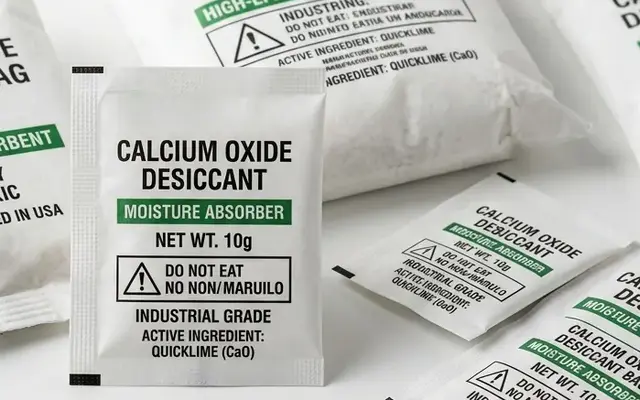



Frequently asked questions
What is container rain and where does the water come from?
It is the humid air inside the box condensing on the roof panel as it cools at night and dripping onto the cargo. The water does not leak in from outside; it evaporates from the cargo itself, the wooden pallets and the cardboard packaging. In a 40 ft container the air holds 1.5–2 kg of water while the pallets can hold 90 kg.
Should I track relative humidity or dew point?
Dew point for decisions, relative humidity for alarms. Relative humidity moves with temperature: without a single gram of water changing, 55% at 20 °C becomes 100% at 10 °C. Dew point depends on the mass of water in the air and answers directly the question of at which surface temperature condensation begins.
How many kilograms of desiccant does a 40 ft container need?
For a 30-day voyage the typical range is 8–20 kg. Non-hygroscopic cargo, dry pallets and a temperate route push you to the low end; wooden pallets, cardboard packaging and an equator crossing push you to the high end. The figure is derived from the target dew point, not from the total water content of the cargo.
Why a CaO-based desiccant instead of silica gel?
Silica gel holds water by physical adsorption; when temperature rises the isotherm shifts and it releases part of what it held. CaO binds water chemically through CaO + H₂O → Ca(OH)₂ and does not give it back at the temperatures seen in a container. That is where the difference shows on sea voyages with a large day-night swing.
Where in the box should the desiccants go?
Hung on the lashing rings of the side walls, level with the upper third of the cargo. They are not spread over the top of the load and must not touch the roof panel; a condensate drop landing straight on the pouch saturates the membrane locally. Leave at least 5 cm of free air around each unit and distribute them evenly along both side walls and towards the doors.
How long can I wait after opening the barrier bag?
As short a time as possible: the target is under 30 minutes from opening to sealing the doors. A unit left open in a humid port spends part of its capacity before it is even hung. Until stuffing, units stay in their aluminium barrier packaging.
What relative humidity should a warehouse target?
For general industrial storage 45–60% works; below 50% is preferred for metal parts and electronics. There is a lower bound too: going under 35% causes cracking in wooden packaging, curl in paper and static problems. What matters is not the average but the wet time spent on the coldest surface.
Does ventilating the warehouse lower humidity?
Only if the dew point of the outside air is below the coldest inside surface temperature. Otherwise ventilation carries water in and makes things worse. Practical rule: ventilate when the outside dew point is at least 2 K below the inside surface temperature, otherwise keep it closed.
Can I trust my hygrometer?
Capacitive sensors drift 1–2 percentage points of relative humidity per year, so annual verification is required. They are checked at three points with saturated salt solutions: LiCl 11.3%, MgCl₂ 32.8% and NaCl 75.3% at 25 °C. Placement matters as much as the reading; a sensor in the middle of the hall says nothing about the pallet against the cold exterior wall.
Is spent desiccant hazardous waste?
No. After reaction the content is Ca(OH)₂ with some CaCO₃; it is solid and produces no free liquid. Being alkaline, it is handled with gloves and goggles and its dust is not inhaled. Where local regulation allows, it can be used for liming acid soils.
Sample and dose recommendation for this process
Describe your current usage and target; our technical team will come back with a suitable specification and a starting dose.