
Applications
Road Infrastructure & Asphalt
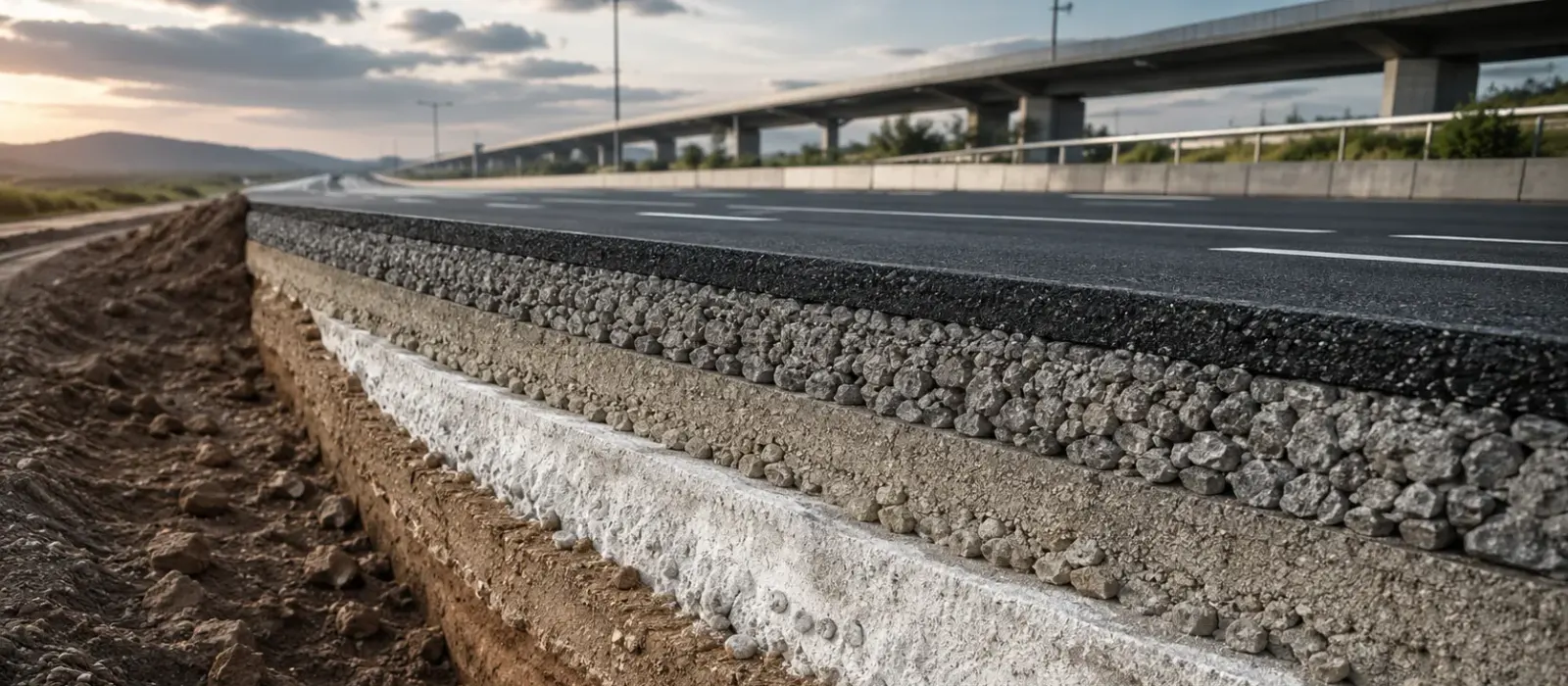
Hydrated lime as an anti-stripping additive in asphalt, base-course stabilisation and aggregate grading.
Overview
In an asphalt pavement the bond between bitumen and aggregate is not mechanical but largely chemical — and it is weak against water. A mix can meet its Marshall stability comfortably in the laboratory and start shedding particles in the field after the first wet–dry cycle. Moisture damage is therefore not a strength problem but an interface problem, and it is not solved by adding pavement thickness.
Lime enters the road cross-section at two entirely different points. At the top, hydrated lime added to the hot mix at 1.0–1.5% of dry aggregate mass permanently alters the bitumen–aggregate interface. At the bottom, quicklime changes how the clay mineral holds water, making bearing capacity independent of the season. The chemistry, the dosing logic and the acceptance criteria of the two applications are not the same.
Here we start the specification from the mix design, not from the product: which aggregate petrography is prone to stripping, at what dose the ITSR curve reaches its plateau, how the filler budget is disturbed, what the initial consumption of lime (ICL) is in the soil, and why the mellowing period cannot be cut below 24 hours. The relationship between aggregate gradation and filler behaviour sits behind every one of these decisions.
Moisture damage: the bond breaks at the interface, not inside the bitumen
Stripping is the physical and chemical displacement of the bitumen film from the aggregate surface by water. Silica-rich aggregates — granite, quartzite, some basalts — carry a negative surface charge in the presence of water; bitumen itself carries negatively charged functional groups such as carboxylic acids and sulfoxides. The bond between two negative surfaces is weak, and an intruding water molecule forms a thermodynamically more stable interface, pushing the bitumen off. With limestone aggregate the surface is naturally basic and the risk is low; the problem is concentrated in regions working with acidic aggregate.
In the field, moisture damage rarely announces itself as stripping. First comes ravelling and coarsening of surface texture, then alligator cracking along the wheel path, finally potholes. Because this picture is mistaken for structural inadequacy, the reflex is to add pavement thickness or raise the binder content. Neither touches the real mechanism at the interface; worse, extra bitumen usually lowers rutting resistance, trading one distress for another.
This is exactly where the measurement misleads. Marshall stability or deformation resistance measured dry says nothing about moisture sensitivity. The discriminating test is the ratio of indirect tensile strength between conditioned and unconditioned specimens — ITSR in EN 12697-12, TSR in AASHTO T 283. A mix with high dry strength can sit at 60% ITSR; the information is in the ratio, not the absolute value. Laboratory conditioning applies a single freeze–thaw cycle while the road sees hundreds over a decade, so the 80% limit is a floor, not a target.
The problem beneath the pavement speaks another language. A clay soil with a plasticity index above 20 becomes uncompactable a few points above optimum moisture; in the spring thaw the soaked CBR drops into single digits and the upper layers meet a stress that was never in the design. However good the pavement, service life cannot be predicted over a subgrade whose bearing capacity moves with the season — which is why soil improvement is inseparable from road design.
Two entry points into the cross-section, and the chemistry of each
In hot mix, hydrated lime is used at 1.0–1.5% of dry aggregate mass and does two jobs at once. Ca²⁺ ions react with the carboxylic acids in the bitumen to form water-insoluble calcium salts, taking out of play the very component water displaces most easily. At the same time lime adsorbs onto the silica surface, making the aggregate surface chemistry more basic and creating polar sites for the bitumen film to hold on to. The intervention is not one-sided: both the binder and the surface change, so the effect does not hang on a single mechanism.
This is where the difference from liquid amine anti-strips becomes clear. Liquid additives degrade and lose activity as hot storage time lengthens at 160–180 °C; lime is thermally stable and stays in the pavement for its whole life. Lime also retards oxidative ageing of the bitumen — slowing hardening and postponing the onset of fatigue cracking — and, as an active filler, stiffens the mastic and improves rutting resistance at high service temperature. One additive touching three separate distress mechanisms is the real justification for the cost of a 1% dose.
On the specification side we look for three measurable quantities, not marketing adjectives: Ca(OH)₂ content (class CL 90-S to EN 459-1, ≥ 90%), fineness (≥ 90% passing 0.09 mm) and free moisture (≤ 2%). Fineness directly governs coating ability; at the same dose a finer lime covers more of the aggregate surface. For the filler function we also look at Rigden voids (EN 1097-4) and the delta ring and ball value (EN 13179-1): lime is not inert in the mastic and in design it replaces part of the natural calcium carbonate filler — it is not added on top of it.
Beneath the pavement the chemistry changes completely. Quicklime works in the soil in two stages. Over minutes to hours, Ca²⁺ ions exchange with the monovalent cations between clay layers, the double layer thins and the particles flocculate. The result is immediate: plasticity index falls from 25 into the 8–10 band, the material begins to behave granularly, optimum moisture rises and the compaction window widens. The second stage takes weeks; an environment around pH 12.4 dissolves the silica and alumina of the clay, calcium silicate and aluminate hydrates form, and the strength becomes permanent. Soaked CBR can move from 3–5% into the 30–80% band.
Quicklime brings a second site advantage: the slaking reaction chemically binds about 0.3% water for every 1% CaO, and the heat released evaporates more. A fill turned to mud after rain becomes workable without waiting for it to dry — a gain measured in days on the programme. Where dust control and worker safety dominate, hydrated lime or lime slurry is preferred instead; the decision is made together with dose, climate and equipment. The same stabilisation logic applies unchanged in platform and fill preparation on the building materials side.
Operating ranges
| Parameter | Value | |
|---|---|---|
| Hydrated lime dose — anti-strip | 1.0–1.5% | On dry aggregate mass |
| ITSR / TSR | ≥ 80% | EN 12697-12 / AASHTO T 283 |
| Marshall stability | 900–1400 kg | EN 12697-34, heavy traffic |
| Air voids in mix (Va) | 3–5% | Wearing course |
| Filler content — below 0.063 mm | 4–9% | EN 13043 |
| Filler / bitumen mass ratio | 0.8–1.4 | Mastic stiffness balance |
| Rigden voids | 28–45% | EN 1097-4 |
| Lime dose in soil | 2–6% | ICL + 0.5–1.0; ASTM D6276 |
| Mellowing period | 24–72 h | ≥ 48 h in sulfate soils |
| UCS at 7 days | 0.7–1.5 MPa | Stabilised base |
| Soluble sulfate limit | < 0.3% (3000 ppm) | Ettringite heave risk |
| Compaction | ≥ 95% modified Proctor | OMC + 1–3% |
Hydrated lime dose — anti-strip
1.0–1.5%
On dry aggregate mass
ITSR / TSR
≥ 80%
EN 12697-12 / AASHTO T 283
Marshall stability
900–1400 kg
EN 12697-34, heavy traffic
Air voids in mix (Va)
3–5%
Wearing course
Filler content — below 0.063 mm
4–9%
EN 13043
Filler / bitumen mass ratio
0.8–1.4
Mastic stiffness balance
Rigden voids
28–45%
EN 1097-4
Lime dose in soil
2–6%
ICL + 0.5–1.0; ASTM D6276
Mellowing period
24–72 h
≥ 48 h in sulfate soils
UCS at 7 days
0.7–1.5 MPa
Stabilised base
Soluble sulfate limit
< 0.3% (3000 ppm)
Ettringite heave risk
Compaction
≥ 95% modified Proctor
OMC + 1–3%
Application steps
- 01
Diagnosing bitumen–aggregate compatibility
We start from the petrography of the aggregate, not from a lime dose. Silica content, surface texture, clay and mica impurities and the clay activity of the fines (methylene blue, sand equivalent) are the first indicators of stripping potential. With limestone aggregate lime still pays off, but the justification shifts towards ageing and mastic stiffness; with granite or quartzite it is usually mandatory.
The second step is to measure the conditioned strength ratio of the reference mix. If ITSR without additive sits below 70%, the problem is proven. That dry strength on the same specimens can be high is the clearest demonstration of why a dry test alone is not enough.
The functional group profile of the binder also matters. A bitumen high in carboxylic acids reacts more strongly with lime; with polymer-modified binder the lime dose is re-examined through mastic viscosity and laydown temperature.
- 02
Fitting the dose and the filler budget into the mix design
The dose is not picked at a single point; an ITSR curve is built at 0.75, 1.0, 1.25 and 1.5%. Typically the curve plateaus around 1.0–1.2%. Beyond the plateau, extra lime does not raise ITSR meaningfully but keeps stiffening the mastic — so over-dosing costs money and adds low-temperature cracking risk.
Lime sits inside the filler budget. Total material below 0.063 mm must stay within EN 13043 limits, and the filler/bitumen mass ratio should be held in the 0.8–1.4 band. If lime is added on top of the natural filler instead of replacing part of it, the mix turns dry, brittle and unworkable; the field symptom is rapid cooling behind the paver and an open surface texture.
Marshall stability, flow and voids are revalidated on the limed mix. Lime typically lifts stability by 50–150 kg and slightly reduces flow. If voids drift off target, the right correction is to rebalance the fine band of the gradation, not to move the binder content.
- 03
Establishing the lime requirement in the soil
In soil the dose is determined by the Eades–Grim method (ASTM D6276), not by guesswork: the pH of a soil–water suspension is measured at increasing lime percentages, and the lowest percentage reaching pH 12.40 at 25 °C is taken as the initial consumption of lime (ICL). This is the threshold the clay needs to sustain the pozzolanic reaction; the design dose is usually set 0.5–1.0 points above ICL.
Two objectives are kept apart. Where only workability and plasticity reduction are wanted (modification), 2–3% may suffice; where a load-carrying layer is required (stabilisation), the dose rises to 4–6% against a 7-day unconfined compressive strength target. Soaked CBR and strength loss after immersion are reported together — dry strength alone is deceptive.
Soluble sulfate is always measured. Above 0.3% (3000 ppm), sulfate together with lime and clay alumina can form ettringite or thaumasite and cause heave months later. In that case mellowing is extended, two-stage liming is applied, or a different binder is considered. The same sulfate check applies across all soil stabilisation work.
- 04
Subgrade works: spreading, mixing, mellowing, compaction
Lime is spread at the mass per square metre corresponding to the target percentage; on a 25 cm layer, 4% works out roughly at 18–22 kg/m². In windy weather dust loss lowers the effective dose, so either an enclosed spreader or lime slurry is preferred.
Mixing depth and uniformity are decisive. The pulverisation criterion is that all material passes the 25 mm sieve and at least 60% passes 4.75 mm. Mixing water is kept 1–3 points above optimum because both slaking and hydration consume water; short of water, plasticity drops but strength never develops.
Mellowing takes 24–72 hours and cannot be skipped: ion exchange and the breakdown of clay clods need time. In sulfate-bearing soils at least 48 hours is advised. Compaction follows a second mixing pass and targets 95% of modified Proctor. Keeping the surface moist through curing is a condition of strength gain; a surface that dries early leaves a dusty layer and spoils bond with the layer above.
- 05
Introducing lime at the asphalt plant
Three methods are used. Dry lime on dry aggregate is the simplest but the most sensitive to dust loss and coating uniformity. Dry lime on damp aggregate (2–3% moisture) markedly improves retention on the grain surface. Lime slurry (25–35% solids) gives the most uniform coating but raises drying energy and needs an extra preparation unit.
In a batch plant lime is usually held in a dedicated silo and weighed into the mixer; in a drum plant it is dosed onto the aggregate belt or at the dryer outlet. In both cases the dosing unit must be calibrated by weekly gravimetric verification — lime flows and bridges differently from mineral filler, so volumetric dosing misleads.
Keeping the lime silo dry is critical. Lime that carbonates with atmospheric CO₂ loses activity, cakes and interrupts feed. Silo venting, filter maintenance and short stock turnover manage that risk. We work through dosing equipment selection and commissioning trials for each plant type together with our technical team.
- 06
Production, laying and site quality control
Mix temperature is held in the 150–180 °C band. Lime is stable at these temperatures; the real risk is a narrower compaction window as temperature falls, because limed mastic is somewhat more viscous. In cold weather, haul distance and roller pattern are planned accordingly.
On site, ITSR is verified periodically on samples taken from production, and cores give layer thickness and void content. Target voids in the wearing course are 3–5%. Above 7%, water enters the section and erodes the very protection lime provides — a compaction defect undoes the additive.
Judgement does not rest on laboratory results alone; surface texture after the first winter is read as well. Localised ravelling usually points to segregation or compaction; widespread ravelling sends the question back to the mix design.
- 07
Storage, handling and site safety
Lime is hygroscopic and reacts with atmospheric CO₂. For bulk tanker delivery the silo must be dry and sealed; for big bags, storage on pallets and isolated from the ground is essential. On long sea shipments the real risk is not rain but condensation inside the container; a liner and a desiccant are standard practice for us.
Quicklime releases heat rapidly on contact with water; eye protection, dust masks and skin-contact precautions are mandatory on site. Hydrated lime carries lower risk but is still an alkaline dust, and the same precautions apply.
Short stock turnover is a cost issue as much as a quality one: carbonated lime forces the dose up to reach the same ITSR and distorts the tonnage calculation. We track not how much lime arrived on site, but how much active Ca(OH)₂ arrived.
Products used in this field
Frequently asked questions
Should we use 1% or 1.5% hydrated lime?
The decision comes from an ITSR curve, not from a table. Specimens are made in steps from 0.75% to 1.5% and the plateau point is identified; for most aggregates it falls between 1.0 and 1.2%. With very acidic aggregate or clayey fines the plateau shifts towards 1.5%. Dose beyond the plateau adds no ITSR and only stiffens the mastic.
What is the difference from a liquid anti-stripping agent?
Liquid amine additives degrade thermally as hot storage time lengthens; lime is stable at 180 °C and stays in the pavement for its whole service life. Lime also acts beyond adhesion, on oxidative ageing of the bitumen and on mastic stiffness. One additive touching three mechanisms changes the cost comparison.
Should lime be added dry or as slurry at the plant?
Dry lime on dry aggregate is the simplest but is exposed to dust loss. Dry lime on damp aggregate (2–3% moisture) improves coating uniformity markedly and is the most common practical solution. Slurry gives the best coating but raises dryer energy and capital cost; the choice follows plant type and production volume.
Does lime replace filler or is it added on top of it?
It replaces it. Lime is finer than 0.063 mm and counts inside the filler budget. If natural filler is not reduced by the same amount, total fines and the filler/bitumen ratio rise; the mix becomes dry and brittle and cools too fast during laydown. The correct approach is to recompute the gradation with lime included.
Does ITSR really represent field moisture damage?
Only partly. The test applies a single conditioning cycle, while a real pavement sees hundreds of wetting and freezing cycles over a decade. That is why we treat the 80% limit as a floor rather than a target. On heavily trafficked routes in harsh climates we support the decision with multi-cycle conditioning tests.
Hydrated lime or quicklime for soil stabilisation?
If the soil is wet and the programme is tight, quicklime has the advantage: slaking binds about 0.3% water per 1% CaO and the released heat dries further. Where dust control, proximity to housing or worker safety dominate, hydrated lime or lime slurry is preferred. In both cases the dose is recalculated on an active-substance basis.
Can lime be used in sulfate-bearing soil?
Below 0.3% (3000 ppm) soluble sulfate, normal practice applies. Above it, lime, clay alumina and sulfate can form ettringite or thaumasite and cause heave months later. The remedy is extended mellowing, two-stage liming or an alternative binder; the decision must be supported by a laboratory swell test.
Why can the mellowing period not be skipped?
Cation exchange is fast, but breaking down clay clods and equalising moisture through the material takes time. With less than 24 hours the mix may look homogeneous while the plasticity drop is incomplete, and post-compaction strength falls short of target. In sulfate soils we recommend at least 48 hours.
How does lime affect Marshall stability and rutting resistance?
As an active filler lime stiffens the mastic, so stability typically rises by 50–150 kg, flow falls slightly and rutting resistance improves at high service temperature. But pushed well beyond the plateau, the mastic becomes over-stiff and low-temperature cracking risk appears; the dose is therefore closed out with stiffness data alongside ITSR.
Does adding lime force a change in binder content?
Usually not — the real correction is in the fine band of the gradation. When lime is counted in the filler budget and natural filler is reduced accordingly, optimum binder content rarely moves more than 0.1–0.2 points. If voids drift, look first at the filler/bitumen ratio, then at the 0.063–2 mm band.
Sample and dose recommendation for this process
Describe your current usage and target; our technical team will come back with a suitable specification and a starting dose.